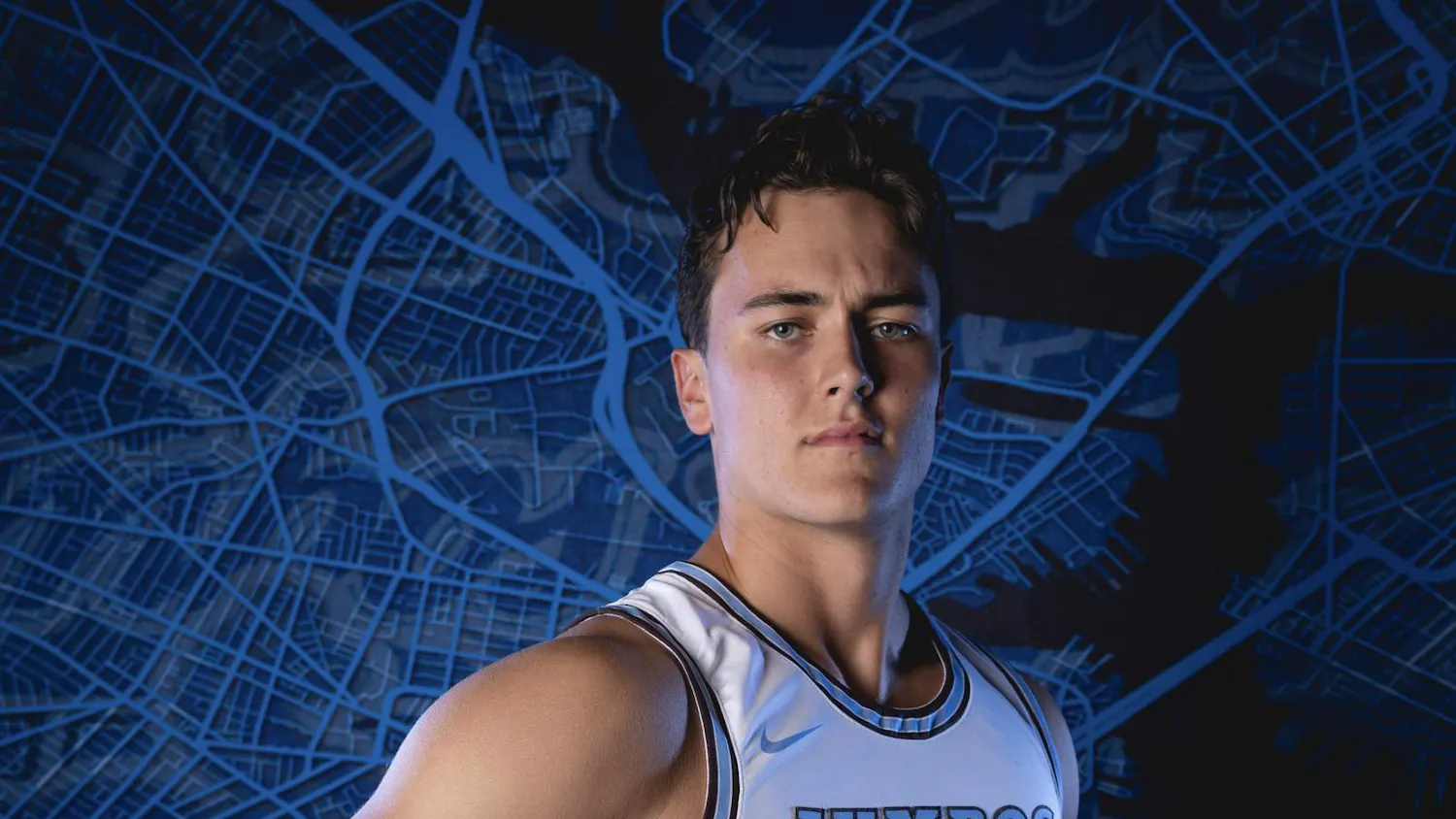
Senior skipper Peter Bermudez redefined the concept of performing under pressure at the New England Intercollegiate Sailing Association (NEISA) Co-ed Dinghy Championships this past weekend.
After 31 races of the 32-race regatta, the final qualifying spot for a berth to the national semifinals was still up for grabs. The nationally ranked No. 12 Jumbos were in ninth place, three points behind Brown — and, more importantly, they were a spot out of the eighth and final position to make the cutoff for a nationals berth. The conditions were tough all day, and finding any semblance of consistency on the water was extremely difficult. After a 16th- and 18th-place finish in the 28th and 29th races of the day, only three races remained for the Jumbos to jump into the qualifying position. In a last-ditch effort to secure this final spot, head coach Ken Legler made the switch from senior tri-captain Baker Potts and senior Christina Kelly, who had been sailing well for the majority of the regatta, to Bermudez and senior Francine Magasinn.
It paid off.
"It all came down to the last B race in which Peter Bermudez became the most clutch person," said junior Tomas Hornos, who skippered the entire weekend in the A division with Kelly, senior tri-captain Lara Hwa and junior Nate Rosenberg alternating in the crew position. "We were behind Brown by three points, meaning that [Bermudez] had to not only beat them in the race but put three boats between them. He stayed cool the entire race, and slowly they started to separate, and at the finish we were the ones on top."
Bermudez sailed to a fourth-place finish in the final race, while Brown's B boat came in ninth — a large enough gap to propel the Jumbos to the eighth and final semifinal spot.
"I sailed over to Ken [before the final race] and got a little sheet of paper that had the scores on it, even though I didn't really want to know because I don't really like to put that much pressure on it," Bermudez said in a video interview with sailgroove.org after the race.
"I didn't think about it much at the start," he continued. "I just tried to get off the line and go fast."
The first half of the race became a tacking duel — essentially a match race — between Tufts and Brown, with the Jumbos ultimately prevailing by the second rounding of the windward mark in the windward-leeward twice around course. After that, Bermudez and Magasinn were focused on keeping a two-boat lead on Brown that they had built up. By the end of the race, they were able to pick off a few others for some cushion.
"I have never been so emotionally involved in a sailing race — or three races, as it were — in my life," Magasinn said. "I'm still thinking about it."
"We couldn't afford any mistakes in that last race," she continued. "Brown was sailing right on our hip, and we needed to put at least two boats between us. Peter and I were not as focused on our overall place in that race as we were on our place relative to Brown."
As a whole, the Jumbos' position in the regatta fluctuated just as much as the shifty breeze and choppy conditions the team faced.
Much of this variation was not a result of particularly good or bad performances by Tufts, but rather a result of the fact that the competition was so talented that minor mistakes could mean the difference between first and last in any given race.
"Literally, every race could swing us from second place to sixth to 10th because the competition was so good," Hwa said. "NEISA definitely has so many great teams that good ones did not get to qualify."
Hornos shared these sentiments, noting the fact that the regatta's high intensity and competition were a result of the teams being in a playoff mindset from the get-go.
"The racing was extremely close," he said. "There were 12 good teams fighting out for eight spots, so there were going to be good teams left out. The regatta definitely had a different feeling and you could sense that everyone only had one thing on their mind — qualifying."
"This weekend has made our team realize never to get too high," Magasinn added. "At certain points, we thought we could win the event, which mentally removed us from the chance of not making the top eight. We faced extremely good competition, which is well illustrated in the close point spread between first place Boston College and ninth-place Brown University."
At the end of the 32 combined races between the two divisions, only 31 points separated the top nine teams — in other words, an exceptionally low average of less than one position per race. The champions of the regatta were the nation's top-ranked Boston College Eagles, with 207 points, while the Jumbos finished with 236. The Eagles' 207 points over 32 races is an average finish of roughly 6.5, yet they still came in first overall — a testament to fact that any of the top teams could win any given race.
"We sailed well and at some points were battling out for first place, and then with only a few bad races, we were looking at ninth place," Hornos said. "We were confident, but we also knew there was no room for error."
After some less-than-ideal finishes at team race regattas over the past few weekends, the transition back to more typical fleet racing was not particularly difficult, Hornos said, as it is the most common format. That said, the switch back to team racing in the quest towards Team Race Nationals could be an entirely different story.
"Fleet racing is our strength, especially for Tomas and I," Hwa said. "It's our most comfortable element, so it was nice being back into our groove."
"Getting back to fleet racing was easy for me because it is what I grew up doing," Hornos added. "Getting back to team racing in a few weeks for Team Race New Englands will be harder."
The Jumbos won't be able to revel in the glory of this past weekend for long, as they will once again face extremely tough competition at the national semifinals on the weekend of May 2-3. There, a top-nine finish is necessary to qualify for Nationals in San Francisco at the end of May.
"Eastern semifinals will be especially exciting because the competition will be held right off of Fan Pier here at Boston Harbor, where the Volvo Ocean Race boats will be," Hwa said. "Fans of big boat racing from all over the world will be gathering, and they'll also get to see us race too."
"I don't want to spend May 2 and 3 pissing and moaning about not being in the next great regatta," Legler told sailgroove.com. "Hopefully we'll go on and have these great opportunities to sail at this level. The next regatta I expect to be equally hard as this one."