Skip to Content, Navigation, or Footer.

Opinion


Through Indigenous Eyes.jpg
Column

Through Indigenous Eyes: Revisiting Greenland

Last year, I published an article about the colonial history of Greenland, exploring why it and its Indigenous people would want to be independent from Denmark. Since then, the people of Greenland voted Demokraatit, a center-right, moderately independent party, into power. At the same time, President Donald Trump has intensified his effort to buy Greenland from Denmark, Greenland’s former colonial owner. Greenland has achieved autonomy from Denmark, but is not fully independent. Trump had made it clear that he would consider violence as a tactic to annex Greenland, but walked back such statements earlier this month.


32558817082_294a1c0e70_b.jpg
Opinion

No, America isn’t becoming Nazi Germany

Within the past few weeks, President Donald Trump and his administration have threatened to invade Greenland, referred to a U.S. citizen killed by Immigration and Customs Enforcement as a domestic terrorist and released a racist video of Barack and Michelle Obama. In the past few months, the administration has threatened universities with federal funding cuts, grabbed thousands of people off the streets and engaged in trade wars with dozens of countries. Within the past year, it has pulled out of over60 international agreements, pardoned those with Jan. 6 related convictions and purged federal websites of information Trump deemed ‘DEI.’ This paragraph barely covers the overwhelming actions of Trump’s second term, and doesn’t even cover anything he did in his first.


Death of Education Graphic
Column

The Death of Education: Follow Mississippi

As the spring semester picks up, it’s important to remind ourselves that the average National Assessment of Education Progress scores in math, reading, science, civics and U.S. history for students in the United States are now back to what they were in the 1990s. This decline in student performance has been occurring since 2013; it has only been exacerbated by the COVID-19 pandemic and the post-pandemic inability to curtail chronic absenteeism. Presently, 74% of tested countries outperform U.S. students in science, and a staggering 86% outperform them in reading.


Through Indigenous Eyes.jpg
Column

Through Indigenous Eyes: Let’s talk about ICE

On Jan. 8, an Indigenous man named Jose Roberto ‘Beto’ Ramirez was dragged from his vehicle in Minneapolis by Immigration and Customs Enforcement agents. Despite insisting on both his U.S. and tribal citizenship, he was beaten, detained and then sent to an ICE detention center for questioning. After being told he would facecharges for assaulting a federal officer, he was released over six hours after his initial encounter with ICE.


2017-09-14-06-43-14.jpg
Viewpoint

Environmental policy: How the gap widened

It’s easy to view climate change and environmental issues at large as being inherently partisan. Recent polling shows stark differences in how Republicans feel about climate change versus Democrats. Not a single Republican voted for former President Joe Biden’s environment-centric Inflation Reduction Act. Additionally, our current Republican president has officially left the Paris Climate Agreement. However, in spite of the seemingly intrinsic nature of today’s partisan environmental disagreements, caring for our world was once an issue that brought the U.S. government together.


DSCF0074.JPG
Guest

Op-ed: The U.S. blockade on Cuba is economic warfare, we must name it

Before I went to Cuba, I believed I had a full grasp of what economic warfare meant. I had read about the U.S. embargo and followed the headlines about its harmful impacts on everyday Cubans. But when I was on the ground in Cuba, everything I thought I knew faded. I saw the reality — ration lines, defiant optimism and a revolution still breathing through struggle. The United States’ blockade is a deliberate strategy of harm, and if we cared about justice, we must recognize it and challenge it.The United States has been able to efficiently mask the horrors of its blockade on Cuba, and it is our responsibility as Americans to ensure that Cubans can live with dignity and self-determination. Genuine solidarity with Cuba begins with bringing the blockade to attention as a source of the crisis and recognizing how U.S. narratives distort the reality of Cuba to keep Americans passive.


The Setonian
Opinion

Letter from the Managing Board: Our semester at a glance

As our time on The Tufts Daily Managing Board comes to a close, we want to thank you for joining us for a semester of engaging reporting and nuanced conversation. Throughout the past six months, you’ve enabled us to thrive as a student publication and call attention to the stories that matter most.


oscars
Viewpoint

Are the Oscars really merit-based?

As we await next year’s Oscars and nominees, I’ve been thinking about past winners — especially the 2023 awards season in which two actors, Ke Huy Quan and Brendan Fraser, made major Hollywood comebacks with Oscars in hand, and Michelle Yeoh became the first Asian woman to win Best Actress. The entire “Everything Everywhere All At Once” cast and crew swept that year’s award season, with much of their campaign gaining internet buzz due to the movie’s significance resonating with the Asian American community. One outlier in their success, however, was Jamie Lee Curtis’ first Oscar win, which many referred to as a ‘legacy Oscar.’ This prompted me to think more about how awards campaigns work — and whether some winners truly ‘deserve’ these so-called ‘legacy Oscars,’ or whether they should stop being handed out altogether.


Through Indigenous Eyes.jpg
Column

Through Indigenous Eyes: Vanishing, Surviving

As my mom and I left Arkansas, we traveled north through Missouri and Illinois to Chicago, then east to Detroit and up through Canada to Niagara Falls. At all of these stops, we never really ran into anything that had obvious Indigenous ties. Once we crossed back into the United States, we still didn’t run into anything explicitly Indigenous. While this may be surprising to you, it was anything but surprising to me.


AI Brainrot
Viewpoint

A case against lazy AI use

This week, nearly one in 10 people across the world will use a tool that did not exist just a few short years ago — ChatGPT. According to a September 2025 working paper by economists and researchers at OpenAI, more than 700 million people actively use ChatGPT each week and that “for a new technology, the speed of global diffusion has no precedent.”


Op-ed submissions are an integral part of our connection with you, our readers. As such, we would like to clarify our guidelines for submitting op-eds and what you can expect from the process.

Read More
The Tufts Daily Crossword with an image of a crossword puzzle
The Print Edition
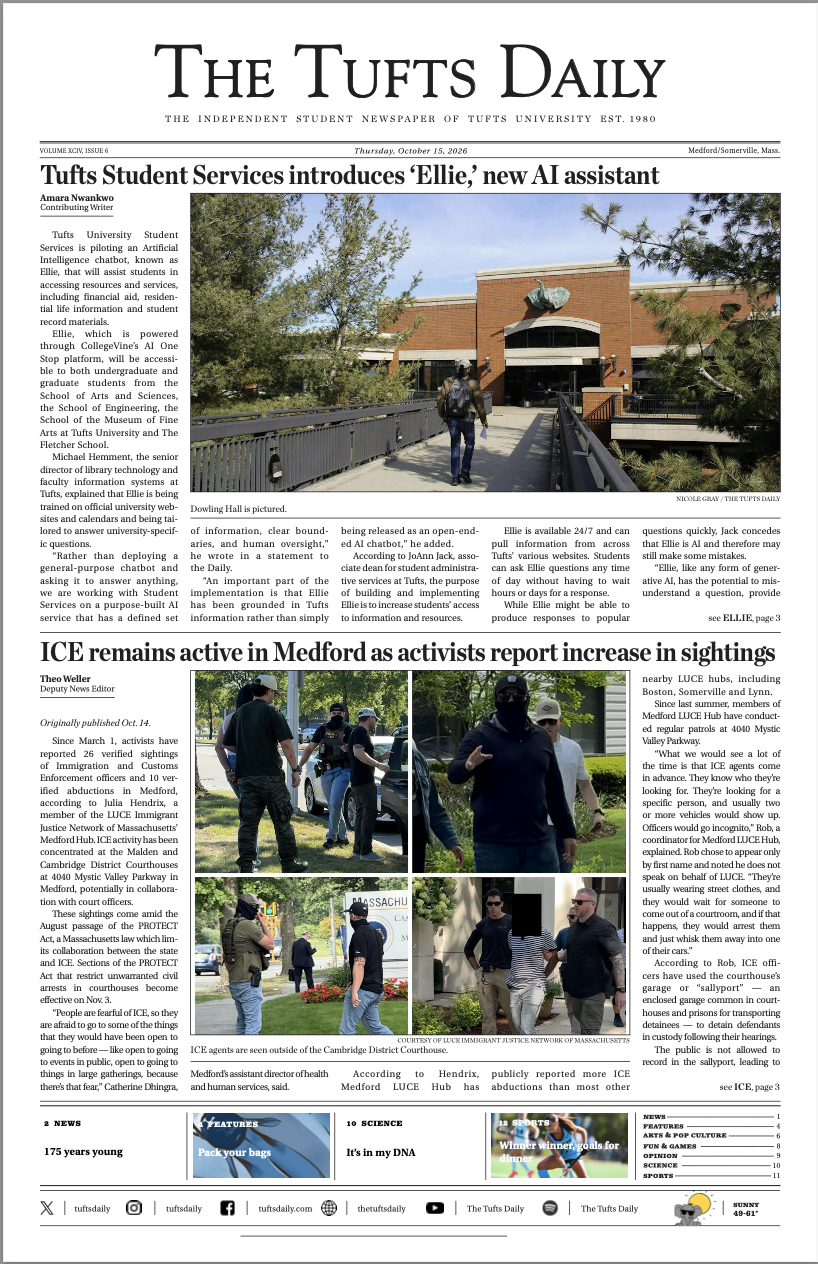
Tufts Daily front page