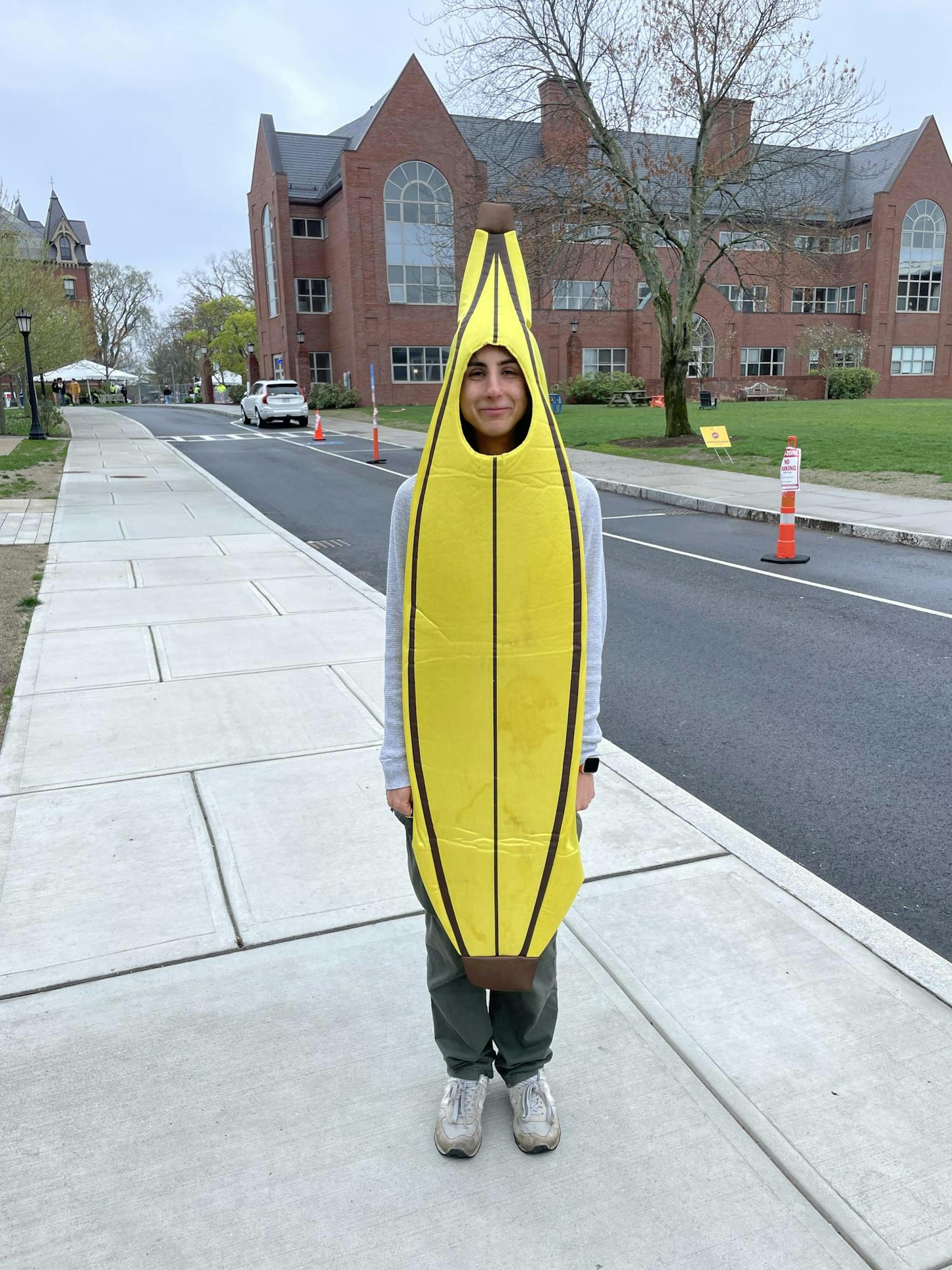
As I prepare to graduate from Tufts, I find myself reflecting on what I’ve learned over the last four years. I’ve learned an incredible amount academically, grown emotionally and matured as an adult. Still, the piece of knowledge that grabs my shoulders and shakes me, screaming, “I am the most important!” is my new, glimmering mindset. Over my time at Tufts, I have realized that our perceptions of “reality” are often fake. As such, why not commit to living authentically, despite what others may think of you?
Our views of the world are constantly distorted by countless cognitive biases, and seemingly little details can drastically alter our perceptions. In “Social Psychology” with Professor Sam Sommers, I learned about a study showing that the order of adjectives given to participants to describe an individual impacts how they view that individual. If positive adjectives were placed first, participants had a much more flattering view of this hypothetical person than if negative adjectives were placed first, even though the adjectives were the exact same. This is known as the primacy effect, and cognitive biases like it constantly surround us like a swarm of mosquitoes –– you try to eliminate one, but there will always be more.
Our biology plays a role in our perspective on life as well. In the book “Thinking, Fast and Slow” by Daniel Kahneman, I learned that humans are innately more attuned to the world’s negatives than its positives. We pick out a singular angry face from a group of smiley faces faster than vice versa. Our evolution programs us this way, as threats are often more urgent to our survival than pleasures. No wonder we often unintentionally focus on the downsides of our environments rather than the upsides. Understanding this phenomenon, when I am going about my day and feel like everything is going awry, helps me remember my mind is probably playing tricks on me. I take a breath and remind myself that my perception of this “terrible day” probably isn’t reality; this reminder is freeing, not frightening.
I could go on and on about all of our cognitive biases and why our memories and perceptions are probably inaccurate. While coming to accept that the world I see as false, I have also come to appreciate that the way others may perceive me is likely also somewhat artificial. Others may perceive me based on minute factors, such as the narrative they construct from a quick first impression, how they were feeling just before interacting with me or via accounts from their friends, riddled with adjectives in random, but nonetheless impactful, orders.
If perception is so unstable, why not just commit to being yourself? If everything we see and experience is interpreted through distorted lenses, why not live life with whimsical authenticity? If objective life is a figment, or a bit, why not commit to it?
When I say that “life is a bit,” I’m borrowing language from comedy. A “bit” is a performance or running joke someone commits to, even if it’s ridiculous. I believe life itself is a bit, as our “reality” is so far from the truth that oftentimes it could be considered a joke. Since our lives are so skewed by perception, we might as well lean into our roles and perform with intention and authenticity.
The realization that the way I see the world is more or less an illusion — and, likewise, the way the world sees me is also more or less an illusion — has empowered me to live my life to the fullest. Although this ethos has been cultivated throughout my time at Tufts, it has flourished during my senior year, as I learned to truly lean into myself.
When my friend and I danced with big, waving arms and loud, scratchy voices at a basement party, we received some not-so-admiring side-eyes. But my friend and I were having fun, and the unenthusiastic spectators had zero clue who my friend and I truly are, so why should I care? Earlier this semester, I wrote an article about how much I appreciate JoJo Siwa. Some may think the article is cringey, and maybe it is, but does it really matter? If others perceive me as doing something “strange,” those who know me will be glad I am being authentic, and those who don’t know me simply don’t know me. Why does the perception of people I don’t even know carry any weight?
As much as I would like to say that letting go of the “objectivity” of how I perceive the world and how the world perceives me has set me free from the all-powerful hands of “caring what other people think,” I admit I oftentimes still feel self-conscious and wary of how others view me. However, accepting the inherent subjectivity of the world has empowered me to act authentically, even if I have to fake comfort sometimes.
So text your crush first. Wear that silly shirt you’ve been wanting to wear. Ask the person in your class who you think is cool to hang out. If you’re worried about how they might perceive you, know that their perception of you is clouded by bias, and your perception of how they perceive you is too.
I will take my commitment to authentic acceptance forward as I venture beyond Tufts as an undergraduate (and into the scary and disparate realm of graduate school at Tufts) with the knowledge that it will do me well. Reality is a sandstorm of cognitive biases — trillions of specks of sand prevent us from seeing clearly, no matter how hard we squint. So let’s just let go of the validity of “factual perception” and commit to the bit. Who knows, it could be fun.