When I arrived at Tufts in 2021, I knew who I was and what I wanted. When I introduced myself across countless icebreakers that fall, I made sure to let anyone and everyone know that I was here to major in international relations and minor in economics, aiming to work in a think tank after I graduated to be close to the political world. This confidence, at the time, seemed well justified. After all, since middle school, I had maintained a passionate interest in Model UN as a vehicle by which I could learn about international affairs and diplomacy, and in my International Baccalaureate program, I regarded my classes as preparation for delving deeper into international relations. In the weeks before I arrived at college and for weeks after matriculation, I remained clear-eyed about my future, researching past courses in international relations and listing down the classes I hoped to take in my four years here, as well as extracurriculars which would support my ambitions.
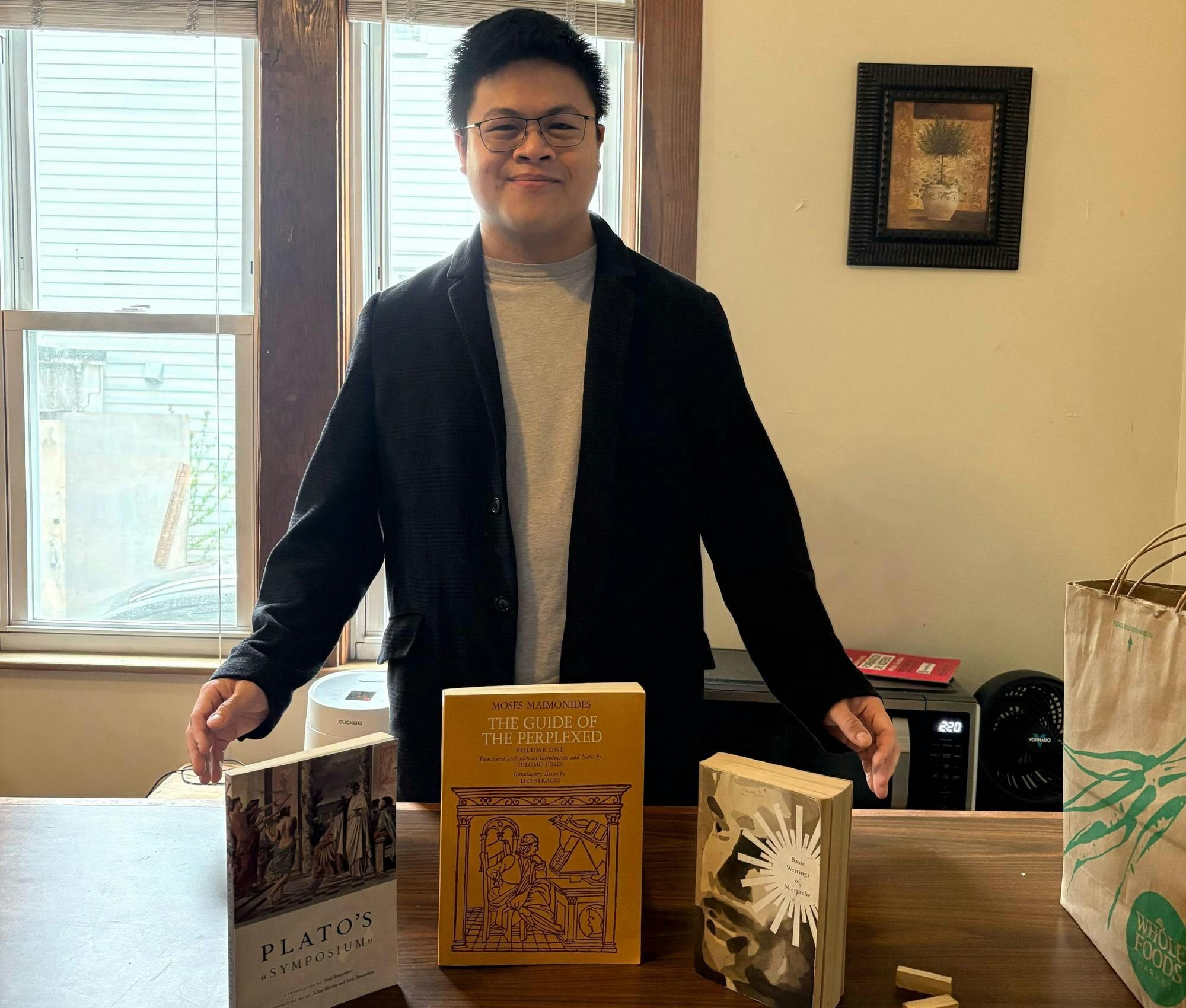
Suffice it to say, my clarity did not survive for long. “Western Political Thought I,” taught by Professor Vickie Sullivan, brought me face to face with a new world — face to face with the understanding that there were more things in heaven and earth than I had dreamt of. “Introduction to International Relations” that semester had been online, and I was worn down by years of Zoom courses. At the recommendation of my pre-major advisor, hoping to take care of a requirement for my major, I decided to take Sullivan’s class. However, the course immediately gave me an experience of the beautiful, especially through an early encounter with Plato’s “Symposium,” which concerns human erotic longings, making my prior aspirations pale in comparison. That, and similar texts, somehow put into words feelings I had only unconsciously been aware of my entire life. As Sullivan’s mentors did for her, she brought these classic political theory texts to life for me. I still don’t even fully understand the works I encountered in my first fall here but have come to see that they turn, at their peak, into philosophical reflections on philosophizing itself. Plato and others speak to the love of learning I’d had for my entire life before Tufts, showing how the passion for knowledge which I had been only vaguely aware of could flower into a drive that one could organize their life around.
My exposure to political theory did not sweep me away from my life before I had discovered it. In fact, it has helped me live in a more authentic manner. Friedrich Nietzsche’s compelling analysis of the difficulty of attaining true friends made me more committed to building off of the relationships I had formed early in my first year. Philosophical accounts of the difficulty of maintaining sincere commitments in modern society with the rise of a more divided self — beginning with Jean-Jacques Rousseau and stretching to figures like Michel Foucault — has helped me exercise better practical judgement about the endeavors which will and will not genuinely contribute to my self-development. I’ve been led to know when to drop extracurriculars or other activities when they no longer serve me, no longer holding on out of sheer habit as I did in high school. I haven’t only oriented myself around political theory as a parochial discipline. Classes from both the Department of English and the Department of Religion have shaped my self-understanding and subsequent action, and I am certain that many courses across the humanities have fulfilled this function for countless other students.
As my time at Tufts has drawn to a close, I’ve been reflecting on what I gained from my experience here. A few weeks ago during his office hours, Professor Yonatan Brafman of the religion department asked me how I had developed a strategy for reading texts. My answer was long and winding. By the time I had finished articulating the experiences which proved decisive for how I approach a book, thirty minutes had passed, and I still wasn’t sure I had answered the question properly — a sign that my reorientation towards acquiring crumbs of self-knowledge, prompted three years ago, is far from complete. Yet, there was something satisfying about articulating the episodes I just knew were important in how I have become who I am, and about articulating what knowledge each experience has contributed to. Self-knowledge is an immensely difficult aspiration, as an acquisition, and it is difficult to see how it will be useful in today’s commercial society. My own scraps of self-knowledge, however, have convinced me that no matter what one believes themselves to be, life can be a much more rewarding endeavor when one is not blind to self-understanding. I hope students at Tufts will take advantage of the humanities at this school to continue engaging in journeys of real self-discovery.