
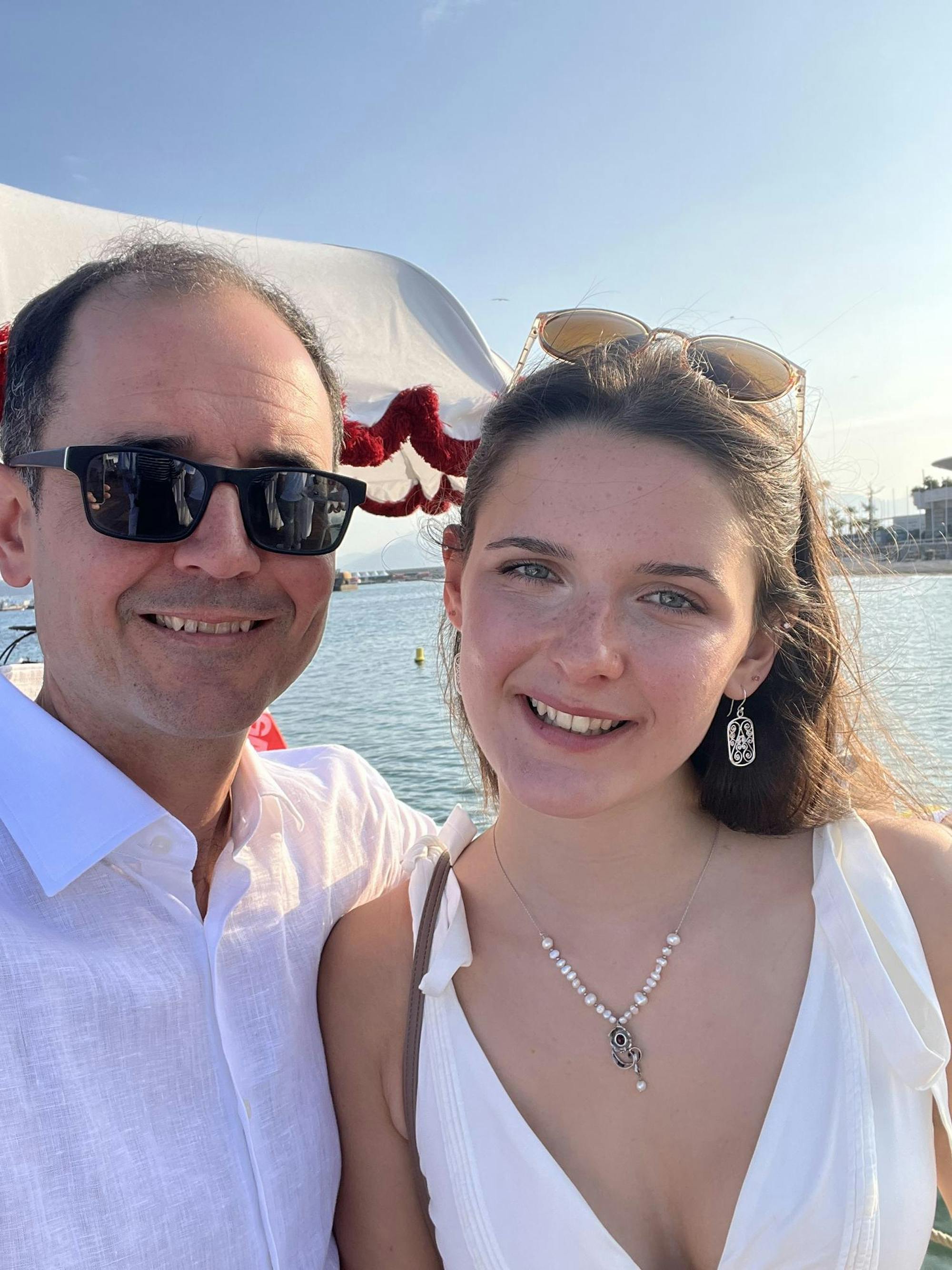
For many Tufts students, starting university marks the first time living away from their families back at home. This is not the case, however, for Madeline Cook, a first-year combined degree student pursuing fine arts and psychology. Upon moving into Tufts this past fall, her dad decided to come with her. Well, not literally, but Geoff Cook did begin taking online classes as part of the Tufts Friedman School of Nutrition Science and Policy master’s program.
The pair form an impressive father-daughter duo. Geoff Cook has founded various businesses and is the current chief executive officer of Noom. Valued at $3.7 billion, the company specializes in lifestyle and behavioral changes, mindful eating habits and weight loss. His daughter is the author and illustrator of a children’s book “The Peacock Tree” and also works as a special projects intern at Noom.
Madeline and Geoff Cook’s collaboration has strengthened the impact of both of their work through a focus on art and mindfulness. Despite their previous successes, Geoff Cook understands the importance of broadening your horizons and continuing to grow.
“I didn’t have much background in nutrition per se, and so the idea of a master’s program and a deeper background [in nutrition], I found appealing,” Geoff Cook said.
Geoff Cook graduated from Harvard University in 2000 with a bachelor’s degree in economics. In his initial years post-grad, he founded various technology-based companies. His primary entrepreneurial venture was The Meet Group, a company that developed various social entertainment apps designed to create meaningful human connection, including dating apps and livestreaming services.
The Meet Group was acquired for $500 million by a German media group and a private equity firm in 2020. Three years later, Geoff Cook left The Meet Group and became the CEO of Noom shortly after. While Noom is also a technology company, its focus differs from what Geoff Cook had been used to. The app uses a combination of psychology, technology, medication and coaching to improve everyday wellbeing and — per recent trends for many new successful products — help clients manage their weight.
Geoff Cook came across the Tufts nutrition program while browsing the website after his daughter had already been accepted through early decision.
“I had thought about a graduate program [to get] an MBA or an executive MBA in the past, but having been so deep in business, I concluded that I wouldn’t get anything out of it,” Geoff Cook said. “When I saw the nutrition program, … I thought this was a great way to go deep.”
Madeline Cook is attending Tufts for similar reasons, seeking to build upon her art portfolio by approaching art through an academic lens. In high school she wrote and illustrated “The Peacock Tree,” which was published in 2024. Her art was also featured in a full-page Noom ad in the Wall Street Journal and in a mural in the mayor’s office in Lake George, N.Y.
“I think my time at SMFA will definitely impact my further illustrating career,” Madeline Cook said. “I really want to take [the] ‘Book Arts’ [course] eventually. … I have another idea [for a book] about alpacas that I want to explore.”
Despite their preexisting successes, both Geoff and Madeline Cook emphasize the importance of continuing to learn.
“It’s this willingness to start over, to be wrong [and to] try something that you don’t really have a lot of background in, and a lot of times you … could make a connection that you wouldn’t have otherwise have made,” Geoff Cook said. “The [Friedman School] program is definitely affecting what Noom is going to invest in, as far as research.”
Geoff Cook also spoke about attending his first online class — “Brain, Nutrition and Behavior” — in which he wrote a paper about food noise (similar to food cravings) and GLP-1s (a class of drugs which includes Ozempic). Noom focuses on quieting food noise through mindfulness. Despite having no previous academic writing experiences, he was able to get his paper published as well as apply it to his work at Noom.
“That paper was a call to a specific research agenda, and I expect that [Noom is] actually going to fund that agenda,” Geoff Cook said. “We’re going to try to get to the bottom of how GLP-1 influences food noise and [how] that [leads] to … behavioral interventions [that] would work given that you have this period of reduced food noise.”
One intervention that Geoff Cook and his colleagues found effective in reducing food noise is the use of art therapy, a pursuit inspired by the work of his daughter. Noom released an art therapy feature to their programs in October 2025, and in January, Noom hosted their first Art of Wellbeing Annual Summit.
At the summit, researchers, clinicians, artists and innovators gathered to hear about a study presented by Noom. They invited 10 SMFA students to submit artwork and compared subjects’ reactions to student artwork versus museum pieces. They found that both the student art and museum pieces induced awe and significantly reduced stress.
“It was really fun creating art for a specific goal and to induce a specific thing,” Madeline Cook said. “That’s not normally what creating art is about, and I think the other artists would feel the same way.”
Geoff Cook was inspired by the impact of the students’ artwork and hopes to collaborate with SMFA in the future. He is also working on collaborating with the Friedman School on research related to Noom’s work. These connections benefit the Cooks, other Tufts students and faculty as well as Noom’s clients.
“It made it much more concrete for me, seeing the student pieces and how they induce different emotions,” Geoff Cook said. “I think I was better able to appreciate how fascination and awe are a bit different. … I had no real understanding of that from just doing the study with the museum art, but when the students’ job is to actually induce the emotion, you can see how they went about it.”
The story of Geoff and Madeline Cook demonstrates the power of a Tufts education to help students continuously seek out new information. Just through their first semester, they have been inspired to continue innovating and improving their work. Both of them use their unique backgrounds and interests in combination with Tufts classes to forge a new path.
Geoff Cook emphasized the importance of finding your own niche.
“There’s this rise of AI and there’s this question of where a human adds value versus where the models add value, and it seems more and more true now that you have … to create your own thing or your own brand and to be known for that,” Geoff Cook said.
Despite having no major in business or a similar field at Tufts, he encouraged students to take advantage of the entrepreneurship minor to gain some of those skills in alignment with other academic disciplines. His return to school and open-mindedness to include his daughter’s interests in his work demonstrate these values.
“This concept of constant reinvention is something I believe in, both professionally and just generally as a life goal,” Geoff Cook said. “I’m generally a very curious person and it’s not unusual for me to go into something that I’m not particularly familiar with and just go all the way down the rabbit hole.”



