
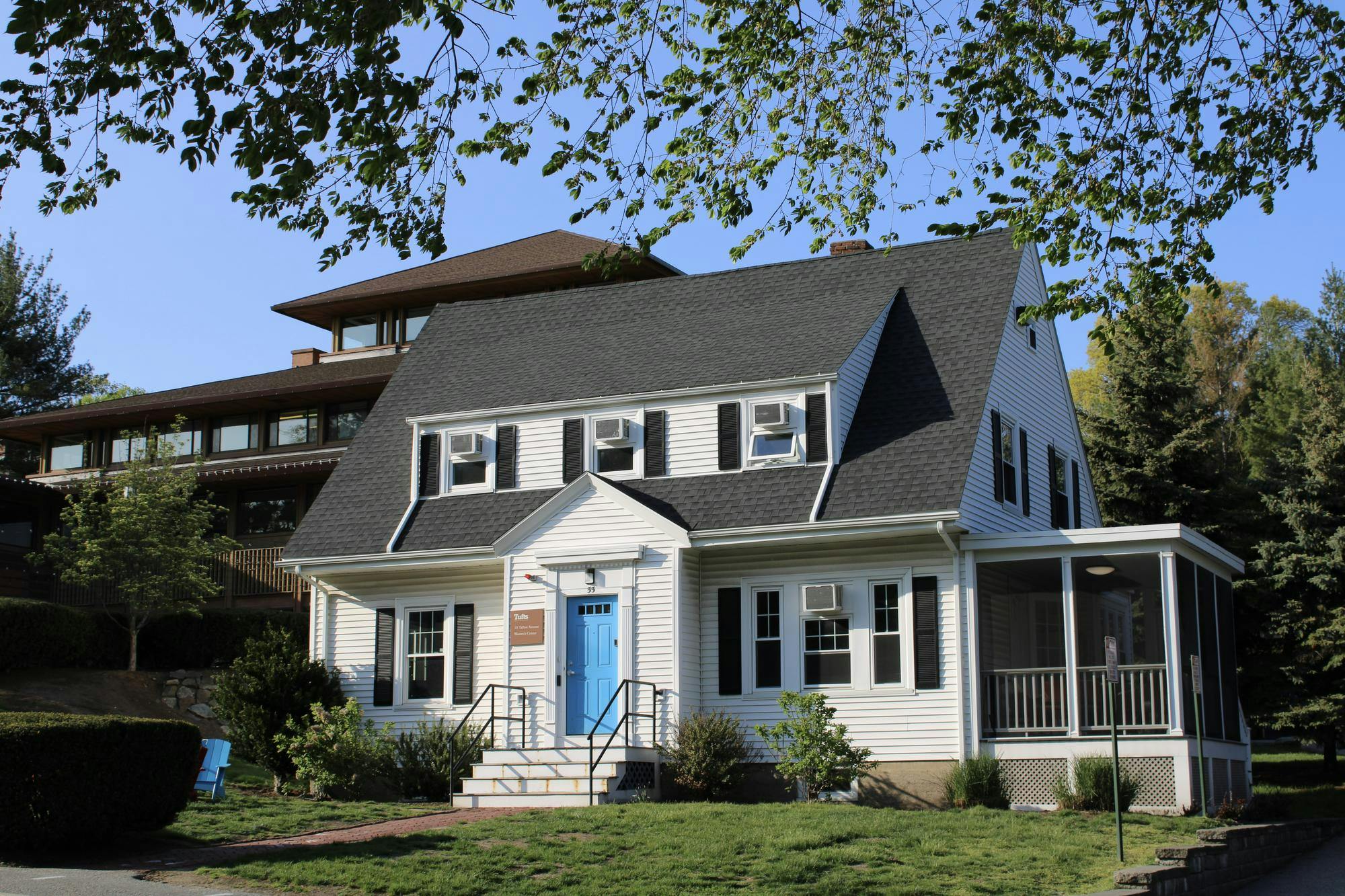
In 1892, the Tufts Board of Trustees enrolled the first women students “on the same terms and conditions as to men.” However, the journey to coeducation would not end there, as in 1910, women were separated, matriculating instead at Jackson College, a separate institution associated with the university. It was not until 1980 that Tufts returned to being fully coeducational.
As of 2024, women make up over half the undergraduate population at Tufts. Student organizations, academic programs and community spaces across campus continue to build on this history to expand opportunities for women and promote equality for all.
March celebrates Women’s History Month, making it especially important to acknowledge these efforts and the people behind them.
One of the most prominent spaces dedicated to this mission is the Women’s Center, located at 55 Talbot Ave. beside the Mayer Campus Center. It serves as a hub for community building, discussion and advocacy surrounding gender equality and intersectional feminism.
“Our mission is to intentionally interrogate the gender binary for all people,” Atarah Redmon, associate director of the Women’s Center, said. “Most of the time, we’re doing work around claiming control over our own bodies: challenging patriarchal structures and systems.”
For many students, the center functions as a place of reflection and belonging. Sarah Dorielan, a sophomore and Women’s Center intern, described the space as one where students are encouraged to engage openly with complex and vulnerable issues.
“To me, the [center] offers a space to learn without judgment and a place to talk without being censored,” Dorielan wrote in an email to the Daily. “The Women’s Center is a site for belonging and empowerment in order to encourage community and critical thinking.”
As an intern, Dorielan works alongside the program coordinator to design and facilitate events for both undergraduate and graduate students. Her work is informed by feminist scholarship and by her own topics of interest, particularly examining the experiences of Black women within feminist movements.
As part of her internship, Dorielan founded a book club at the Women’s Center that explores womanism, a movement championed primarily by Black feminists that addresses the intersectional struggles of Black women through literature.
“We meaningfully analyze texts that are focused on the lived experiences of women of color and form community through these vulnerable issues,” Dorielan wrote, adding that the club is currently reading Toni Morrison’s “Sula.”
Through initiatives like these, the Women’s Center offers an opportunity for students to bridge scholarship with lived experience in an environment outside the classroom.
In addition to regular programming, the Women’s Center hosts events throughout the year to highlight the intersectionality of gender identity and feminist activism. In celebration of Women’s History Month, the center has partnered with several campus organizations to host panels and discussions.
On March 25, the center, in collaboration with the Department of Women, Gender and Sexuality Studies, will host a panel titled “Bodies Without Borders: Building Feminist Autonomy in a Time of Control.” Two days later, in collaboration with the Africana Center, Rep. Ayanna Pressley, D-Mass., will speak about her experiences navigating Congress.
The center will also collaborate with the LGBT Center to celebrate International Transgender Day of Visibility.
“We’re looking to really highlight how trans-femininity and cis-femininity really do have so many intersections in which the work must be done together,” Redmon said.
Beyond programming and discussions, the Women’s Center also provides practical resources for students, including free sexual health and reproductive care supplies. The center maintains a fund that allows students to discreetly request products such as menstrual supplies, ensuring accessibility for those who may need them.
Alongside institutional spaces like the Women’s Center, student-led organizations also play a significant role in advancing gender equity on campus and beyond.
Women’s Higher Education Now is a student organization focused on expanding access to higher education for women globally. On Friday, WHEN hosted its annual International Women’s Day Coffee House in Curtis Hall to raise proceeds for the Asian University for Women in Chittagong, Bangladesh.
“All of our proceeds go towards scholarships for women in South and Southeast Asia who wouldn’t otherwise have the opportunity to [receive a] higher education, [who are] usually garment factory workers and tea estate workers,” WHEN’s director of community awareness Veena Bulusu, a junior, said.
For the past two years, the organization has focused on fundraising for an emergency scholarship program supporting women from Afghanistan. Currently, 2.2 million Afghan girls are banned from education beyond primary school, making international educational opportunities increasingly critical.
Bulusu explained her personal connection that drives her passion for WHEN.
“I’m a South Asian woman, and I feel very, very lucky … for the education that I’ve received,” Bulusu said. “I feel really connected to all the work we do, and I’ve watched the women in my life succeed because of higher education, and I think it’s something very valuable that everyone should be able to have access to.”
Beyond fundraising, the coffee house event also served as a celebration of student creativity and community.
“It’s also just a great time to bring together the performing groups, like the a capella groups Public Harmony, and also all these incredible student artists to share their work,” WHEN Co-President Zoe Dill, a senior, said.
Another organization focused on supporting women at Tufts is Women in International Relations, which provides a community for students interested in global affairs.
WIIR hosts weekly meetings where members discuss international issues, offering a space where women can engage with topics in an area often dominated by male voices.
“A lot of the IR classes are predominantly male … and a lot of times they will talk over girls or raise their hands first,” WIIR Co-President Madison Bradford, a senior, said. “So I think it’s nice … to have that space where [women] feel comfortable answering questions and talking about the topics we’re talking about.”
The organization hosts weekly meetings where members discuss international issues ranging from global conflict to gender-based violence. Bradford noted how these conversations fill gaps she has noticed in the traditional IR curriculum.
“I don’t often in my classes talk about femicide … [or] female genital mutilation,” Bradford said. “But we’re talking about it [at WIIR], so it’s a nice space to learn more about the specific ways women are impacted by international issues.”
By centering these conversations, the organization promotes awareness and dialogue on how global issues, like climate change and reproductive rights, may impact women differently. On Monday, WIIR hosted a discussion in collaboration with Planned Parenthood to discuss abortion access and women’s resilience globally.
For Bradford, the impact of the club became especially clear during her sophomore year, when WIIR hosted a speaker who had survived female genital mutilation and later became an activist working to end the practice.
“Hearing her story … and how she experienced this traumatic event and used her place in society to better the [lives of] other people ... was really inspiring,” Bradford said.
Bradford, who came from a conservative high school, said being surrounded by women who were passionate about global issues and gaining exposure to professionals in the field changed the way she saw herself and her ambitions.
“Joining WIIR my [first year] made me more inspired and realize how capable I was of [having] a career working for the government, or [having] a career working as a lawyer or working in international relations in general,” Bradford said.
The organization also hosts an annual research trip funded by the Institute for Global Leadership where students travel abroad and engage with grassroots organizations while conducting an independent research project.
Bradford traveled to Ireland with WIIR during her sophomore year, an experience that deepened her connection to the organization and inspired her passion for international relations research, motivating her to write a senior thesis.
Last year, the research trip took students to Mexico City, and this year, members will travel to Nairobi, Kenya. These trips allow students in the club to apply the work they do at Tufts to real-world challenges alongside the people directly impacted by them.
As Women’s History Month reaches its midpoint, these initiatives stand as examples of how the Tufts community empowers its members to confront systemic challenges and gender-based disparities. They serve as a vital reminder that while progress is an ongoing process, there is always an opportunity to be part of the solution.



