
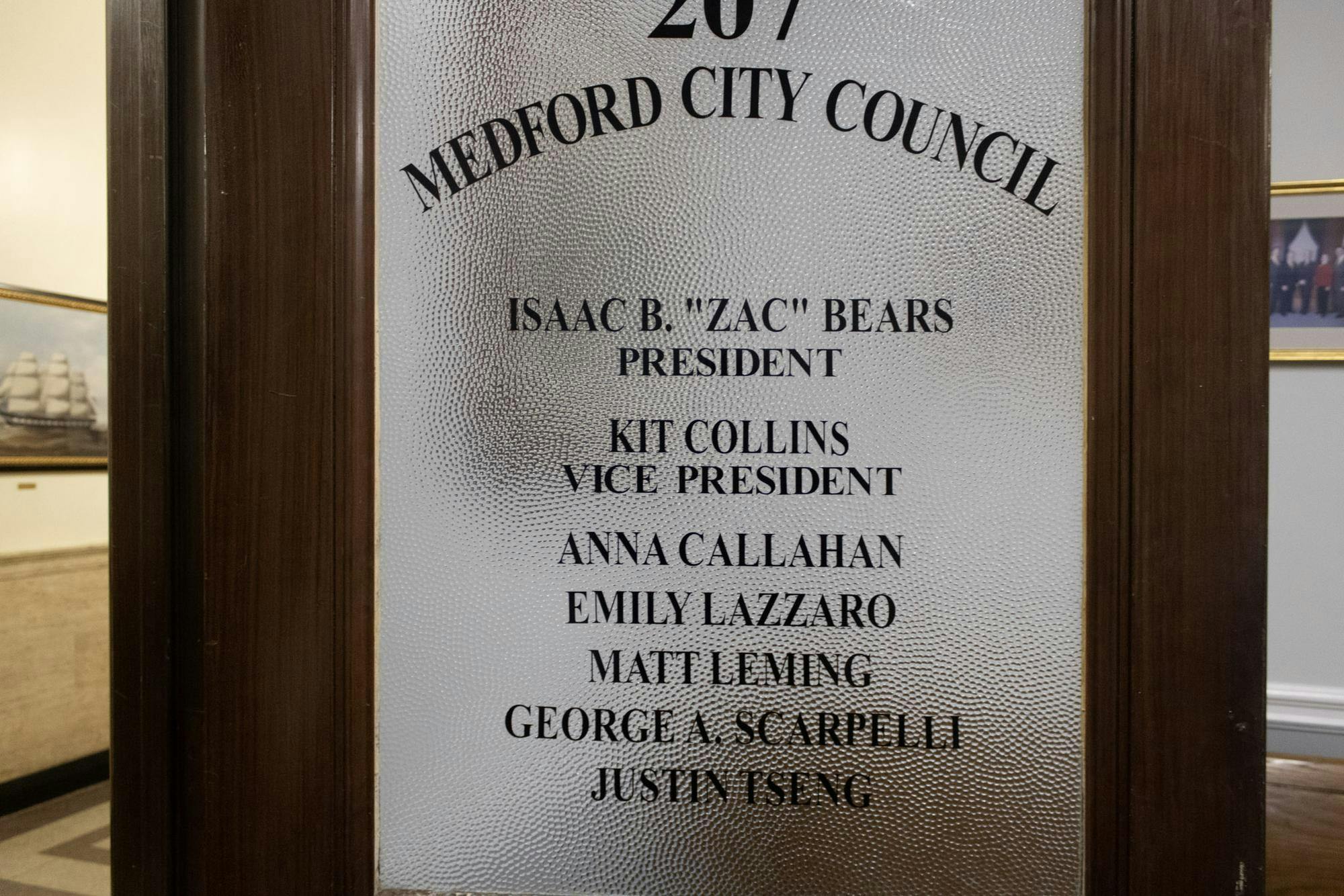
The Medford City Council approved its Values-Aligned Local Investments Ordinance on Wednesday, overriding a mayoral veto. The body also voted to postpone a vote to reconsider an element of the Salem Street Corridor District rezoning project until next week.
The ordinance — which would direct the city to divest funds from entities involved in fossil fuels, weapons manufacturing and severe human rights violations — was passed in third reading in September but was vetoed in October by Mayor Breanna Lungo-Koehn, who cited legal and financial concerns. The override passed in a 6–1 vote, with Councilor Scarpelli opposed.
“This ordinance, in its current form and in my opinion, has not undergone the level of diligence required for a matter of such legal and financial magnitude, nor were any recommendations to do so considered,” Lungo-Koehn wrote in a letter explaining her veto to the City Council.
Lungo-Koehn referenced a memo from KP Law, the firm hired by the city to review the ordinance, which raised similar concerns around the “significant legal implications regarding the City’s compliance with state law.”
During Wednesday’s meeting, City Council President Zac Bears explained the requests he made to the mayor about the ordinance.
“We said, ‘Please send us some comments, because it has to be advertised and then we’ll have a third reading vote.’ We never got those things,” Bears said. “We took a third reading vote, then the mayor just sends us back a veto … It wasn’t: ‘Here are the things you need to change to make this work.’”
Council Vice President Kit Collins disputed the mayor’s claims that the ordinance was not thoroughly vetted.
“Her letter further mentioned an objection that the council did not thoroughly vet this ordinance and seek input from the relevant stakeholders within the city. That is false,” Collins said. “This has been a thorough, multi-month process born of community advocacy vetted by legal counsel, revised and amended before passage based on feedback both from the community and from employees within City Hall.”
Medford resident and attorney Micah-Shalom Kesselman said that public sentiment is shifting toward aligning municipal investments with community values. "People are clear that they want quality public services at the local level and a future for their children and neighbors, not billions being spent on bombing families in tents, destroying Palestinian homes, and subsidizing more and more illegal colonial settlements in the West Bank, despite a so-called ‘ceasefire,'" he wrote in a press release from supporters of the ordinance.
The council also spent several hours debating an amendment to the rezoning of the intersection of Salem Street and Park Street. Councilors ultimately voted unanimously to continue the public hearing for one week, giving the mayor time to offer a concrete commitment to move forward with the rezoning project.
In March, the council implemented nearly all of the Community Development Board’s recommendations for rezoning the Salem Street corridor, designating the intersection as MX-2 — a higher-density zone allowing up to six stories with incentives — rather than MX-1, which allows up to four stories.
In July, Lungo-Koehn suggested that reconsidering the MX-1 designation was necessary for her to renew the city’s contract with Innes Associates, a consultant on the zoning project. She formally requested the council begin the amendment process in September.
Collins criticized the mayor’s approach, describing it as an ultimatum that undermined months of community engagement.
“Her late-July public letter to President Bears made it clear: if we don’t kiss the ring on Park and Salem, she will not sign a contract extension with Innes Associates, meaning that our comprehensive plan will go back on the shelf to do nothing,” Collins said. “And that the input that so many people have shared about how to improve the zoning process will be for nothing.”
The objection to the MX-2 designation stemmed from concern that it could allow a methadone dispensary. A treatment center had filed for a special permit last April to open such a clinic on Salem Street, prompting strong resident pushback.
“I am in favor of the MX-1 qualification and zoning for our area because it goes against any of the medical clinics that we fought so hard against,” resident and former council candidate Trish Schiapelli said. “There wasn’t a need, it was the wrong company and now we do not trust this council, as a result of that, to allow blanket medical clinics.”
Councilor Emily Lazzaro clarified that MX-2 parcels would not permit clinics such as the proposed methadone dispensary. Under the amendment before the council, which designates the intersection as MX-1, all medical offices and clinics would be prohibited.
“We are now holding up our entire discussion of zoning in the city of Medford until this council agrees to never let there be a clinic for medication-assisted treatment at the intersection of Park and Salem Street,” Lazzaro said during the meeting.
Correction: A quote previously attributed to Kesselman came from a version of the press release that was out of date.



