
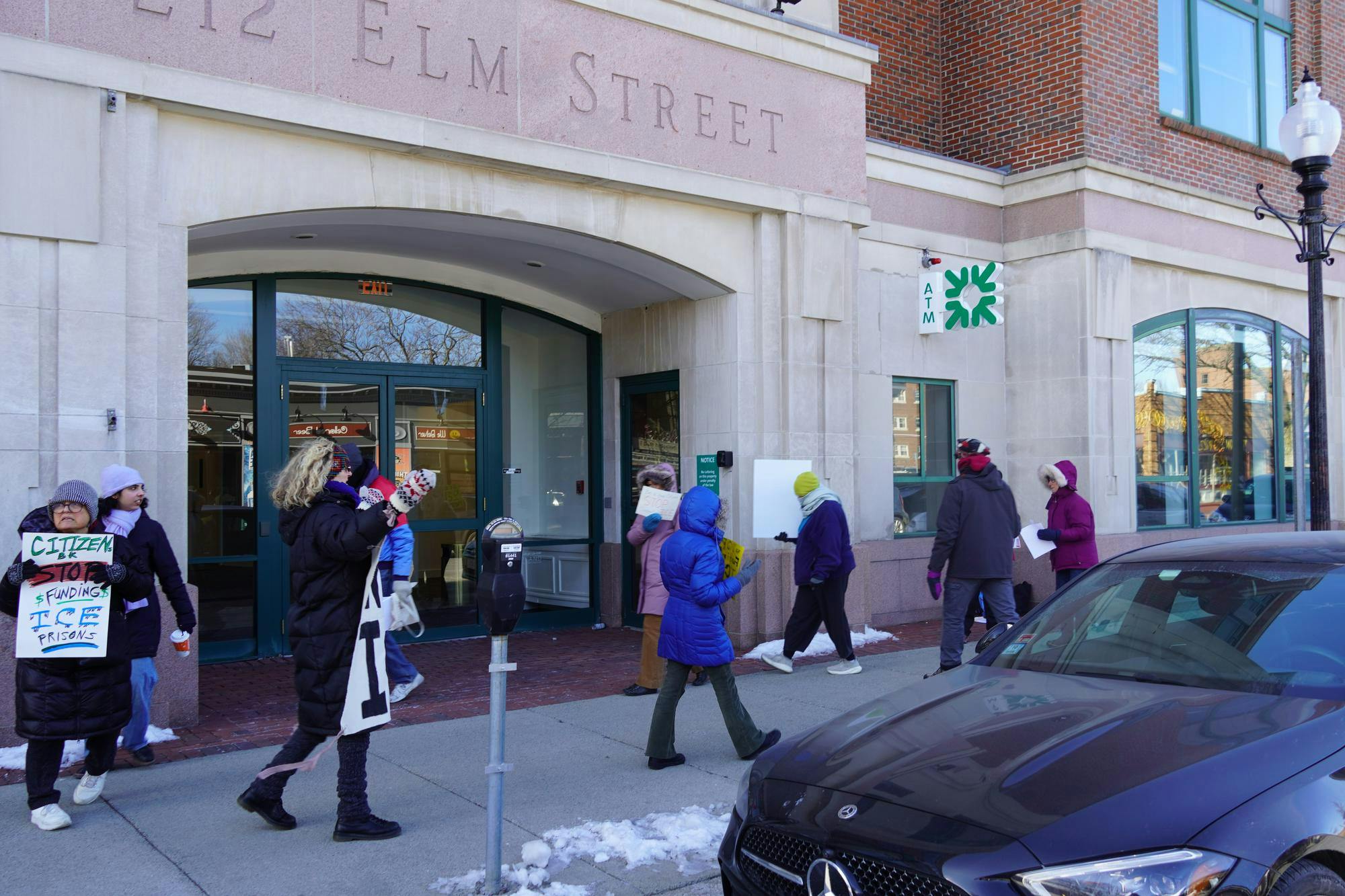
Residents gathered at the Somerville and Medford branches of Citizens Bank on Saturday to protest the bank’s links to private prison companies that own and operate immigration detention centers under government contracts, including with Immigration and Customs Enforcement.
The protests were part of three dozen similar demonstrations taking place across the Northeast, organized by the de-ICE Citizens Bank Coalition. According to the coalition, Citizens Bank continues to be a major lender to private prison companies CoreCivic and The GEO Group. They added that other banks, including JPMorgan and Barclays, have distanced themselves from the prison companies.
“Banks matter because they provide the financial backbone for more arrests and detention of immigrants,” the de-ICE Citizens Bank Coalition wrote in a press release. “Cutting off that support weakens the companies that are handsomely profiting from human rights abuses.”
The de-ICE Citizens Bank Coalition includes the Rhode Island Resistance Coalition and dozens of local groups affiliated with the Indivisible movement, a nationwide grassroots effort to empower local groups to defend democracy.
“We got contacted by … [the] national coalition,” Sue Edelman, a member of the local chapter Mystic Mashup Indivisible, said. “These protests are in 42 places, across six states, and they’re gonna keep the pressure on Citizens [Bank] that way.”
Protestors in Somerville walked in a circle outside the Citizens Bank on Elm Street in Davis Square, carrying signs and chanting, “Stop ICE,” “No ICE prisons” and “No justice, no peace, no secret police.” Some participants handed out fliers, catching the attention of several community members who stopped to talk with the organizers.
Suzanne Boucher, co-leader of Mystic Mashup Indivisible and an organizer of the protest, has been a Citizens Bank customer for decades and said she found the allegations of links with ICE unsettling.
“The ICE prisons that they are funding right now have children in them,” Boucher said, referring to Liam Conejo Ramos, a 5-year-old boy who was detained by ICE with his father last week.
Some protestors said they switched banks as a result of the controversy and advised others to do the same.
“I used to be a Citizens Bank customer,” protestor Judy Scribner-Moore said. “I’ve just switched my accounts because I found out that, unlike many of the national banks [that] have taken their funding out of private prisons and detention centers, Citizens [Bank] maintains [its] standing as a major funder of private prisons and ICE detention centers, and it’s despicable.”
Protests against the widescale ICE and Border Patrol operation in Minnesota — in which two U.S. citizens were shot and killed by federal agents — galvanized some to take action this past weekend. A woman named Ellen, who attended the Somerville protest as a member of her local Indivisible group, said that walkouts and boycotts were effective ways of generating change.
“[The protest] in Minneapolis is a really good example of what we’re heading toward, which [is] boycotts [where] walk out of your job [and] don’t shop,” she said. “The kind of thing that will hit the-powers-that-be in the pocketbook is what’s going to make a difference.”
Protester Martha Friend said she believes any show of resistance is important for building awareness and unity, arguing that protests can foster empathy even among people not directly affected by federal policies.
“[When] more people become educated about what’s going on, it becomes something they can’t walk away from, even if ICE actions aren’t directly affecting them,” Friend said. “When they see reports of cruelty and they see people like them, like us, out taking a stand, it helps.”
Many attendees said they view protests as an initial step and stressed the importance of continued civic engagement, including voting, fundraising and refusing to fund companies connected to ICE.
Although the temperature on Saturday reached the single digits, organizers chose not to cancel the event. Edelman said that the protests in Minneapolis, where temperatures have dropped below zero, inspired residents to protest in solidarity.
Ed Smith, who read about the protest on Facebook, felt it was necessary to act now before ICE’s presence in Massachusetts grows, something he said he believed was imminent.
“They’re masked agents, [and it] seems there’s no restrictions on what they can do,” Smith said. “They beat people up, they drag them out of their cars … intimidating communities.”



