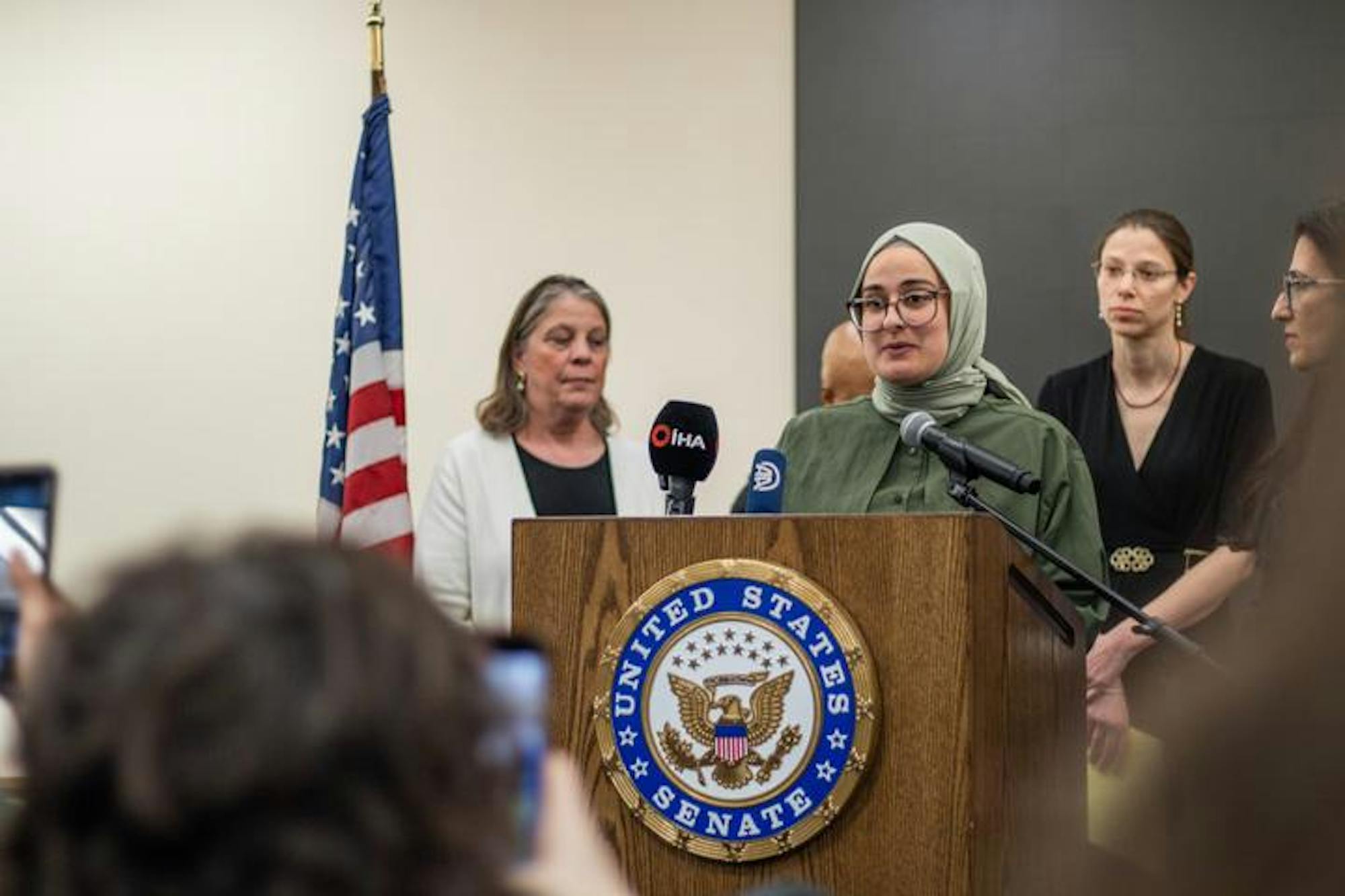
Editor’s note: This article has been updated to include a statement from Rümeysa Öztürk.
U.S. District Court Judge Denise J. Casper granted Tufts graduate student Rümeysa Öztürk’s motion for a preliminary injunction Monday afternoon, ordering the government to immediately reinstate her Student and Exchange Visitor Information System record retroactive to the date it was terminated — March 25.
Immigration and Customs Enforcement terminated Öztürk’s SEVIS record — the federal database governing the legal status of noncitizen students — shortly after her visa revocation and subsequent arrest in Somerville in March.
The termination of a SEVIS record causes the loss of work authorization and an inability to re-enter the United States. Additionally, it means that the government could begin counting days the individual remains in the country as “unlawful presence,” which can lead to further re-entry bans.
Casper ruled that because the terminated record barred Öztürk from paid research roles and key aspects of her doctoral training, the harm is considered irreparable, a necessary element for a court to grant a preliminary injunction. Öztürk is also at risk of additional immigration consequences tied to gaps in her SEVIS status, according to Casper.
“She continues to lose out on paid on-campus employment in which she would otherwise be engaged … [and is] losing out on a unique opportunity to work with her advisor on a project that would further her doctoral training and professional development,” Casper wrote in her ruling.
Casper found that the government’s actions were likely unlawful under the Administrative Procedure Act and that it offered no coherent legal basis for the SEVIS record termination. She added that an internal ICE message issued after the termination could not be used to retroactively justify the decision.
“The government offers no explanation for the shifting justifications it provided for termination of the SEVIS record,” Casper wrote.
The Department of Homeland Security has historically treated SEVIS record terminations equally to terminations of F-1 visas, Casper noted. She determined, however, that the government has argued that Öztürk’s F-1 status remained intact while imposing consequences inconsistent with that claim.
“If Öztürk remains in F-1 status, as the government contends, it is all the more irrational that the government has imposed negative consequences on her that are inconsistent with that status,” she wrote.
Patrick Collins, Tufts’ executive director of media relations, noted that the university is monitoring the situation.
“We are in contact with her attorneys and are actively monitoring SEVIS to ensure her record is restored,” Collins wrote in a statement to the Daily.
In a press release from the ACLU Massachusetts, Rümeysa Öztürk reflected on the termination of her SEVIS record and her detention in Louisiana.
“My student SEVIS record was unlawfully canceled by the government for co-authoring an op-ed in which I advocated for equal dignity and humanity for all — and after eight long months, that record will now finally be restored,” Öztürk wrote in the press release. “Going through this brutality, which began with my unlawful arrest and 45 days of detention at a shameful for-profit ICE prison in Louisiana, I feel more connected to everyone whose educational rights are being denied — especially in Gaza, where countless scholars have been murdered and every university has been intentionally destroyed.”
Öztürk also expressed gratitude for Casper’s ruling.
“While I am grateful for the court’s decision, I still feel a great deal of grief for all the educational rights I have been arbitrarily denied as a scholar and a woman in my final year of doctoral studies,” she wrote. “Nonetheless, this decision gives me hope, and I earnestly hope that no one else experiences the injustices I have suffered.”
This is a developing story. Check back here for updates.