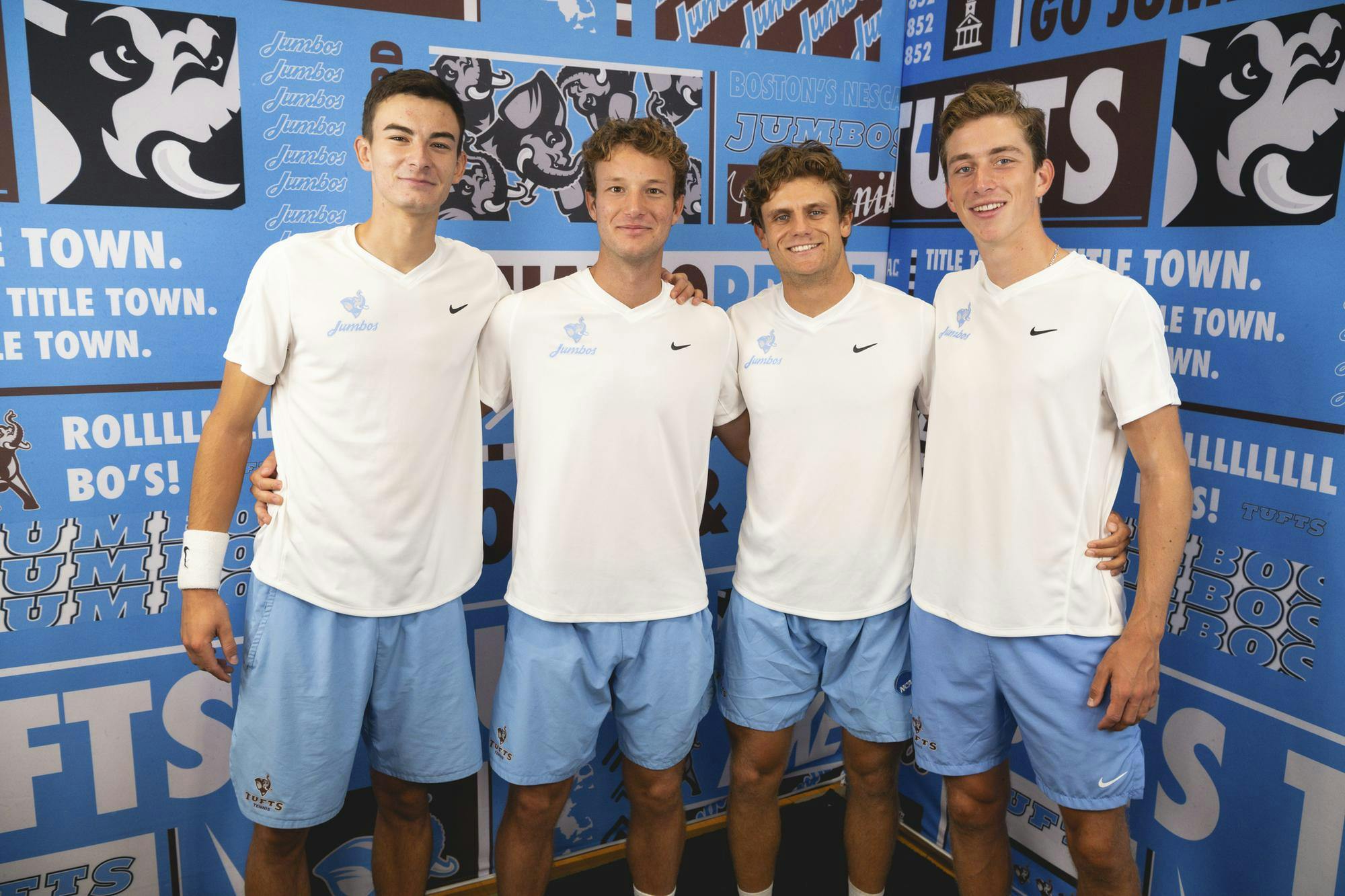
For the Tufts men’s tennis team’s graduating seniors, Javi Gonzalez, Sacha Maes, Alex Ganchev and Andrej Djokic, the past four years have been defined by a singular pursuit: A national championship that has remained agonizingly out of reach. Three consecutive seasons of heartbreaking near-misses — including an undefeated regular season and a national finals appearance as first-years — have only sharpened the hunger driving this class. Now, with one final month remaining, the four seniors aren’t just playing for a trophy — they’re playing for each other.
Falling in love again
Gonzalez’s relationship with tennis stretches back two decades. The Valencia, Spain native picked up a racket at age two and never put it down. However, by the time he arrived at Tufts, the sport had become more of a burden than a joy. Years of individual competition had taken their toll.
“Tennis is a very individual sport. It puts a lot of tolls in your mind,” Gonzalez said. “When you win, you deserve everything, but when you lose, it’s also all on you. And I was kind of getting burned from that.”
That changed the moment he stepped on campus.
“When I came to Tufts, [I] got introduced to a completely different sport in my opinion, which is playing for a team,” he said. “You take for granted that you’ve got 16 guys cheering for you at every single match. … Sharing the wins is even better than experiencing it yourself, and sharing the losses, it’s a lot better than having to cope with them by yourself.”
The result? “Having the opportunity to be part of it made me fall in love with tennis again,” Gonzalez said.
Gonzalez’s teammates have watched him evolve from a naturally reserved first-year into one of the program’s most vocal leaders.
“He’s always been very emotional, but he definitely managed to calm the storm within his mind and be able to channel that energy into doing the right things, especially on the court,” Ganchev said. “Before, in big moments, he would doubt himself, … whereas now, he’s the person you want in the big moment. He’s always going to bet on himself, he’s going to go for the shot, he’s going to give his 100% and there’s going to be no fear.”
Maes echoed the sentiment: “I’ve just seen over the years how he’s used what he saw as examples — all the people above us that have come and [gone] these past four years. He’s really taken some things from each one, and now you can see how all of that has molded him into a leader,” he said.
After graduation, Gonzalez plans to move to California and leave tennis behind for good.
“I’m selling my rackets as soon as we’re back,” he said. “I think I’ve got one more month of tennis in me. No more.”
“Why not me?”
Ganchev’s path to Tufts is perhaps the most winding of the four. The Plovdiv, Bulgaria native started playing at age five under the guidance of his father, a man who had dreamed of going professional himself.
“My dad, he loves tennis. He wanted to become a professional. He never did. So he was like, ‘Alex, you’ll be playing tennis and you’ll become a professional,’” Ganchev recalled.
By age 15, Ganchev was among the best juniors in Bulgaria. He was sent to Spain to train full-time.
“After grueling preparation, six hours a day, six days a week, for three years, I was absolutely burned out,” he said. “I actually quit when I was 18, about to turn 19, and I didn’t play for a full year.”
He found his way to Tufts through a friend who introduced him to head coach Karl Gregor. Once on campus, surrounded by teammates who wanted the best for him, something shifted.
“I kind of rediscovered the love for the sport, because I was doing it on my own terms,” Ganchev said.
Now, in a full-circle twist, Ganchev plans to pursue professional tennis after graduation as a doubles player alongside Maes. The idea took root last summer, when he traveled with professional players and attended the Grand Slam tournaments.
“I kept having this mentality [of], ‘Why not me?’” he said.
A conversation with Quinn Gleason, currently ranked No. 48 in the world in WTA doubles, sealed the decision.
“She told me, ‘You have it, what’s required. You should give it a go.’ And that stuck with me, that planted the seed,” Ganchev said.
His resilience hasn’t gone unnoticed. After a spectacular first year, in which he clinched the decisive match against CMS in the NCAA semifinals, Ganchev endured two difficult seasons marked by injuries and mental adversity.
“The most impressive thing for me has been to see how he’s bounced back this senior year,” Maes said. “That journey has really been a testament to his character.”
Gonzalez was more direct: “Every time we go to a match, they put him in. The trust is just there. … He just goes there and wins. … And being able to do that after having gone through such a hard mental phase is what makes it the most impressive.”
The process
If Gonzalez brings the passion and Ganchev the perseverance, Maes provides the blueprint. The New York City native, with roots in Belgium, Luxembourg, France and Russia, started playing at three years old with his father’s side of the family before committing fully to the sport at 12.
His approach this season has been methodical.
“This year, we kind of recognized that some years, [while] we’ve always wanted [the title], we weren’t always putting [in] the right actionable steps day in day out,” Maes said. “We’ve approached this year having the right process, and we know that if we have the right process … and stick to it consistently, day in day out, the outcome should become reality.”
Maes has also been the team’s quiet backbone, a fact his teammates are quick to acknowledge.
“[Maes] was always almost like the mother of the team since [our first] year,” Ganchev said. “He grew into becoming one of the leaders of this team, someone who has the highest standard. He never slacks. [If] he feels good, he’s always there. [If] he feels bad, he’s always there. He doesn’t complain.”
“I don’t think anyone has his same dedication,” Gonzalez added. “[The team is] bigger than yourself. I think [Maes] is probably the embodiment of that. If he’s part of the team and he knows that one decision is right, even though he might not be benefiting directly, he’s gonna take it.”
One memory stands out above the rest. On Senior Day against Bowdoin, with hundreds of fans packed around the outdoor courts, Tufts delivered a commanding performance.
“We swept them seven-zero, which we’ve never done since our class has been here,” Maes said. “The amount of energy we had during that match, and the amount of people that came out … that was definitely up there as one of my best days at Tufts.”
The fourth man
Though Djokic was not present for the interview, his growth over four years was a subject his classmates couldn’t stop talking about.
“The guy could not take anything seriously [in his first] year,” Gonzalez said. “But now, seeing him as a captain … the way he focuses on the court is admirable to say the least. He’s a different person to two years ago. … He’s [a] completely different player, completely different teammate.”
Ganchev pointed to mental toughness as Djokic’s greatest leap.
“He had a tendency to look for bailout shots when it got difficult. He was willing to escape from a big moment,” Ganchev said. “But now he’s become very tough, because he understands what it means to be out there fighting for your brothers.”
Maes summed it up: “His maturity and willingness to be tougher has not only been evident on the court, but also just as a captain off the court. … He’s been able to understand when is the time for [fun] and when is the time to be a leader and lock in.”
The final set
As graduation approaches, the Class of 2026 is keenly aware of how fleeting their remaining time together has become. Gonzalez captured the bittersweet reality: “We’re very lucky because we just come to school and we get introduced automatically to 17 friends. 17 people are gonna become, realistically, your closest family here. We take it for granted, but that means the world.”
For Ganchev, the legacy is personal.
“10 years from now, it will be the time where I found home away from home,” he said. “When I came here, [to] a different country, they just embraced me. They accepted me the way I was.”
And what would winning the title mean? Ganchev offered perhaps the most complete answer: “Getting it done would mean the world to me, to [the team] and obviously to our parents, who sent us here,” he said. “[Winning] hopefully would give inspiration and motivation for the future generations who will come here.”
Whether or not the championship is won, the legacy of this class is already written in the program they built, the teammates they lifted and the culture they’ll carry past the final points in their collegiate careers.