
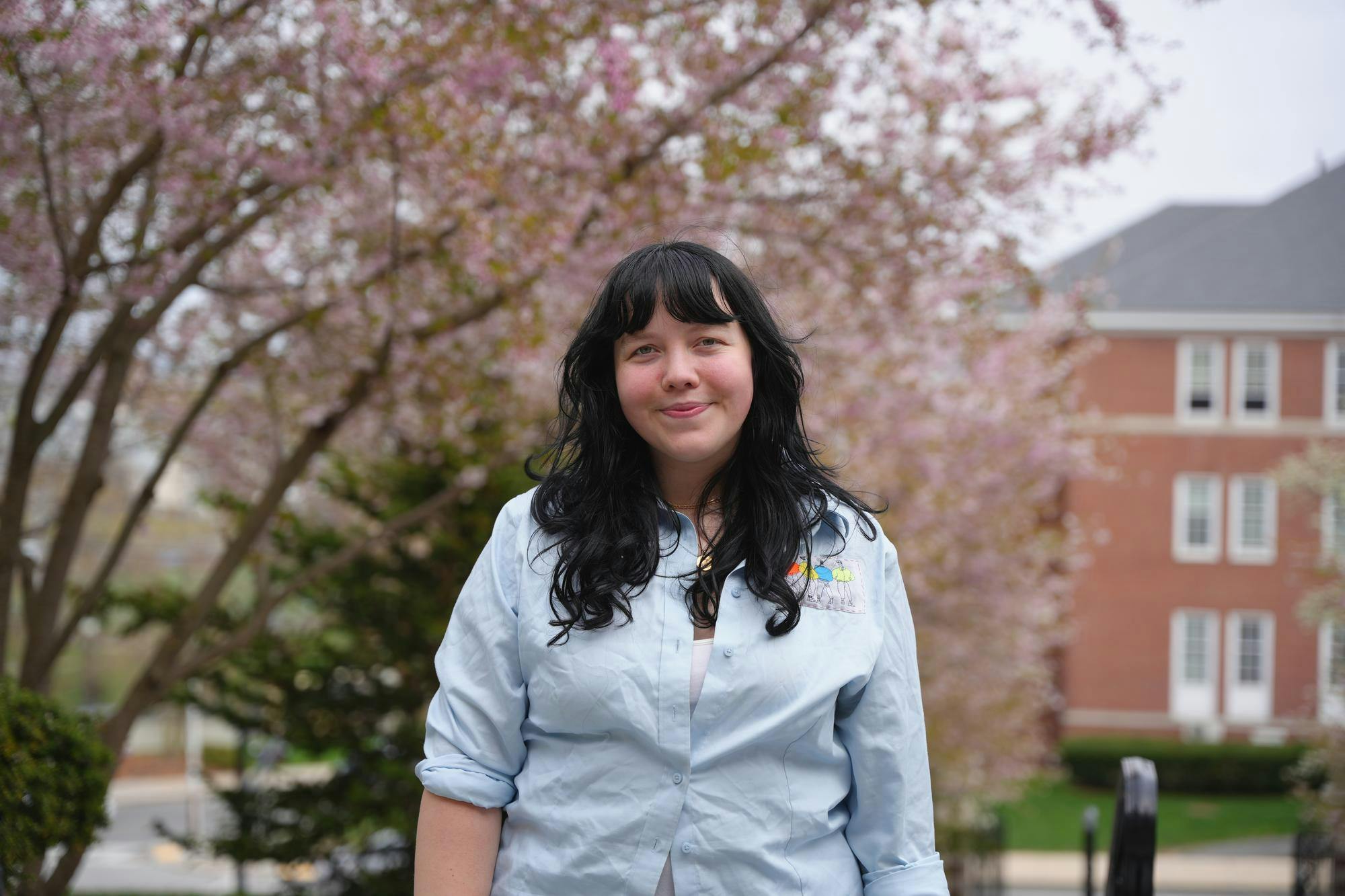
Editor’s note: The Daily’s editorial department acknowledges that this article is premised on a conflict of interest. This article is a special feature for Commencement 2026 that does not represent the Daily’s standard journalistic practices.
Graduating senior Dylan Fee wasn’t expecting to fall in love with journalism halfway through her time at Tufts. As a math and Latin double-major, Fee clearly demonstrated multifaceted interests, but assumed STEM was where she belonged.
“I didn’t really think I was good at writing at all because I was good at math in high school,” Fee said.
It took a persistent nudge from Matthew Sage, her friend and current Daily executive social media manager, to get her to officially contribute to the publication. After serving as an informal point person for Sage’s own Daily questions, Fee was finally persuaded to officially join the features section as a writer in the spring of her sophomore year.
Once she sat down to write her first piece on campus accessibility, something just clicked.
“I just loved doing that article, and I loved knowing that I could do it. Even though it kind of got torn to shreds in the editing process, knowing that it was something I could actually do made me fall in love with it,” she said.
That marked the beginning of Fee’s swift ascent up the Daily’s ranks. Fee entered her junior year as an assistant features editor, but when a vacancy opened up, she readily took on the role of deputy editor. During that semester, she balanced heavy editing shifts with a prolific output of 11 articles. Among them was her cheerful column The Daily Drip, where she reviewed every beverage at The Sink, Tufts’ student-run cafe.
For Fee, features was the perfect section to allow her to focus on the human side of stories.
“I was able to connect with my sources and make source-centric stories about people’s experiences,” Fee said. “It really gives a voice to people that don’t necessarily have it or didn’t have an avenue to show it in the first place.”
During that time, Fee produced the article she is most proud of to this day: a profile on David Delvalle, the education and reentry director for the Tufts University Prison Initiative and the first formerly-incarcerated person to be hired by Tufts.
“I loved hearing his story and how passionate he was about going back to school and getting educated. I see him around campus all the time now, and he just seems like he’s thriving, which is amazing,” Fee said.
The article was the first time Fee realized the genuine impact of journalism as a tool to spotlight underrepresented voices and programs.
That sense of responsibility only grew during last year’s coverage of the Rümeysa Öztürk case, which followed the detainment of the then-Tufts graduate student by ICE. Seeing the campus look to the Daily for answers made Fee realize the gravity of the Daily’s work.
“We’re not just a practice journalism publication, but we are a real publication that people look to,” Fee said, noting that the Daily was the primary source of information during the case. “Our writers were the first-hand journalists getting accounts from students, from professors [and] from the university about what was going on.”
Fee went on to describe the importance of student journalism as an independent news source amid growing distrust of national media.
“People are really, rightfully so, mistrusting of big-name papers like [The] New York Times [and The] Washington Post, because there always seems like there’s some sort of agenda. … They have investors to think about, and they’re trying to please as many people as possible,” Fee said.
In contrast, the Daily operates with a level of independence that Fee believes strengthens the paper’s credibility.
“We’re independently run, so no one’s telling us what to write,” she said. “Everyone is reporting out of a sense of obligation to give news to the Tufts community.”
“The love of journalism is happening because we’re all just volunteering our time,” Fee added. “I think that really makes it more impactful.”
By the spring of 2025, Fee was promoted to the role of executive features editor, and this past fall, she served as editor in chief of the paper.
While her tenure as editor in chief included many accomplishments — including building a stronger multimedia presence for the paper — one of her most profound impacts on the Daily is felt in the office, where Fee brought a notable cultural shift.
“The Daily can be very toxic at the top. The hierarchy is very rigid, and I like to think that I’ve helped contribute to a less toxic space of more productive conversation, more people hearing each other out, more [of] just [a] better community to be in,” Fee said.
For those who don’t know, Fee’s presence in the office feels like a warm hug, bringing in a welcoming energy to all who know her. A few weeks ago, she brought in a homemade cake during a production night to support Sage in his achievement of getting the Daily’s Instagram account to 10,000 followers. The room was filled with editors laughing over the Daily’s recent April Fools edition whilst indulging in a cake Fee baked and decorated to celebrate this milestone.
Now, in her final semester, Fee primarily focuses her energy in the multimedia sections of the Daily, jumping between her roles as an executive photo editor and video section contributor. But, of course, she stays true to her roots in features, finding time to write an article when she gets the chance. Outside the office, she also leads Action for Sexual Assault Prevention at Tufts, coordinating consent talks and survivor support spaces.
After graduation, Fee hopes to work in human interest journalism; her dream is to one day write for The New Yorker. But no matter where she ends up, Fee will bring the Daily to wherever life takes her next.
“Even if I don’t end up doing journalism as a career, the work that I did and the things I learned about myself while doing the Daily will forever impact me,” Fee said.
And to any who are still unsure of what they want to pursue, Fee’s advice is a reminder that it’s never too late to explore.
“I know people that didn’t find their ‘thing’ until they were seniors, and I know people that are still looking for it. That’s what college is for,” she said. “Changing your major is okay, joining a new club late is okay. Trying new things should always be the goal.”



