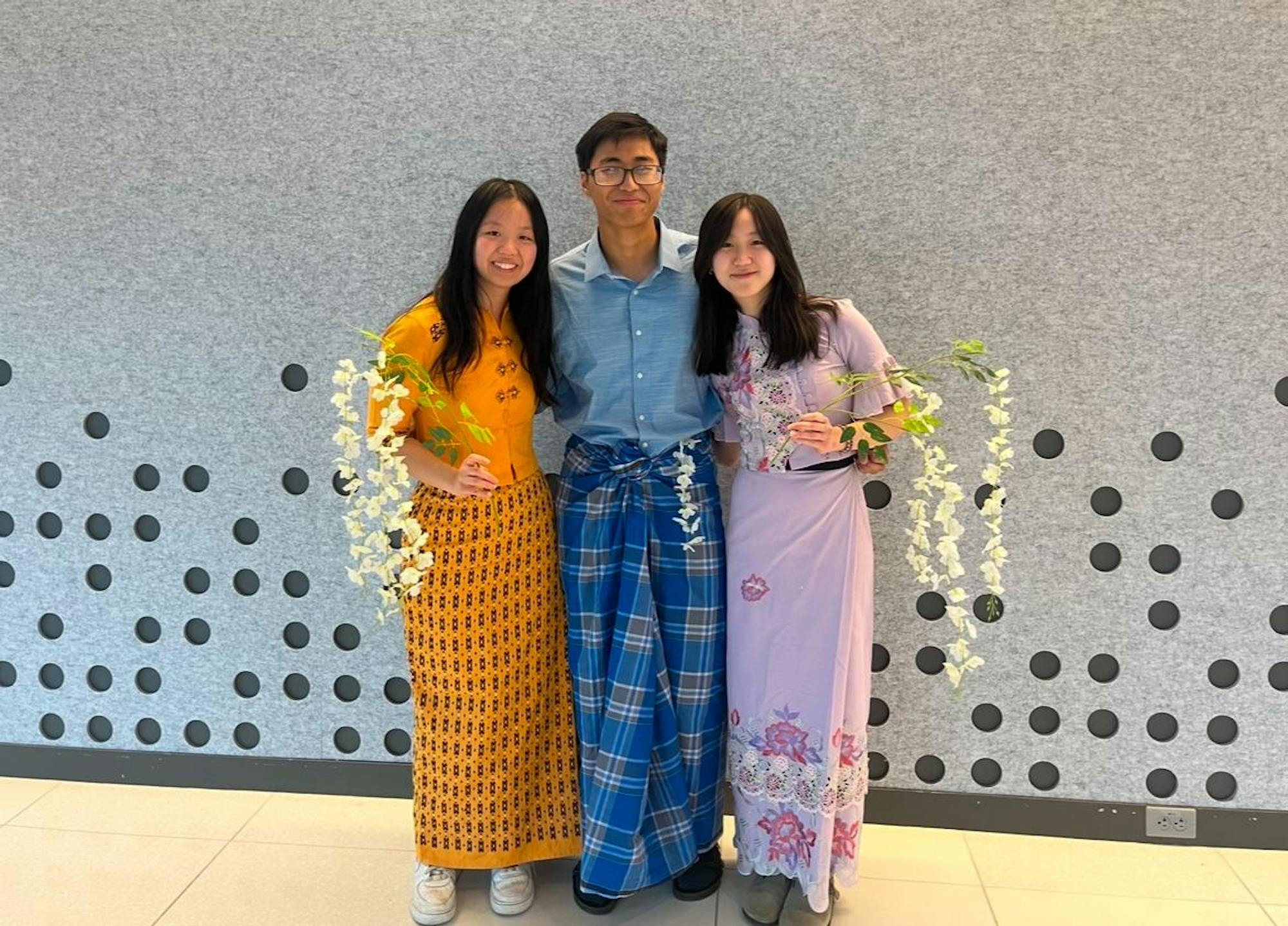
Tufts’ Myanmar Student Union has made significant strides since being established just four years ago. Through cultural celebrations, political discussions, lectures and large-scale cross-club events, MSU has found its footing on campus as both a haven for students as well as a club focusing on larger social and environmental justice efforts for those in Myanmar.
On March 28, 2025, a magnitude 7.7 earthquake struck near Mandalay, Myanmar, killing over 5,000 people and leaving more than double injured. According to the U.S. Geological Survey, the environmental disaster had effects felt as far as Bangkok, Thailand, as its shallow depth resulted in intense shaking and damage across the region. The event sent economic shockwaves through the country, as damage costs were estimated at $11 billion USD, around 14% of Myanmar’s GDP, according to the World Bank. With the country’s poverty rate already at 31% prior to the earthquake, hardships only increased with aftereffects, signaling the need for assistance.
Simultaneously, the country’s internal government has made relief efforts particularly difficult, as the State Administration Council — the current ruling military junta — has directed aid toward its own military purposes. According to Human Rights Watch, this structure has left thousands of citizens devoid of the resources needed for recovery and has made it significantly more difficult for international organizations to intervene by delaying visas, harassing aid workers, taking away supplementary resources and blocking internet access. As a result, Myanmar is still suffering a year later.
Here is where MSU President and rising senior Thang Dopmul, along with his fellow MSU members, stepped in, leaning on their collective identities to help uplift their community. For Dopmul, that community has been a large part of his upbringing.
Dopmul, who immigrated from Myanmar to Tulsa, Okla., described being surrounded by a community from Myanmar in his home state, as well as their unique place within the region.
“For us to be able to live in such a state where it lacks diversity, we’re able to bring that sense of cultural mix, and sense of diversity as well,” Dopmul said. “The fact that we’re a little more well known in [Tulsa] is good representation for us overall.”
Following the 1962 military coup in Myanmar, waves of immigrants traveled to the U.S. as refugees. Tulsa in particular has a large community of immigrants from Myanmar and is home to 7,000–9,000 Zomi, an ethnic group from the mountainous regions of Myanmar. Dopmul can still recall the nuances of his home state that bring him joy.
“I think it’s a perfect mix of both city and country. I love the flat land, I love the cool breeze, I love the rainy season,” Dopmul said. “Everything about Oklahoma I just think is amazing, but more so than that, it’s the community that I was part of.”
Fast-forward to March 2025, when the news of the earthquake that had happened overnight hit him and the larger Myanmar community, both at home and at Tufts, particularly hard. As soon as the news was shared, Dopmul and his fellow MSU members convened for a meeting over Zoom to discuss what to do. Aid was the top priority; they understood that monetary donations would have the largest impact.
MSU members were quick to discover that a Harvard student from Myanmar had set up a GoFundMe page with considerable connections. MSU decided to collaborate, setting up meetings first with the Harvard student before expanding to other university organizations and professors.
What was once a goal of $10,000 was quickly surpassed, as the single GoFundMe page spread across the country and internationally through family, friends and social media. Now, the relief fund sits at over $92,000.
“The one thing about Burmese people is we’re chronically online for the most part, at least a lot of the younger generation, which I think has some benefits,” Dopmul said. “We were able to reach a lot of the Burmese youth much quicker.”
Given the precarious government situation in Myanmar, Dopmul emphasized how much of their work was centered around determining where to distribute funds to. He emphasized the importance of donating to trusted organizations, ultimately choosing Better Burma to send money to. This organization has provided food, clean water, baby formula, diapers, medicine, hygiene kits, mosquito nets and more to people in Myanmar.
A year later, MSU continues to advocate for citizens of Myanmar, raising awareness about the ongoing military junta rule, which has carried out operations against civilians. Additionally, MSU seeks to share its culture through on-campus events that involve outreach, speakers and food, which Dopmul described as a large aspect of Myanmar’s culture.
Reflecting on the speed and proactivity of university students in mobilizing support for the cause, Dopmul noted the uniqueness of the Myanmar community at Tufts and beyond.
“We all love our country, but we don’t love the current state it’s at right now,” he said. “Coming to Boston, when I started interacting more with students who did grow up in [Myanmar] ... I [saw] a lot of their grit and their determination, even given their situation.”
Dopmul described how those students have sought out scholarships and programs to support their education and “live for their future.” As a result, he wasn’t surprised by the quick rally for support in a time of need.
“I think I’ve always acknowledged that Burmese students in general are very passionate or very determined. And I think that comes from the fact that they come from a country that is war-torn, and it’s just their passion. I think it’s very inspiring,” he said.