
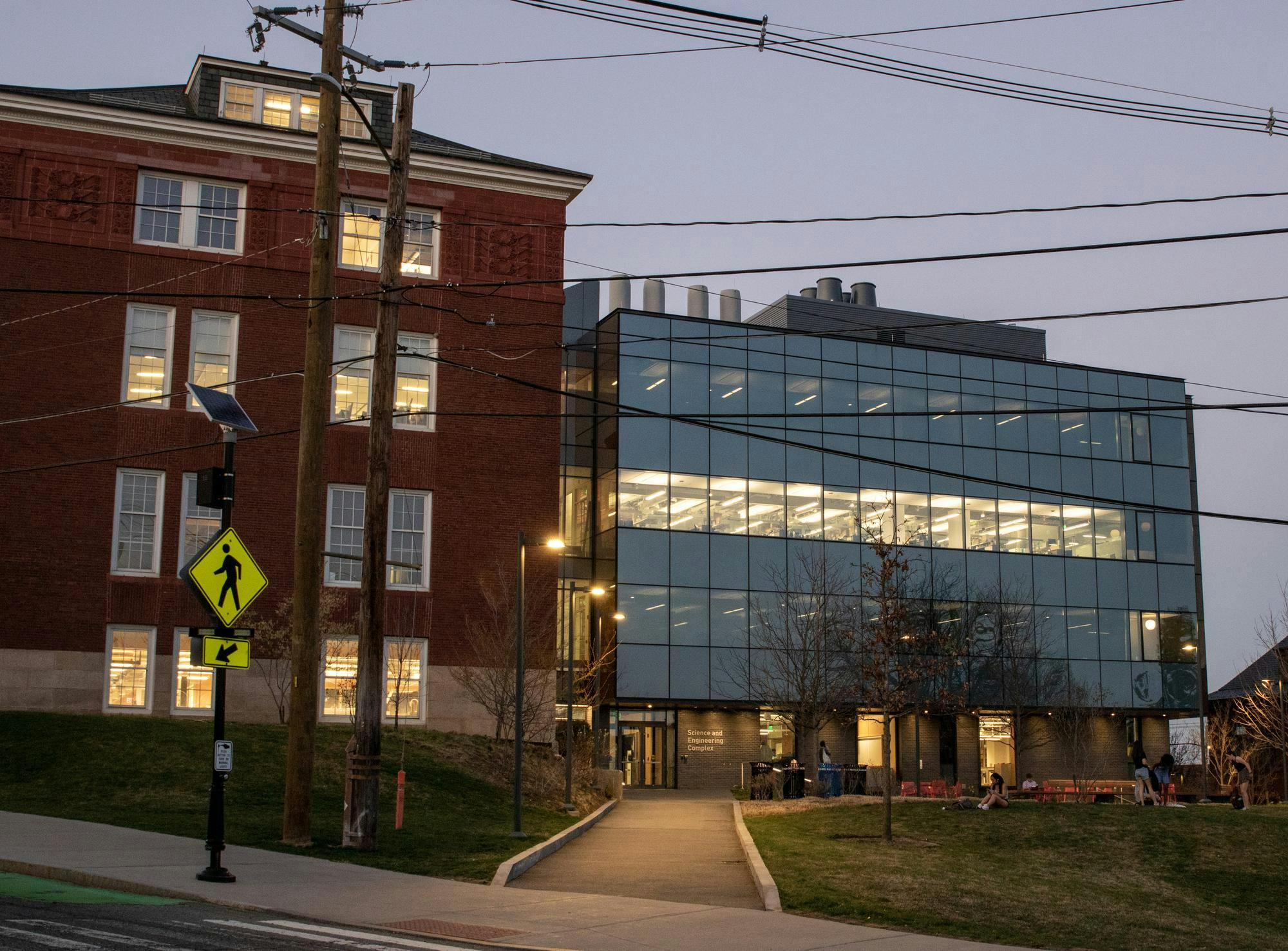
Diving straight into the foundational courses at Tufts can seem very daunting as a first-year engineering student. Between Chemistry 1, Biology 13 and Physics 11, the transition from high school to college is infamously steep. Physics 11, however, is known for a quirk that has made many students intrigued and terrified over the past two fall semesters: It’s completely ungraded.
Without the traditional pressure of individual and overall grades, it can be difficult to navigate physics. The Daily has previously highlighted the theories and systems of this class but I wanted to bridge the gap between the concept and its practical application.
This portrait of Physics 11 is informed by the experiences of previous students and my own.
One of the biggest shocks that other students and I faced was the large amount of independent work and time outside of class. Miguel Vasquez-Vega, a graduate student in the physics department and a Physics 11 professor, stresses that Physics 11 is a five-credit course, suggesting a 15-hour workload — six in class and nine outside of class.
When I first heard him say this in class, I struggled to understand the significance of putting that much time and effort into one class. Between the pre-class readings he assigns before every lecture and the problem sets, I saw that I could pour nine or even more hours into physics, but the idea of spending that much time on one class was unheard of in high school. Beyond understanding its significance, it seemed impossible to schedule nine hours outside of class between other classes and commitments.
Daniel Dawit, a rising sophomore studying electrical engineering, also felt this way.
“Because there’s no immediate threat of a bad grade on an exam, it is so easy to push the work off. You have to treat those nine hours like a part-time job and physically schedule them into your calendar,” Dawit wrote in a message to the Daily.
In my opinion, those nine hours are a baseline, and not a max. The best strategy or way to go about it is to over schedule the time you need for problem sets and studying. If you think a certain problem set will take you two hours, schedule three or four and treat it as a non-negotiable.
Another problem many students face is the lack of immediate motivation with grades out of the picture.
“We hope learning is the motivator! I don’t want an engineer/doctor/professional who’s motivated by grades, but one that’s motivated by wanting to solve the problems around them,” Vasquez-Vega wrote in an statement to the Daily.
Because the course is focused on evaluating your understanding on a holistic level, the motivation to learn for the sake of a test or quiz is taken away. Bezawit Gessesse, a rising sophomore studying computer science, emphasized the course’s fast pace.
“At first, the lack of grades just felt disorienting because I didn’t know where I stood,” Gessesse wrote in a message to the Daily. “But I quickly realized that if I didn’t truly grasp the ‘why’ behind an equation during the week we learned it, I couldn’t fake it later. You have to actively understand the material week by week.”
A common way to support students in this class was the check-in quizzes. There were a set of 10 questions given in class to help students assess where they stood in the pacing of the course. Gessesse further noted that these quizzes “pushed [her] to develop a much deeper level of active learning.”
The question isn’t ‘Am I the best at physics? or ‘Can I solve the overly generalized and niche problems the teacher gives us?’ anymore. Rather, you have to ask, ‘Am I making progress in my physics understanding?’ This stems from a willingness to engage with the problem-solving, trial-and-error process, not a love for word problems.
“You gotta be willing to engage with the hard work it is to think through the questions we give,” Vasquez-Vega wrote. “Learning happens while you do the thing, not while you’re being told the thing.”
There is much more to be said about this class, but regardless of what is mentioned here, you might still struggle as the semester progresses and the class becomes overwhelming. To this, Vasquez-Vega offers the following advice: “Reach out! There are a lot of resources we can connect you to and we want to talk about different ways we can help you find yourself in how to approach learning.”
Mahilet Girma, a rising sophomore studying mechanical engineering, put it beautifully.
“When physics was overwhelming me the most, I learned that the greatest value the upgraded system gave was pure, fruitful collaboration,” Girma wrote in a message to the Daily. “We were not competing against each other or ourselves and the format of the class fostered freely flowing ideas.”
All of the things mentioned here are by no means exclusive to Physics 11 and are heavily applicable in every class you will take in college. However, what makes Physics 11 special is the unique way it teaches these softer skills. While I can’t generalize to every student, I still believe that most, if not all, students have a great deal of value to gain from this class. When asked what he hopes students take away beyond the physics content, Vasquez-Vega’s answer summarizes this idea very well.
“That you learn to learn! And learning comes with feeling comfortable engaging with being confused,” he wrote.
Having taken this class last semester, although the ungraded system fades away, your habits don’t. The tenacity to navigate confusion and rely on your peers stays with you and is what helps you become a successful student.



