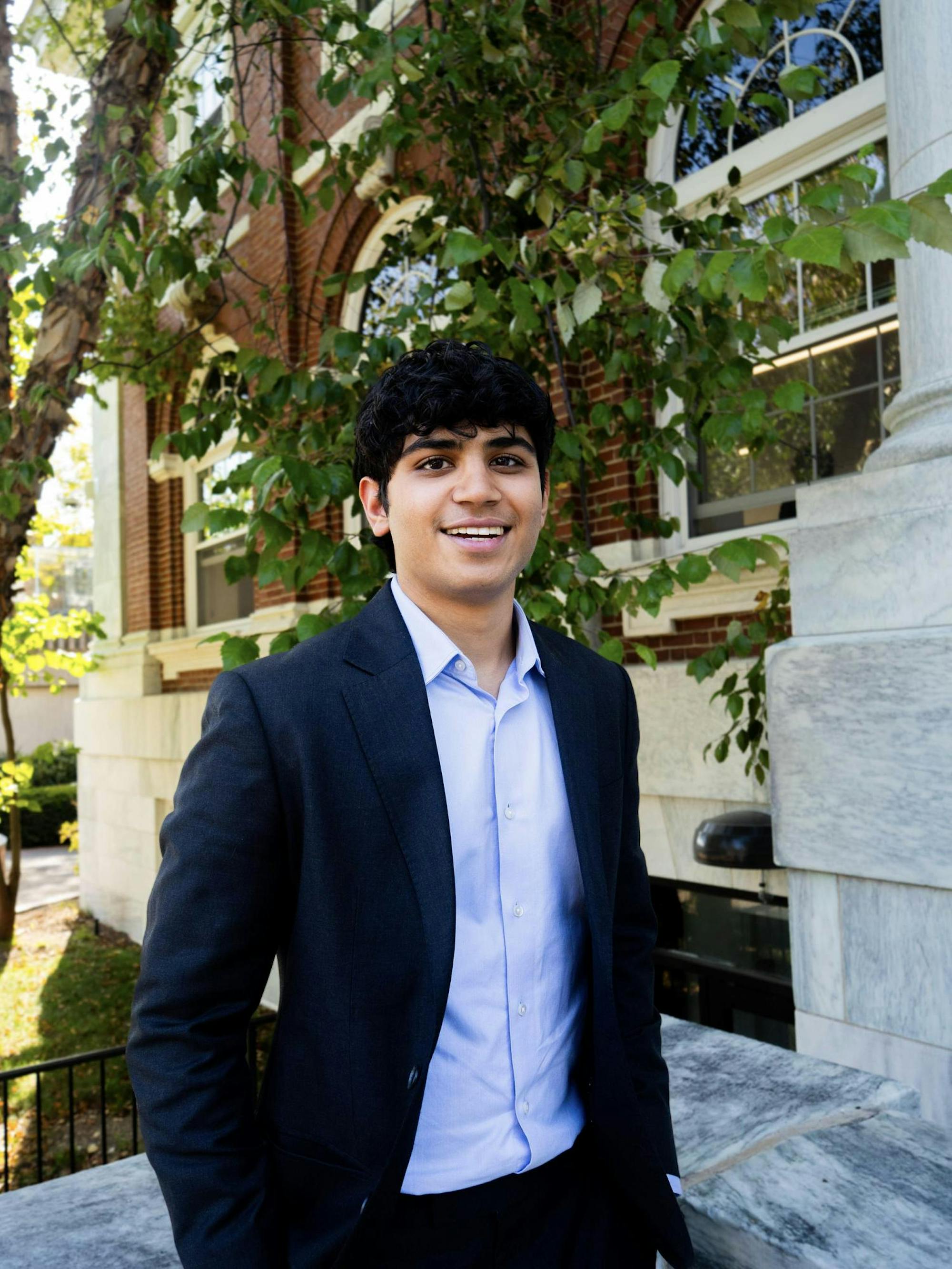
If you’ve been consistently reading the Daily, or even if you’re just knowledgeable enough about campus happenings, you probably know who graduating senior Dhruv Sampat is. As the president of the Tufts Community Union Senate, he’s been featured in the Daily on several occasions and often shows up in other events and coverage.
Every Tufts commencement features the Wendell Phillips Speaker, named after the attorney who advocated for women’s and native peoples’ rights. The speaker is a student in the graduating class who “demonstrates both marked ability as a speaker and a high sense of public responsibility” according to the Tufts University Chaplaincy website. It makes sense that someone like Sampat, who has been a visible part of the Tufts community, ended up in this role.
“It means the world to me,” Sampat said. “I view it as an opportunity to celebrate every single one of my peers that is graduating and the work that we have all done, to better the Tufts community and to better the world. … [It is also an opportunity to] leave people inspired and remind people that this is one of the early examples of a very, very strong community that we have in our life that is never going to leave us.”
The importance of community and its inherent values have always been important to Sampat, even before he entered Tufts. A key part of deciding where he wanted to study included the overall ethos of a school, but especially how civic-minded its student body was.
“The quality and ideology of my peers was very important to me, not in the sense of having everyone that agrees with you about everything, but having a very civic-minded student body that may be studying very different things,” he said.
Sampat has been involved in student government for all four years he’s been at Tufts, starting out on the TCU Treasury before making the leap to presidency. It is interesting to note, however, that Sampat had no intention of joining the Senate before college. Throughout his four years, his focus has been on an “open-door” policy: to meet as many students, faculty members and administrators as he could.
What exactly does Sampat do as president? He describes the job as diverse, with roles including setting the year’s agenda for Senate, establishing goals for senators and assisting in relations between the Treasury management and clubs. On what drew him to the Senate in the first place, Sampat touched upon how it connected very well to what he was learning in classes.
“[Senate] was everything that I was studying in my classrooms in a very practical way, allowing me to actually really identify and have the conversations that are being had on a global stage, on a much more localized stage at Tufts,” he said. “Senate has really shaped who I am as a person and has really helped me find my people at Tufts.”
Sampat’s focus on connecting with people throughout his time at Tufts also reflects in his speech at this year’s commencement ceremony. For him, it’s important that his speech reflects a shared experience, rather than just his own, at Tufts.
“A lot of my inspiration is drawn from the conversations I’ve had with peers over the years, the engagement I’ve made in classes with faculty members, the discussions we have had as a community at large,” he said.
There are still personal touches in his speech that reflect on his own experiences.
“There’s a personal aspect and a personal element to it of my early days in India and a lot of the cultural practices that grounded me during periods of intense conflict and polarization,” he said. “I wanted to share with the community how we’ve all been practicing some of those methods without realizing that we’re doing so, and how we’ve come together to really master being able to find our way back as a community to one another after periods of intense polarization and … intense disagreement.”
Sampat’s process for preparing his speech, which he described as “iterative,” continues to reflect the collaborative, community-focused nature of his time at Tufts. Sampat has been constantly sharing his drafts with peers and friends, building off their feedback to ensure that the speech shares an experience as accurate as possible to the Tufts community. His preparation also involves physicality and memorization in order to help the speech emphasize the values it represents. He also finds places in the speech where he can put more humorous, lighthearted moments. Overall, it still comes back to making a speech that can relate to as many people as possible.
“It’s not only students; it’s such a big day for parents, for family, for friends, also for faculty members and for administrators,” Sampat said. “It’s really supposed to bring everyone together on that one day and leave everyone feeling good, but also leave everyone feeling like they can all depart from Tufts with one unified learning and goal.”
Sampat will be graduating one day after delivering his speech, and with graduation comes an often-complicated, bittersweet mix of emotions.
“The thing I will miss most is walking into the campus and knowing almost every face there, and being able to say hi to everyone and just talk to friends, talk to colleagues, talk to peers, ask how everyone’s doing,” he said. “In a sense, you also feel very grateful to Tufts for making you feel so safe and comfortable that you feel like you’re ready to also go out into the real world. And that, I guess, is what the point of college is.”
He hopes that regardless of these feelings, graduation is still a happy, celebratory moment for everyone.
“This speech has also really helped recap … what each year has meant to me, what the challenges that our class as a whole face every year,” Sampat said. “It’s been a lot of thinking about what has bothered this class, what has inspired this class, what has frustrated this class, what has angered this class, what has made this class happy. And that … has also made it easier for me to process the fact that I am graduating, but also makes me happy that there’s always the Class of 2026 and the community that we built here that will have our back.”