
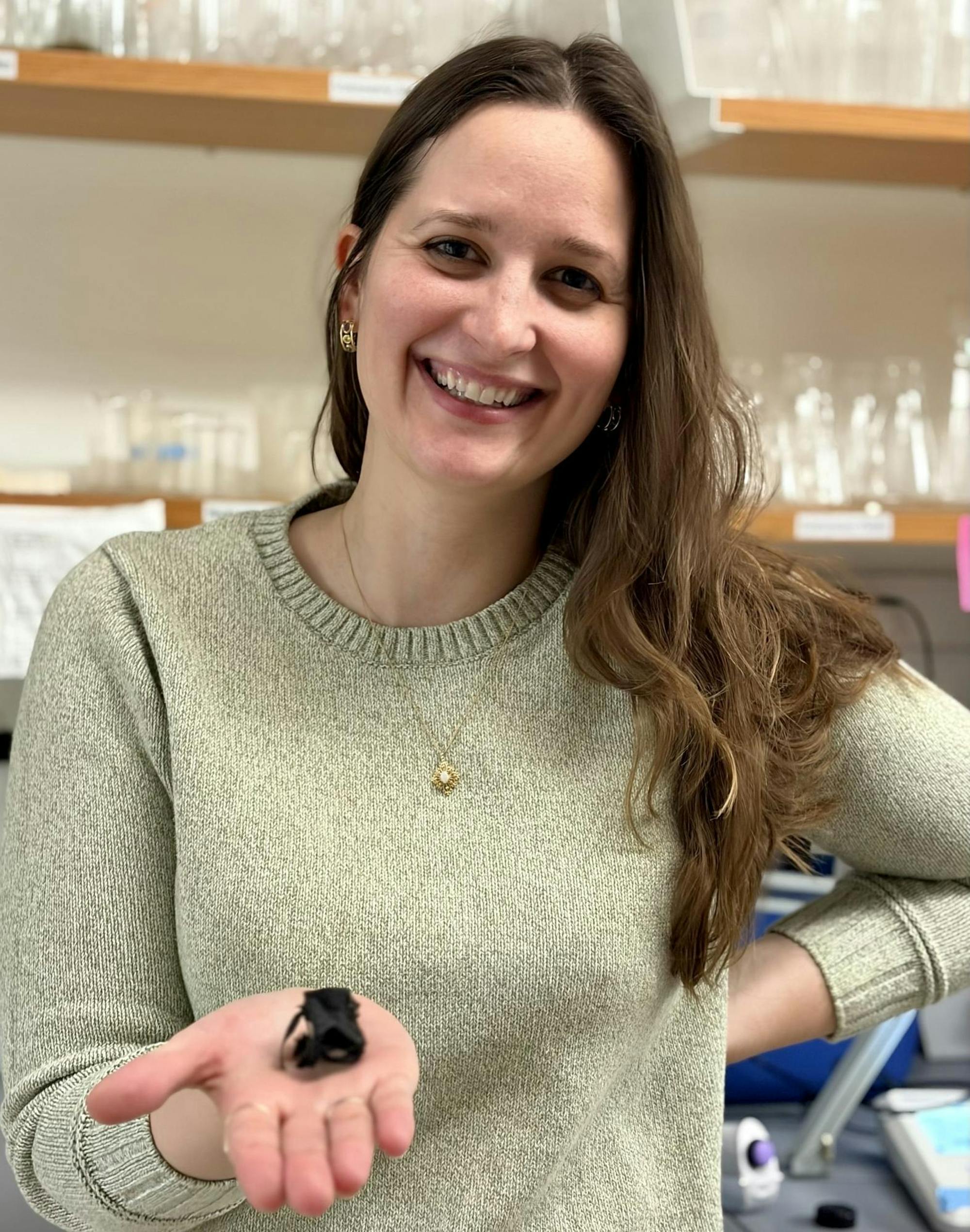
Rachel Riccio, a graduating Ph.D. student in the Romero Lab at the Tufts Department of Biology, tracks birds’ stress through temperature.
Riccio got her Bachelor of Science in Ecology and Evolutionary Biology from DePaul University in 2016. Originally a pre-veterinary student, Riccio has always been interested in animal welfare. After an internship at Lincoln Park Zoo following her junior year, however, she realized she wanted to work in animal research and conservation instead of veterinary medicine. This internship, in which Riccio monitored animal welfare via the ZooMonitor app, taught her how technology is currently being used in animal settings. After subsequent research into ocular herpes, often driven by herpes simplex virus type 1, and work in conservation spaces, Riccio recognized the disparity in technology between animal conservation and human research and medicine.
This realization led Riccio to Michael Romero and his lab, which studies the interplay between stress response and survival in vertebrates. Riccio’s dissertation focused on the continuous monitoring of house sparrows to determine peripheral temperature changes in response to stress. The first part of this process was the development of effective temperature sensors, for which she partnered with engineers at Tufts’ Sonkusale Research Labs.
Once the sensors were developed, Riccio and her team investigated the magnitude and timing of cooling after stress exposure in a cohort of house sparrows. The continuous monitors the team developed, which demonstrated success on a free-flying bird, allowed them to track temperature while the birds were moving. This work added to results generated by thermal imaging of stationary birds while building a model that more accurately reflects the birds’ natural conditions.
Riccio found that by about 120 seconds after the introduction of a stressor, house sparrows will cool from their baseline temperature of 30 degrees Celsius to 32 degrees Celsius. The extent to which they cool depends on the individual, with three general cooling classes represented: weak, intermediate and strong. After cooling, about 300 to 360 seconds after the initial stress, peripheral temperature overshoots the baseline. The magnitude of the overshoot is also variable.
Next steps for Riccio include investigating this variability by examining whether factors like sex and experimental group impact cooling. She also hopes to monitor birds in their natural environment to determine what actually causes them stress. An understanding of this question could inform whether and how humans should intervene.
“Fine-scale physiology is a gap we are trying to fill,” Riccio said.
She, along with her collaborators Surya Varchasvi Devaraj and Leah Berube from the Sonkusale Research Labs, aims to turn their featherweight devices into a business venture.
Riccio, Devaraj and Berube were selected for the E-Team Program by VentureWell to aid in this pursuit. This $5,000 grant is awarded to teams for innovative thinking and the use of science and technology to create solutions to unmet challenges. It provides resources, networking opportunities and business training for its awardees — something “scientists don’t always have,” Riccio said.
Outside of this grant, Riccio is applying to post doctoral fellowships to continue her work. She hopes to secure her own funding, develop her own goals and work her way up the ladder to become an independent researcher.
Riccio’s favorite part of the Ph.D. process — and what she found most difficult — was navigating how to approach an experiment that did not go as planned.
“Being able to ... grow and pivot and figure out how to reach the goal, even if it’s not the direct path you thought it would be ... was cool,” Riccio said. “I still accomplished what I set out to, but it was in a little different way and a little different path.”
Her advice to new Ph.D. students is to “keep moving forward.” She encourages them to make use of available resources and ask for help.



