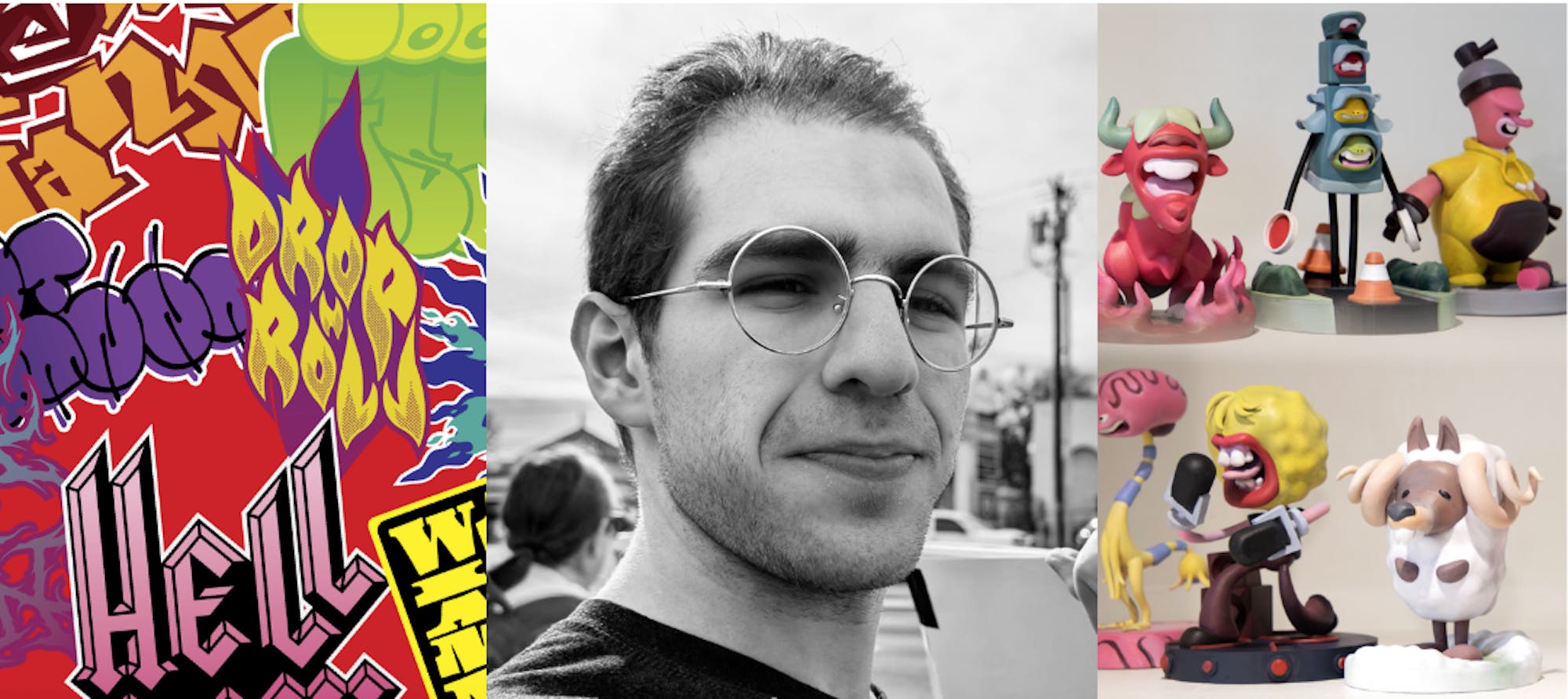
When Zak Goldstein was around 4-years-old, he built a model solar system out of ping pong balls with his dad. Today, he’s wrapping up his senior thesis at the School of the Museum of Fine Arts at Tufts University.
Although his work has evolved, the notion of art as play continues to guide his process. Goldstein remembers his grandma taking him to a game store in his hometown, where he was inspired to draw videogame characters.
“That infused my work with a sense of fun and vibrance that I still try to continue in today,” Goldstein said. “Enjoying the act of creation is really important to me and my process.”
For Goldstein, art school was a clear choice. “Since the point that I’ve been conscious, I’ve been making art,” Goldstein said. “I really didn’t have anything else that I wanted to pursue.”
Tufts specifically appealed to Goldstein because of the breadth of its curriculum. “I’m really interested in the mixture of the arts and the sciences. And [at] Tufts, in [...] SMFA, I was allowed to really take an interdisciplinary approach to art, and both get an academic background and be able to create art,” Goldstein said.
For example, Goldstein has taken two creative writing classes, one for poetry and one for fiction.
“As I’m writing, I feel like I’m kind of coming up with ideas for art pieces,” Goldstein said. “I feel like, when you get your mind in that headspace, you start generating ideas for other artistic avenues.”
Goldstein’s fiction writing professor, Joseph Hurka, is one of several professors that have influenced him. “He just really was passionate about us being passionate,” Goldstein said.
Goldstein added that students should “take the class based on the professor, not based off the course subject. … A great professor can make an awful class interesting, and an awful professor can absolutely ruin something that you’re passionate about.”
While exploring academic disciplines, Goldstein also explored artistic mediums. “I had a preferred medium coming in, and now I do a little bit of everything,” he said.
His projects included creating an album cover for his vocal professor and an interactive piece for Mary Banas’ course, Type as Image.
“I was really interested in the idea of sticker bombing and graffiti … so we created these little stickers that all responded to the word stop. … And it was up for a couple months or so in the graphic art suite, and you can stick a sticker up on the stop sign,” Goldstein said.
Goldstein encouraged future and current SMFA students to take advantage of the opportunity to try new mediums.
“I feel like there’s a lot of room in this world to get stuck in doing the same thing. And there’s nothing wrong with that. But, I feel like if you are given the opportunity to try something new, there’s really a chance there to expand your sights on art,” Goldstein said.
Goldstein hopes that his thesis will encompass the range of his studies.
“The whole idea of the senior thesis project [for me] is to be an unconventional portrait of all of my interests over my college years,” Goldstein said.
His thesis centers around a series of vinyl or 3D-printed figurines, but it doesn’t stop there.
“I’m doing a whole branding and marketing project where I’ve designed posters and boxes and a book,” Goldstein said, adding that he is “a big fan of not just having fun with art, but also making stuff that’s commercial and marketable and sellable.”
Goldstein has always been interested in toy design, especially since high school. Early inspiration for the project include the books “I am Plastic: The Designer Toy Explosion,” and “I am Plastic, Too” by Paul Budnitz, which Goldstein read close to 10 years ago. His coursework at SMFA sealed the deal: “In taking some 3D classes, I was like, ‘Why don’t I do this myself?’”
Goldstein’s procedure for creating his thesis reflects his general process.
“I start with a lot of ideation. I never really go into things blind,” Goldstein said. “I have like 10 or 20 pages of sketches somewhere, just kind of figuring out what the art toys would look like.”
After graduation, Goldstein plans to pursue a career in graphic design. His interest in the field “flourished at SMFA” thanks to classes like Triton Mobley’s [En]Coded Type: Computational Craft, Digital Terrains + Motion Designed Space and Chantal Zakari’s artists’ books class.
“I think it’s the media that stresses me out the least. Not that graphic design is easy, but compared to illustration, it’s a little bit less labor intensive,” Goldstein said.
In addition to graphic design, Goldstein is considering a side gig in medical illustration.
“I’ve been really interested in medical illustration since high school. But even then, if we’re talking about planets and scientific illustration, then I’ve been interested since I was 4-years-old,” Goldstein said.
He had the opportunity to explore this interest through an internship at a hospital in Dallas.
“I really loved just getting to try something new, getting to be around a bunch of doctors and [feeling] like I was part of an advancing team,” Goldstein said, although he acknowledged that it was intimidating to be the youngest person at the hospital.
Based on his experiences interning with the hospital and with the Nasher Sculpture Center in Dallas, Goldstein encouraged students to take advantage of opportunities to explore career paths while at college. “You’ve got time,” he said.