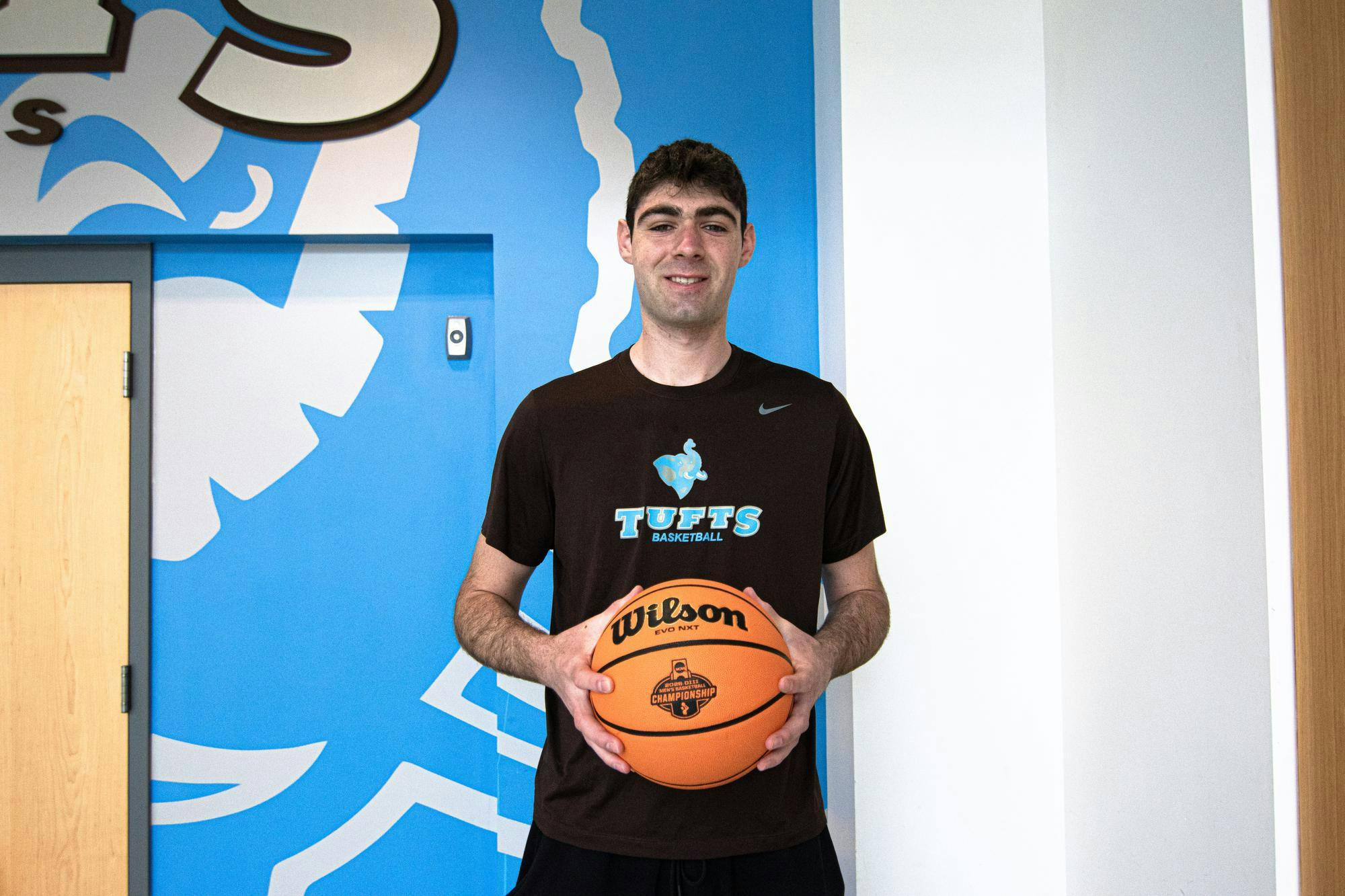
Graduating senior Joshua Bernstein did not have much time on his hands during college. Both a student athlete and start-up founder, Bernstein managed to balance a schedule most would be stressed to look at.
The star center from Miami is a big reason why the Tufts men’s basketball team has been as dominant as it has been these past four years.
Most would assume that a talented player like Bernstein must have been playing basketball since elementary school, but Bernstein did not start until his sophomore year of high school. He never thought about getting recruited, and his choice in college was influenced by academic merit alone.
“I had no idea Tufts basketball was good. My choice was completely school driven,” he said.
The summer before coming to Tufts, Bernstein played in the JCC Maccabi Games in Israel as an 18U. Afterwards, he was approached by multiple agents, making him realize he could play basketball professionally.
In his first season as a Jumbo, Bernstein played in 23 games and started in one. He came out of the gate as a strong contributor to the team, averaging 5.5 points and 4.4 rebounds per game — even putting up a double-double in points and rebounds during an NCAA tournament game. Despite being a first-year, he led the team in 32 blocks during this season.
Bernstein’s sophomore season included some of his favorite moments on the men’s basketball team. He started in 26 games and played in 28. He increased his overall averages with 8.6 points and 7.4 boards per game. Again, Bernstein led the team with 59 blocks — the most on the team. His 2023–24 season blocks are recorded as seventh most in Tufts history. A standout in the NCAA first round game with 14 points, Bernstein helped lead the Jumbos to victory.
According to Bernstein, his favorite memory during this season was easily the NCAA second round game, which the Jumbos won against New York University. The game happened in New York City, allowing many local Tufts alumni to come watch the game. His favorite part was when the alumni came into the locker room and celebrated with the team. Even talking about it later, the smile he had recounting this memory lit up his face.
Bernstein started all 27 games during his junior season. He averaged 9.4 points and 6.9 boards per game, helping lead the team to the NCAA tournament again. For a third time in a row, he led the team in blocks. His 60 blocks in the 2024–25 season is now recorded as fifth most in Tufts history — one of two athletes to have two seasons in the top 10. During the first round tournament game against Yeshiva University, he earned a season high of 19 rebounds. Tufts made it to the second round of the NCAA tournament during this season — much of this success attributable to Bernstein.
In his senior year, Bernstein started all 29 games with 11.6 points per game on average. With an outstanding performance this season, he led the Jumbos in field goal percentage, total rebounds and blocks, leading him to be given the All-NESCAC Second Team recognition. Bernstein considers the final season his favorite, expressing how going to Fort Wayne, Ind. for the NCAA quarterfinals was very special.
Excited that the team reached the quarterfinals this season, Bernstein acknowledged that it was a shame to lose to Trinity College. However, he stated that the loss was “nothing to hold our heads on.” For the last four games of the season, he had the mindset that each game could be his last. Having a great career and being the part of one of the most successful classes in Tufts history, Bernstein is grateful for the college experience he had at Tufts.
Bernstein remarked that he felt this season was his strongest. When speaking on how his style of playing progressed over the past four years, he answered, “I think it’s just confidence.”
“It hasn’t changed in what I can do. What I actually do [is go] back to the basket post player and [be] a shot blocker. This year, I realized how consistent I could be and [that’s] mostly because the coaches and teammates of the past four years supported you for what you could be,” he said.
His big support has been from head basketball coach Brandon Linton.
“He’s such a good guy. Honestly, it’s hard being a coach handling the team and a team player,” Bernstein said.
Bernstein’s favorite piece of advice from Linton is, “Don’t get too high, don’t get too low.” In Bernstein’s words, it means: “When you’re doing well, don’t lose perspective, and don’t get too down when low.”
Bernstein isn’t just a basketball player, however, as he also co-founded a start-up during college. For Bernstein, balancing his business, basketball and academics proved challenging. He felt his mind was always elsewhere.
Bernstein emphasized the importance of not burning out. Prior to his first-year season, the captain told him to be prepared for the grind. Now, Bernstein understands that it really is a grind, and the only way to get through it is consistency.
“At the end of the day, the main thing is the college experience and playing basketball,” he said. “There’s time for everything else. Whatever time it is, be in that moment.”
Looking back on his time here, Bernstein highlights that what he will miss most about Tufts is the people.
“I live in the basketball house. I’ve met the coolest and smartest people [on this team]. I want them at my wedding and [to meet] my kids when I grow older. I will be staying in touch with them for the rest of my life, honestly,” he said.
Bernstein’s future right now is still up in the air, with many options and opportunities at hand and his entrepreneurial successes preparing him well for the future. In 2025, he won the Montle Prize — awarded to three accomplished student entrepreneurs each year by the Derby Entrepreneurship Center at Tufts. This past April, he sold his company and was awarded $10,000 for “Most Progress in a New Venture.”
The computer science major is still evaluating his options. No longer having to run a business, he is deciding between playing basketball professionally overseas or working a regular nine-to-five.
Not many people can say they have both competed in the NCAA as well as successfully founded — and sold — a start-up by the end of college, but perhaps this is what happens when the rare few use the intersection of talent and ambition to chase their dreams.