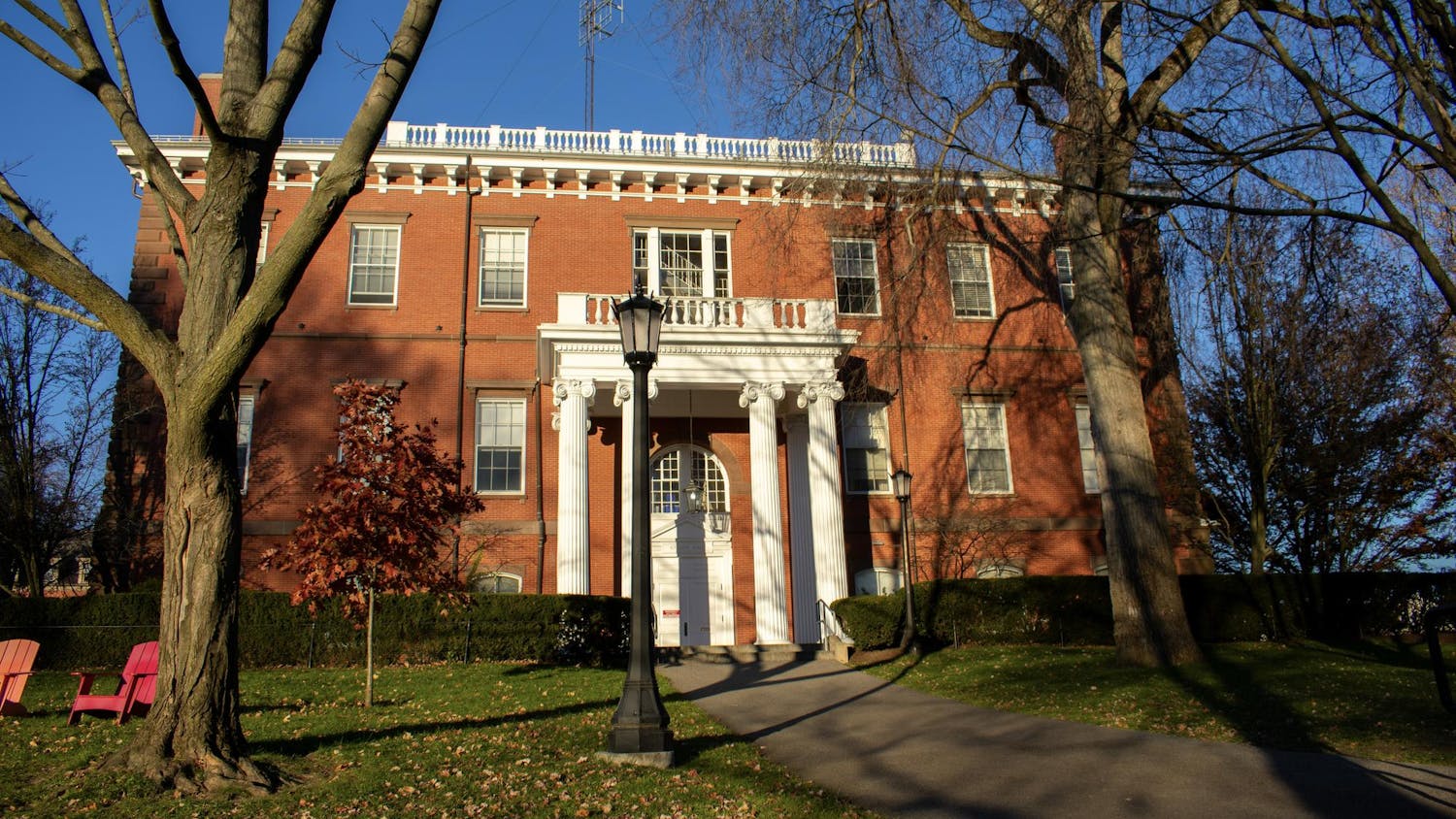
Documentary filmmaker Ken Burns and his colleagues received the annual Constitutional Commentary Award during a live webcast in Ballou Hall's Coolidge Room yesterday as part of a presentation from non-profit think tank The Constitution Project (TCP).
Burns, whose documentaries have won twelve Emmy Awards among other honors, received the award for the film "The Central Park Five" (2012). The film analyzes the controversial 1989 Central Park Jogger case in which five non-white New York City teenagers were convicted of raping 28 year old Trisha Meili. Two of the convicted teenagers served over a decade in prison, only to have their convictions vacated in 2002 when the actual culprit, Matias Reyes, confessed to the crime.
The event was hosted by the Office of the President, the Office of Academic Affairs for Arts and Sciences, the Jonathan M. Tisch College of Citizenship and Public Service, the Department of Political Science and the Communications and Media Studies Program.
In presenting the award to Burns, TCP President and Founder Virginia Sloan cited this case as one of many instances in which innocent suspects have been imprisoned for crimes they did not commit and stressed the urgency of combatting this issue.
"Twelve hundred people are wrongly convicted every year in the United States, and 140 people are forced to make false confessions," Sloan said. "When an innocent is convicted, no one wins. The innocent lose their freedom, and the guilty get to keep preying on their victims."
Burns accepted the award with much gratitude, saying it was particularly meaningful to receive this prize on behalf of The Constitution Project, and spoke of how significant it was for him to highlight the value of the U.S. Constitution through documentary projects such as "The Central Park Five."
"The Constitution is in every one of my frames, in every single film I've done," Burns said.
Several excerpts of the film, showing interview footage from numerous parties involved in the case, were screened during the presentation. Moderator Carrie Johnson as well as panelists Executive Director of the Mid-Atlantic Innocence Project Shawn Armbrust, Distinguished Professor of Psychology at John Jay College of Criminal Justice Saul Kassin and retired detective Jim Trainum joined Burns on the webcast to further address the film's message about wrongful convictions.
Johnson, a Justice Department correspondent at National Public Radio (NPR) in Washington, D.C., spoke of the importance of addressing the issue of dishonest judicial systems. She argued that the five men implicated in the Central Park Jogger case actually proved far more fortunate than the profound majority of unjustly convicted felons in that they were ultimately exonerated.
"In most cases of wrongful convictions, that is usually not the outcome," she said.
Trainum, a retired detective of the Metropolitan Police Department in Washington, D.C., spoke about ways to limit the obtention of false information during trials, which he believes occurred during the Central Park Jogger case.
"Videotaping does not prevent false confessions," Trainum said. "Instead, it can lead to the unintentional contamination of confession evidence as obtained by the police."
Kassin explained that false confessions have been made throughout the history of the United States, including during the time of the Salem Witch Trials. He said he was optimistic that "The Central Park Five" would help raise awareness of this serious issue, but he also hoped that viewers would not take the events of the film to be an isolated incident.
"I was worried that this story was so compelling that people would walk away with the impression that this was a unique, one-time-only event," he said. "In reality, this is the tip of a much larger iceberg."
Burns expressed his admiration for the resilience that the five wrongly-convicted men in his film have displayed over the years.
"The PTSD they experienced from this will never go away," he said. "No amount of money or any apology can change that, and yet they plough on."
Burns said that he hoped his film would bring this infamous case back into public dialogue and lead to heightened efforts for improved accountability during trials. He also hoped that the film would rid viewers of all doubt regarding the five defendants' innocence.
"You can start watching this film thinking they're guilty," he said. "I defy you to leave the film thinking they're anything but completely innocent."