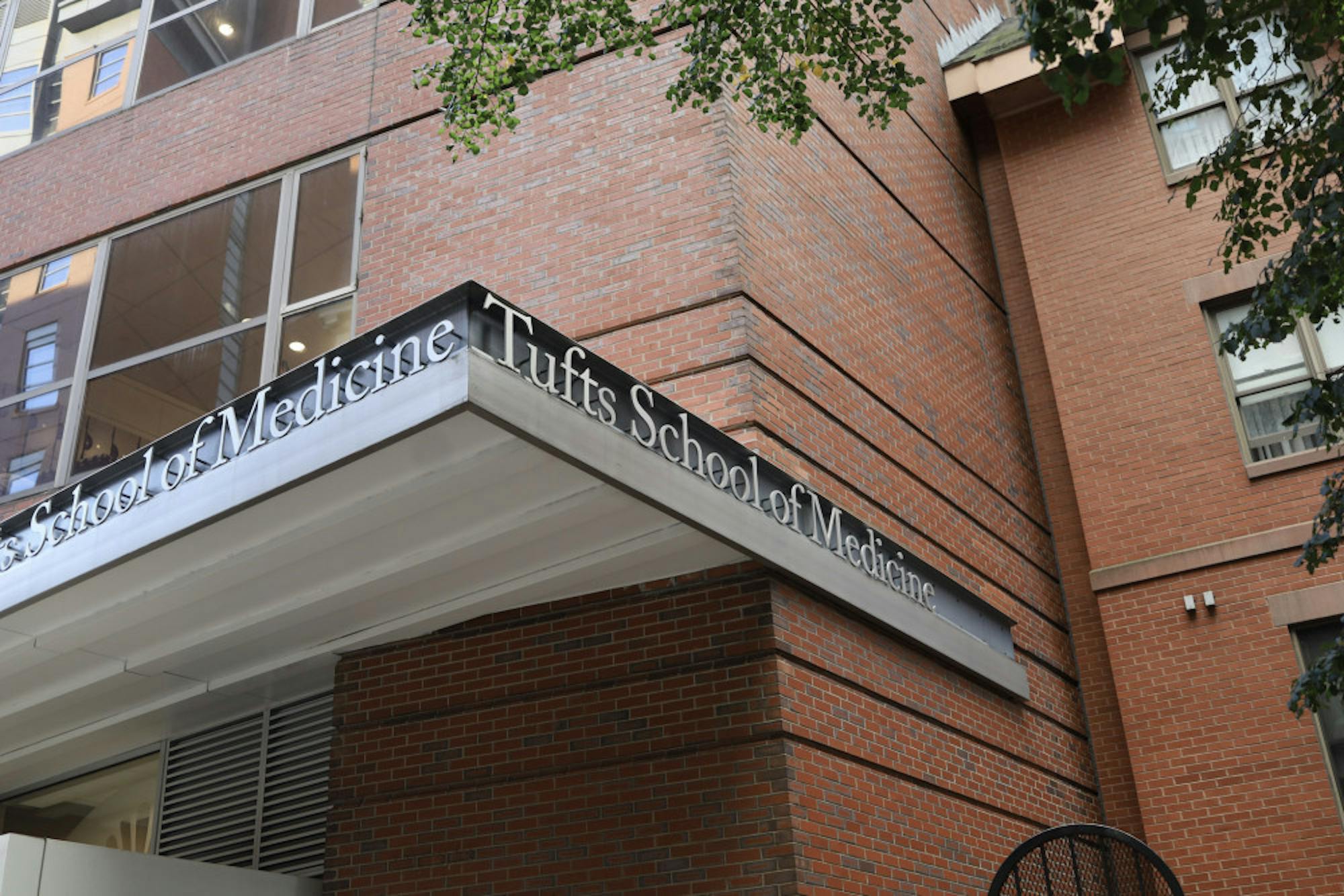
Health and Human Services Secretary Robert F. Kennedy Jr. and Education Secretary Linda McMahon announced on March 5 that 53 medical schools, including the Tufts University School of Medicine, had signed on to Kennedy’s federal nutrition training initiative.
The initiative requires that schools review the amount of nutrition training they currently provide, appoint a faculty member to oversee nutrition education and outline plans to provide at least 40 hours of nutrition education to medical students.
Many of the nation’s top-ranked institutions, such as Harvard Medical School, Johns Hopkins School of Medicine and Duke University School of Medicine, did not sign on to the initiative. Tufts is the only medical school in Massachusetts to participate.
In a statement to the Daily, Tufts School of Medicine Dean Helen Boucher said the university’s decision to participate is largely due to its current curriculum.
“Our existing curriculum aligns closely with the nutrition education milestones outlined by HHS,” Boucher wrote a statement to the Daily. “Supporting a robust nutrition curriculum in medical education is essential because nutrition is one of the most powerful, evidence-based tools for preventing and managing chronic disease.”
Evaluation of graduates’ preparedness for patient care in relation to nutritional programming is done through rigorous evaluation of every course and assessment of students’ knowledge, skills and attitudes about nutrition in the clinical setting during clinical clerkships, according to Boucher.
The annual Graduate Questionnaire is also administered, which not only asks graduates for extensive feedback on the curriculum but can also serve as a measure of “graduates’ preparedness for patient care.”
Boucher added that Tufts currently meets the required 40 hours of nutrition instruction across its four-year curriculum and “has deeply integrated nutrition into its curriculum.”
“There is no planned change to the already excellent nutrition education that has been taught and assessed at the School of Medicine for decades,” she wrote.
Tufts’ nutrition training is also supported by the Friedman School of Nutrition Science and Policy, the only standalone graduate school of nutrition in the U.S..
Christina Economos, dean of the Friedman School, said medical schools nationwide should treat nutrition as a core component of training.
“In an ideal national model, every medical school would provide meaningful, comprehensive nutrition education—not as an add‑on, but as a core component of medical training,” she wrote in a statement to the Daily.
She added that continuing medical education offerings should be available so that practicing clinicians “can stay current with rapidly evolving nutrition science” and that national nutrition competencies should be updated regularly to ensure training remains “relevant and evidence-based.”
Economos said Friedman School faculty could support expanded nutrition requirements at the medical school by scaling the culinary medicine course to reach more students, providing additional experiential learning opportunities and broadening the existing curriculum to include content from molecular mechanisms to policy implementations.
“We have both the expertise and the commitment to partner with the School of Medicine in strengthening nutrition education across the training continuum,” Economos wrote.
Aviva Must, a professor of public health and community medicine at the School of Medicine and a professor at the Friedman School, wrote that the School of Medicine has included nutrition education in its MD curriculum for nearly 70 years.
Must added that the existing curriculum covers virtually all of the dozens of competencies outlined by an expert panel whose recommendations were published in JAMA Open Network in 2024, and that many of those recommendations are reflected in the current administration’s initiative.
Despite her support for nutrition education, Must raised concerns about the federal government’s involvement in medical school curricula.
“I have grave concerns about the federal government wading into curricular matters that have long been the purview of the professional schools and the universities of which they are a part,” Must wrote. “I am further concerned about the proximity of this call to medical schools at a time when universities are being pressured and threatened by the current administration in realms unrelated to health professional training.”
She also noted that evaluating the initiative’s long-term impact on patient care would be difficult given the many factors that influence quality of care. But adding nutrition-related content to licensing exams such as the USMLE Step 1 could serve as a potential measure.