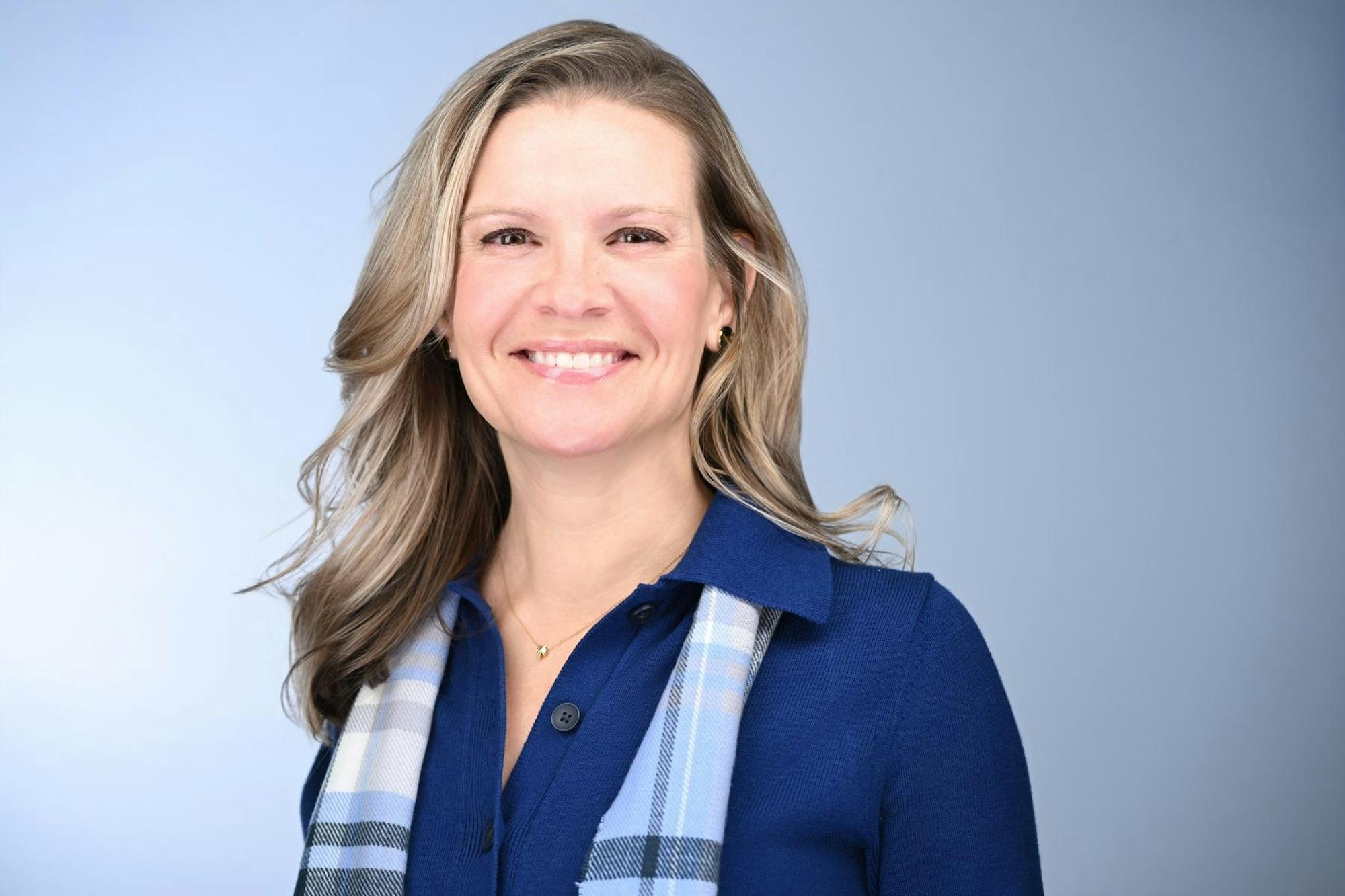
Mayor Breanna Lungo-Koehn met with the Daily to discuss her initiatives and remaining goals for the city as she begins her fourth reelection campaign for Mayor.
Editor’s note: This interview has been edited for length and clarity.
The Tufts Daily (TD): You’re currently in your third term as mayor of the city of Medford. What would you say your accomplishments of this term have been?
Breanna Lungo-Koehn (BLK): With the help of the past and present superintendents and the [Medford] School Committee, we applied for our third phase of the [Massachusetts School Building Authority] process to develop a new Medford High School.
Another big accomplishment is working really well with the school committee and the city council, realizing that cutting budgets year after year is not the right thing for children and staff — especially our teachers — and so working together to get rid of some things that we felt we weren’t spending the best money on and then to be able to support an override this past November.
I think probably one of the biggest [accomplishments] is charter review.
TD: Now that [the charter has] been approved, do you think it properly represents the needs of Medford citizens, and what impeded the charter from getting passed in the first round of the process?
BLK: I don’t love every single piece of it, but I think it’s definitely a strong document that is going to help govern the city, assuming it passes. I’ll be campaigning for it to pass in November. It’s long overdue.
It’s one of the biggest accomplishments that I set out to do when I became mayor, and even beforehand. There’s things I conceded with. The council wanted the mayor [removed] as chair of the school committee, so did members of the school committee. I did concede there, the mayor will be just a voting member, but will not be the chair. One thing I really held strong [on] was something that I know that many campaigned on, and that the community really wanted based on the survey, and that the charter study committee really advocated for, which was ward representation.
TD: Where would you say there’s room for growth and development, for the city and for you as a leader?
BLK: We want to just make sure we can budget correctly so that we don’t need an override any time in the near future. Keeping up with our streets and sidewalks, creating a plan to rehab our streets and sidewalks to replace all the lead lines — that’s a huge undertaking. It’s going to cost close to $50 million to get done. We just got a loan, hopefully partially a grant from the [Massachusetts Water Resources Authority], to do $8 million of that work, as well as our water and sewer infrastructure that is over 100 years old. We also just [went] out to bond for almost $30 million for the [heating, ventilation and air conditioning] systems for [McGlynn Middle School and Andrews Middle School] because those were in really bad shape. Being able to have somebody in office as mayor to be able to budget all these large undertakings is going to be extremely important.
TD: The city’s finances were a major point of discussion during the 2024 election with the override votes and were cited as a reason that the city needed those votes to pass. What else will you be doing to ensure that the city can have a strong economy and municipal budget in the near future and in the long term?
BLK: It’s not easy because of inflation and the rising costs. We’re struggling through the city side budget now. We’re in decent shape, but we still have a gap to fill, and that is mainly because health insurance continues to rise at a rate that is beyond what we can afford, with still-expanding city services. Our health insurance is up 10% this year, which is $2.5 million, and then our new waste contract is up $1 million.
It’s just a matter of trying to budget right, and trying to work with our [Office of Planning, Development, and Sustainability] and our assessing department to capture our new growth and continue with the development that we’ve started.
There’s so many new businesses wanting to come to Medford. It’s just about being on the phone and having meetings constantly to try to bring in new development to the city.
TD: Consistently throughout your years as mayor, various unions have criticized your performance and just your relationship with them. The leaders of many of these local unions claim that you don’t have their interests in mind or the consideration to engage in bargaining. The fire union, police patrolmen and teamsters union are the most prominent voices. What has caused this upset, and how do you plan to address these concerns?
BLK: Teamsters and fire are resistant to change and accountability, so they definitely have pushed back when we try to hold them accountable. But the fire contract settled, and there’s a new union president, so we are working much better together. The Teamsters, they’re great. We have two new reps that once they came in, we negotiated almost every contract except one. We had a gentleman who was keeping requests at around 9% a year just for the last election, to try to say that I wasn’t settling contracts. A lot of it has to do with politics — that gentleman runs, usually, my opponent’s campaign.
The police are asking for what the fire and the teachers received, plus a 2% post each year. So it’s just about affordability. The attorney that represents the police, the patrol and the superiors is just adamant that they should get 6% extra for those three years than everybody else. It’s about balance and figuring out what we can afford.
TD: The new Tufts dorm has ruffled feathers among residents. Some Medford residents are frustrated that Tufts has in recent years created an imbalance of power with municipal governments. Do you think that power balance exists in a significant way?
BLK: I know that Tufts was amazing to us when [the COVID-19 pandemic] hit, and Tufts helping us was the reason that our students got back into the classroom sooner. I did push back on the dorm a bit, because I felt like [the fact that] the residents that were going to be shaded for pieces of their days was pretty unfortunate. The [University] President [Sunil Kumar] and myself chatted a few times and they created a fund of $500,000 to support those residences, and residents that are going to be mostly affected by this dorm. They also upped their $250,000 donation to the Affordable Housing Trust to $500,000, so there was some negotiation there.
In the end, I didn’t have control. It was the [Community Development] board, but I continued to say, “I wish that you didn’t switch your plans from seven stories to 10 stories in somewhat of a last minute fashion.” It doesn’t sit well with me that there was that switch just months before they needed that vote. But I continue to work as best I can with [Kumar] and our government relations team, because I believe that Tufts is an asset to Medford, and I hear the residents when they say that Tufts should do more.
TD: What would you say your biggest campaign goals will be in this election?
BLK: Completing Medford Square, completing the high school, completing the HVAC project, finishing and making sure that the charter gets on the ballot and then implemented correctly, working through a plan for streets, sidewalks, lead service lines, water and sewer infrastructure.
We also want to continue with our green energy goals. We’ve expanded our [electric vehicle] station network. We are expanding our Blue Bike network. We have renovated almost every park in the city, one way or another, from a basketball court to a full $8 million renovation up at Carr Park that is underway — it’s completely dug up, and that will be another year before it’s complete. So seeing that come to fruition and continuing to rehab our open spaces and our connector paths [is another goal]. Next up is trying to put some work into the school playgrounds because they’re 25 years old, if they have gotten some work like McGlynn, [which] just had a full redo, which is great. But then we have another four or five schools that need new play structures, new padding on the ground. We want to make sure we’re continuing to increase our tree canopy.
[We want] to get off paper and be more tech savvy.