
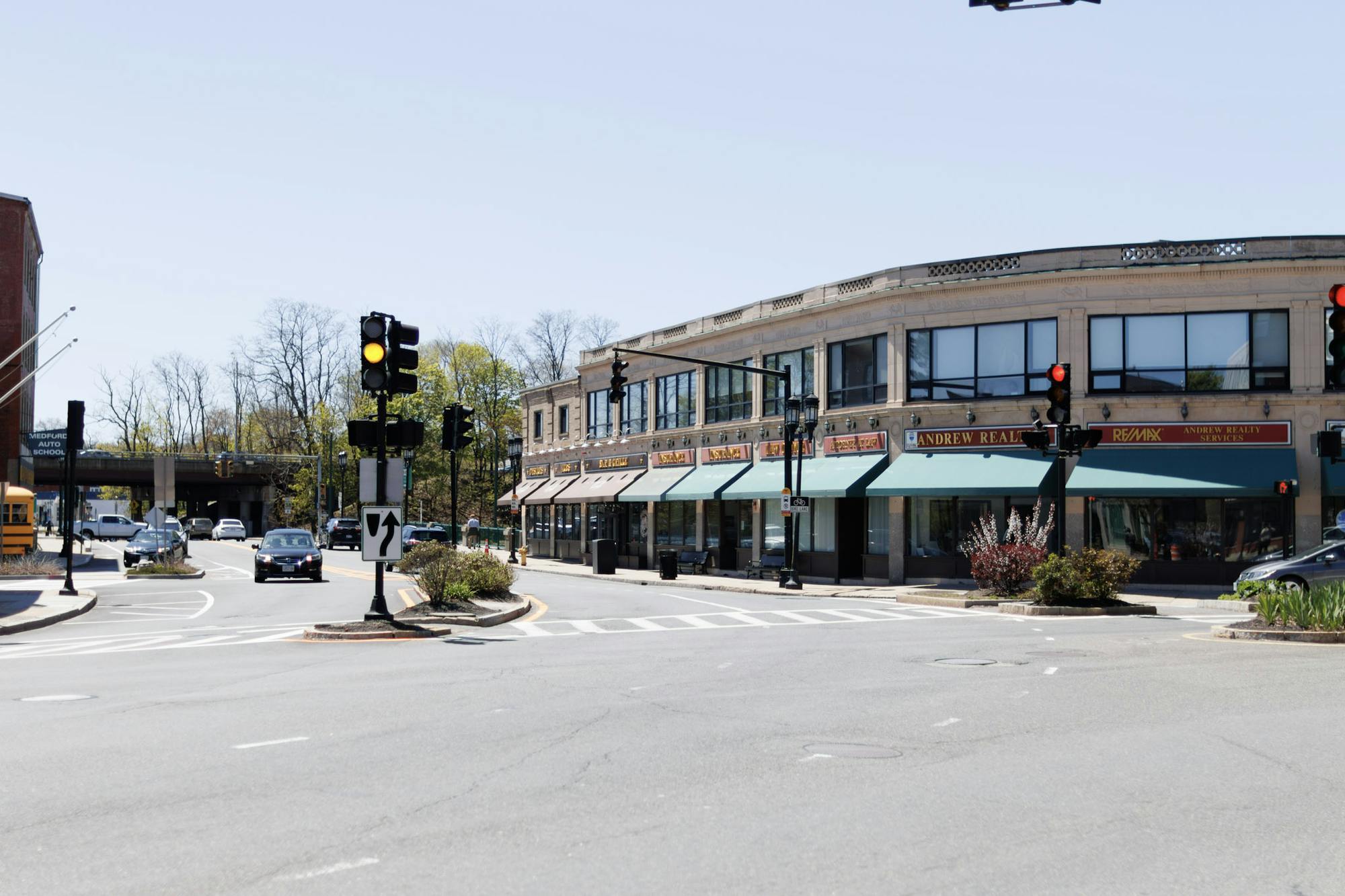
The Medford City Council’s Planning and Permitting Committee is reviewing a proposed update to the city’s Vacant Building Ordinance, aiming to reduce long-term commercial vacancies. Sponsors argue that such vacancies harm neighborhood vibrancy and stifle local business activity.
Under the proposed update, owners of vacant commercial or industrial properties would be required to register their property with the Building Department within 90 days of vacancy and pay a $1,000 registration fee. For each additional year the property remains vacant, this fee would increase by an additional $1,000.
Failure to comply with these regulations would result in a $300 fee for each day the building remains unregistered. In certain circumstances, such as financial hardship or an agreement to display public art, the registration fee may be partially or fully waived.
During the Committee’s Jan. 22 meeting, Councilor Matt Leming described the broader impact vacant buildings can have in cities like Medford.
“Even if there’s only a handful of properties that people talk about, they tend to be noticed,” Leming said. “They create harm to economic vitality, … reduce foot traffic and … generally contribute to a sense of blight.”
Councilors also argued that existing regulations lack sufficient penalties to discourage property owners from leaving commercial spaces vacant. As a result, some landlords may conclude that keeping properties empty is more financially advantageous than renting them out.
“What we’re seeing is a lot of commercial landlords who have made the calculation that it’s better for them to hold on to their property in case, in the future, someone who’s willing to pay higher rents comes around,” Councilor Justin Tseng, who helped present the updated ordinance to the Committee, told the Daily. “Or they’re holding on to their property because they think that they can get tax credits, … which they think that they’ll profit from more than renting the property. Even [though] it’s mathematically incorrect, … it’s a [misconception] that’s pretty common.”
Tseng worked with a team at Harvard Law School — where he currently studies — to draft the new ordinance. He emphasized that the updated version is intended to expand the city’s ability to respond to vacant properties, adding that he has received strong support from residents since introducing the proposal.
“This was something that there was a lot of grassroots support for,” Tseng said. “[Residents are] seeing that we’re taking in their concerns and feedback and adjusting for them in the ordinance text.”
Tseng also said that the updated ordinance could boost economic activity and cultural engagement in Medford Square and throughout the city, where he noted a lack of meeting and convening spaces.
“My hope is that this can really create much more economic vitality in our squares and improve the aesthetic appeal of … being in our squares and spending time there,” Tseng said. “The community events exception [and] the public art exceptions are really enticing options for landlords to take, and for the city to have as a real benefit to the community.”
Some property owners in the Medford Square area, however, raised concerns about the ordinance’s necessity and effectiveness. Kelly Catallo, the CEO of Realty ONE Group Cosmopolitan, located on Salem Street, said the proposed fines were excessive.
“Medford does not have a big vacancy rate on commercial storefronts,” she said. “We don’t have a huge [enough] vacancy rate in the City of Medford for people to be … saying, ‘We’re going to fine you all.’”
Catallo also believes the updated ordinance is unnecessary and that Medford’s existing vacant building policies are sufficient.
“We have fire laws for making places safe. We have building codes to make sure places are safe. We already have enough laws on the books — they just need to find the money to hire enough people to enforce those laws,” Catallo said.
John Veneziano, broker-owner of RE/MAX Andrew Realty Services in Medford Square, raised concerns about a lack of communication between city officials and property owners. He urged the City Council to engage directly with property owners.
“I always believe that you [should] speak to the people … you’re trying to work with instead of talking to … people [who] have nothing to do with the properties,” Veneziano said. “In revitalizing these areas, you need to speak to the property owners. You can’t just have surveys [or], in my opinion, … talk to everybody else [who has] nothing to do with the property.”
In response to the concerns about transparency and outreach, Tseng said he remains open to discussion and feedback by phone or email.



