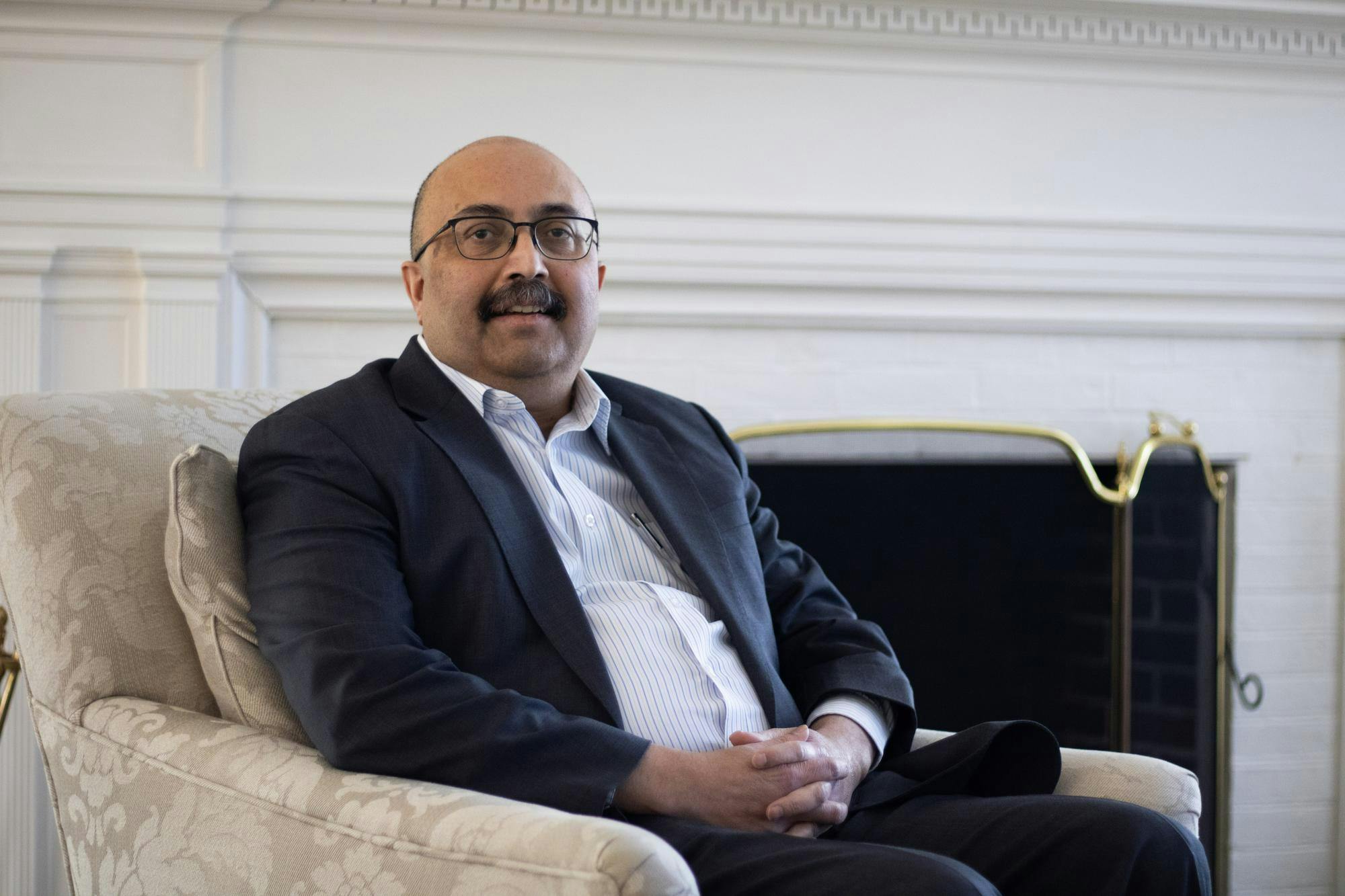
The Daily spoke with University President Sunil Kumar on Friday about his Beyond 175 plan, a blueprint for the university following its 175th anniversary in 2027. The plan was first announced in October of last year with a final working draft released in January.
This strategic plan is intended to provide a focused path for the whole university, not just specific schools. In the interview, Kumar discussed alternative sources of funding in light of federal changes, faculty activism movements, expansion of the university, tuition and student life.
Community members may submit feedback on the final draft to the Steering Committee via a form that closes at the end of the day on Feb. 6. A final draft of the plan is expected to be presented to the Board of Trustees in May.
Editor’s Note: This interview was edited for length and clarity.
The Tufts Daily (TD): How did the Beyond 175 plan come about? What was the process behind putting it together? What did you hear from students in the surveys?
Sunil Kumar (SK): There’s a fairly lengthy process. It took several months. In all, there were two sets of surveys. One was internal to our community and there’s reasonable feedback. Several hundred students responded, and then [the Steering Committee] did a bunch of focus groups to get feedback on various ideas that were floated around. … We heard about facilities, we heard about career services, we heard about support services and, depending on who you talk to, there’s quite a broad gamut, which is what this committee spent time digesting into these broad buckets, and then priorities within those buckets.
Since then, we put it out for comment, and we’ve gotten some comments back as well from the community. We’re also doing a town hall for faculty and staff to talk about this some more.
TD: The plan references significant challenges in higher education. What do you see as some of the university’s greatest challenges and how you’re hoping the plan will address it?
SK: It is precisely because we have challenges facing us that we need such a plan whose time horizon is farther out than just this year or this semester. That’s why it’s titled Beyond 175. Our 175th anniversary is still a couple of years away. So this is done by design. If we keep worrying about just what’s happening today and get lost in just dealing with the day-to-day, we might find ourselves five years from now not having made major improvements to the university. That’s why we need a plan and a mechanism. For me, the plan is to focus attention and to have a sense of accountability. We said we want greater socioeconomic inclusion in the student body — access to Tufts is important. Well, let’s ask how much more have we put out in financial aid? How many more students are supported by our free 150K tuition package? This becomes an accountability mechanism as well.
In terms of the challenges themselves, they fall into three categories and they’re reflected in the plan. One is the fragility of research funding. A lot of the research at the university is funded through federal grants, and that has become more fragile. We have not had any cancellation of large grants … the faculty are concerned about it. Therefore, philanthropic fundraising for faculty becomes a priority as well as diversification of where we get our support for research and scholarship.
One of the pressures we are facing is, of course, the pressure on international students, visas and enrollment, especially for schools like Fletcher. … Making sure that they can support those students and making sure those students are successful becomes part of the priority of the plan as well.
It is intended to acknowledge the pressures we are facing and respond to them, but to do it in a way that, say, five or 10 years from now, we are a stronger version of Tufts.
TD: In terms of research funding, are there specific alternative sources you have in mind?
SK: Yes, I’ll give you an example. We got a very large philanthropic gift to engineering from a material science company — the CEO of the company is an alum. That gift is intended to drive research in material science at Tufts. That’s an example where, by working with a company, we can get funding this way. The other is through foundations. It is possible to expand the base from which we support our research, and there are already examples of that.
TD: Through this plan, are you hoping to switch more to private donations, as opposed to alternative sources of government funding?
SK: We want to do all of the above. What we don’t want to be is solely dependent on the federal government. That’s why the plan says, ideally, we would be no more than 50% dependent solely on federal funding because it’s not just federal government funding. We get state funding. For example, we have an offshore wind project that’s funded by the state … Boston has funded projects in the history department. State funds, city funds, foundations like Gates or Cummings Foundation, which funds our veterinary school, and then private, which typically tend to be our alumni. Those are all the sources we’d like to engage.
TD: In what ways does the university hope to support and retain faculty in terms of salary in the context of recent labor activism movements?
SK: We are to separate faculty into two buckets: faculty who are on the tenure track are not unionized … a substantial majority. What we want to do there is to bring them up to a competitive salary level with the market. In some areas, not all, we have fallen behind where our peers are at on salaries. We think of ourselves as a good place to work so these faculty have stayed on, but they should not be punished for being good people and so we need to make sure that we pay them competitively.
When it comes to unionized faculty, we do the same benchmarking but we do it in a collective bargaining agreement with the union, rather than unilaterally from the university, as we do in the case of tenure and tenure-line faculty. The basic principle is the same: We’d like to support our faculty in terms of not just salary, but overall career support.
The third way is housing subsidies. We actually have a mortgage assistance program to help faculty, especially younger faculty, buy so that they stay in the region and remain part of the community. Finally, we want to have leadership development and community and belonging programming as well. This plan is not intended to dictate all of this top-down; it is intended to make sure that each school and each department comes up with what works best for them and also to ensure there’s accountability overall.
TD: How do you plan on ensuring that the goals are completed?
SK: We intend to have a kind of public accountability. The website that has the plan will have a tracker that will say “completed in school X,” “will be completed in 2027 in school Y,” or in the case of, for example, financial aid, I think we would have some kind of gross metrics as to what fraction of the student body is currently being supported in the traits of student success. Also, what are our retention rates? How well are they getting placed? The idea is to have that website be a living document that makes us accountable to the community.
TD: Do you foresee any overlap between the Beyond 175 plan and the Operational Model Transformation?
SK: One of the things that the plan does talk about is making ourselves more efficient administratively. There are connections here. In fact, you can argue that the OMT is part of what we call the “key enablers” of the plan. Is that contradictory to the support of staff and faculty? I don’t think so. Even though there have been fears expressed to that point, that plan is not about headcount reduction; it’s about efficiency improvement.
I’ll give you an example of this. We think our biggest savings from that plan will be in purchasing. The university buys $400 million a year of goods and services from various vendors. The idea is, can we build more streamlined, efficient ways in which we can write contracts with our vendors so that we get the same quality outcomes at a lower price? Even if we were to save, say, 2% or 3% on purchasing overall, that’s $12 million a year. To put that in perspective, last year, our entire surplus for the university was $18 million. Even a small savings in purchasing would make a big difference to the university. That’s how we are thinking of the OMT. It’s not eliminating 500 positions. We’re never going to think that way.
TD: What is curricular flexibility? What collaboration between schools and academic opportunities for students is ideal?
SK: There is a reason why that language is vague, because it means different things for different people.
I’ll give you an example of my own school and the biomedical engineering department. The BME department has, for years, complained that the accreditation standards are so onerous on the department that its students cannot take full advantage of the liberal arts experience. It’s almost impossible for a BME major to also be a Spanish major.
The whole point of coming to Tufts — which the plan repeatedly emphasizes — is our liberal arts foundations. We want everybody who comes here to grow as a human being, but it’s very hard to do that if you’re only taking required courses. Basically, the reason we don’t specify a specific number of courses is that the curriculum should be and is managed by the faculty, so they should come up with it. All we’re doing is accountability. We are asking, have you increased flexibility? Have you run a curriculum review? Have you looked at, for example, the impact of artificial intelligence on your curriculum? How they resolve it is their prerogative, and the plan does not intrude on those. However, it does insist that you look at it and keep it current and to ensure that all students can take advantage of two things that Tufts has to offer: for the undergrads, the ability to get foundations in the liberal arts … and the second, for all students, graduate and undergraduate, the ability to have a meaningful civic engagement experience. Right now, you have to be in the Tisch College to get that experience and the question is, why can’t everybody who comes to Tufts have it? That’s an example of something that we’re hoping schools will find ways to incorporate in whatever way works best for them. It’s not intended to be prescriptive, but we still feel that’s a goal to aspire towards.
TD: You mentioned AI. How do you see the future technological landscape fitting into the plan?
SK: The plan is somewhat silent on it, because I think technology is, at best, an adjunct for it. … Some parts of the plan, technology doesn’t affect but other parts it most certainly can, including the curriculum, of course. In the School of Engineering, there’s already an AI task force to look at how it should be incorporated in the curriculum. What the plan says is: You should review and make sure you’re taking advantage of the technology and, at the same time, doing it in a way that lives up to our basic ethos. It would be a shame if we turned our classes into regurgitations of what ChatGPT told you. In fact, if I was teaching, I would simply print out what ChatGPT gave as answers to my quizzes, give it along with the quiz, and say this gets a B-minus. If you want to do better, figure out another answer. That’s me as a faculty member, I’m not prescribing that, but I think most faculties have started to do that. That’s on the teaching side. On the research side, it will have unambiguously a tremendous impact, because the ability to process large amounts of data, the ability, for example, in material science, the nature of experimentation changes and so on. AI will make fundamental differences there. But, again, we have to be cautious in how we adopt it, and we have to adopt it in a way that is consistent with our ethos and principles.
TD: Do you foresee any plans beyond the Tuition Pact to expand access to the university?
SK: One of the first things that has come out from the Tuition Pact is how it actually calculates your assets because we all use similar calculators. … We are need-aware, we’re not need blind as an institution. For us, given our limited resources, we may have to cap how many people qualify for this. What we want to do is make sure that that cap is much higher, so that we basically meet the need for anybody we actually want to admit. We meet them right now, but we meet them through a combination of loans and through a package. We’d like to do it cleanly by saying we’ll admit 30% more students with need, for example. That would require us to raise money through fundraising and so on. The idea would be that we offer the same good package to as broad a population as possible, but in a kind of sequential manner.
TD: The plan mentions giving back to local communities. There are a lot of opportunities for growth between the new residence hall on Boston Avenue and the empty plot on Professors Row, for example. What does giving back to local communities look like for you? How does the university plan to respond to any local pushback against expansion of the university?
SK: We have to be careful in how we expand. If you look at where we built the residence hall or our athletics expansions, they have all happened well within our own footprint. That is, they were always zoned for this. They are effectively by-right projects. We’re not, in that sense, saying we’re going to go buy a bunch of stores and turn them into university dorms or something. We have to be careful in how we do this. I, for example, think the residence hall will be a boon to Medford because it will bring a lot more population into the northern part of campus, which currently does not have much by way of residential life. It will activate Boston Avenue. There will be a shuttle that runs to Medford Square, which has not developed quite as well as Davis Square has, and I would like to see both of them develop.
That’s in terms of just the physical footprint, but the real way in which we give back to communities is twofold. One is our faculty’s research. This makes a tremendous impact. We just created the Center for Women’s Health and Menopause Initiative that will help our local communities and, more broadly, the nation, possibly the world. The other way in which we have a tremendous impact on the community is through our two hospitals. We have a dental hospital and we have a veterinary hospital — we are the only veterinary school in New England. … We serve a giant swath of land for the very high-end care of animals.
We also give back through our students volunteering. … Finally, our staff and faculty live here, and so do our students. I think pulling our students back from the community, back on campus, helps the community because it allows them to bring in younger families who will pay taxes and send their children to school.
TD: Does the plan discuss expanding ways to give back to the community?
SK: Indeed. If everybody has a civic engagement experience, then that itself will build a lot of opportunities for volunteering, which is a mutually beneficial use of both our students and our faculty. I hope relations with the community get better.
TD: You’ve mentioned wanting to bolster nonacademic student experiences. Are there any specific departments that this plan seeks to bolster?
SK: I already talked earlier in this about career services, but I think mental health support, as well as advising, we’d like to make that more robust. [The numbers of] our advising staffing, for example, doesn’t quite live up to where our peers are, and we’d like to get that up there. But more than that, one of our main issues with student life on campus is the limitations of the facilities themselves.
Finally, I don’t think we have enough convening spaces where people can just hang out. I’m hoping we’ll get a nice local vendor for the space that Starbucks vacated. We have to figure out what we’ll do at Curtis Hall. There will be some more, both exercise space as well as convening space in the new residence hall. And the Student Center has been outgrown by the student body. So infrastructure for just convening and hanging out. Every time I go to JCC, I’m struck by how many students are just in the lobby. There’s no other place to hang out. They just sit in the JCC lobby. None of these problems get solved overnight. They’ll take years to do. But that’s an example.
TD: The new dorm is expected to accommodate a growing student body. Does the university plan on expanding further?
SK: We’re tapped out on undergrads for the next conceivable future. I’ve gone on the record saying this: There will be no meaningful expansion. We don’t plan on any expansion of our undergraduate body, because the way I see it, the facilities are catching up to the new size. It’s not that the facilities are allowing us to grow. The undergraduate expansion is not mentioned in the plan. What we do want to do is to expand our programs that are mid-career, expanding the definition of a student at all stages of their life. What we might do in schools like Fletcher — for example, can we run more programs for sitting diplomats? That’s something we should think of and expand. But undergrad, on my watch, I think we’re good.
TD: What does the free exchange of ideas and institutional pluralism look like for you over the next few years, as informed by the plan?
SK: You can’t have pluralism without belonging. I think the belonging part matters too, which is we want all our students to feel like they belong here. The university published a statement on institutional pluralism, and it’s really a proscription on what I can opine on. The way I see it is, we want all voices to be heard here, and hearing a voice is not the same as acquiescence to that voice. It doesn’t mean you’re saying, “Yeah, we must agree with every voice.” No, you shouldn’t, but you have to engage with the voice, challenge it and be willing to be challenged in a way that does not destroy belonging. You know why you disagree with this other person, but you’re both Jumbos and can get along. That’s what it means to me.
TD: You mentioned in the plan that you want it to be distinctive to Tufts. In what ways do you think the final product is?
SK: This is hard to answer in the abstract, because if you’re at Tufts, it just feels routine. But if you were to look at a plan of a very different institution, it wouldn’t look like this. If you looked at, say, MIT or Chicago, it wouldn’t look like this. And I’ll give you one absolutely concrete example: emphasis on civic engagement. It’s one quarter of the plan. That’s not how you would see it somewhere else, right? The other is the emphasis — even in the research and scholarship section — on liberal arts. That’s our ethos, our roots. We should emphasize that. Finally, it’s the emphasis on people and community.