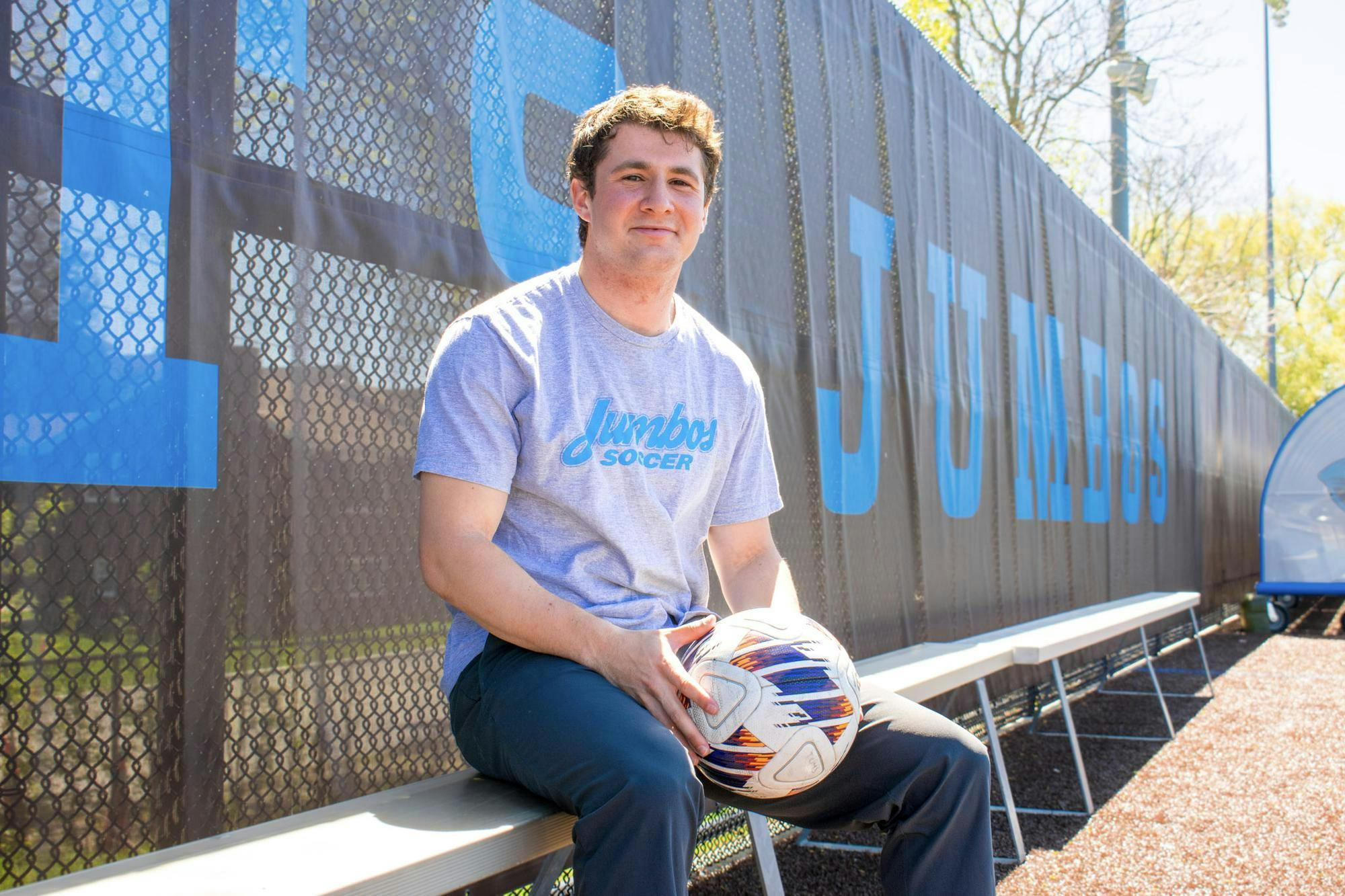
A lone white shirt wrestled through a sea of defenders, deftly maneuvering the ball while shrugging off a host of aggressive tackles. Despite his shirt being pulled, the young 5-foot-6-inch winger was unfazed, keeping balance and gliding past his markers before threading a pass to graduating senior forward Anthony Bhangdia, whose shot was deflected back into play and into the path of the tenacious winger who pounced on the loose ball and buried it in the bottom right corner.
1–0 Tufts. The deadlock was broken in a fiery NESCAC semifinal against Middlebury. This was graduating senior midfielder Ethan Feigin’s first goal for Tufts, a moment that inspired an injury-ridden team to the NESCAC title in 2021. Seventy-one games later, Feigin prides himself on the same bravery, dedication and confidence that his memorable career opener was built on.
“For that goal, there were four [first-years] on the pitch at the time, and we were the ones who passed to one another and got the ball up to him, and he was the one who put it in the back of the net. It was electric,” graduating senior defender Owen Denby wrote in an email to the Daily.
When asked to describe his teammate, Denby pointed toward Feigin’s inspiring attitude and style of play.
“The two words I would use to describe him are dynamic and extremely hardworking,” Denby wrote. “Ethan was a menace on the ball, and we all knew that his favorite part of the game, and what he was probably best at, was taking defenders on 1v1 and getting the best of them.”
Denby further praised Feigin’s defensive work rate as a winger, emphasizing his ability to track back and recover the ball. As a player who excels in tight spaces and taking on defenders in the final third, transitions often offer wingers respite, allowing them to slowly jog back into action. Feigin, however, would press aggressively without the ball, often tracking opponents deep into his own half.
A hallmark of Feigin’s game has always been his dribbling prowess, a skill he developed early on in his playing days. As a smaller player, Feigin was aware of his strengths and looked to similarly built professionals for inspiration. Some of his early memories of the beautiful game came from watching his older siblings.
“I have always had a similar style of play, being one of the smaller players on the team from a young age, I had to rely on technique and soccer [IQ] which are two things I pride myself on to this day,” Feigin wrote in an email to the Daily. “My early memories of soccer were mostly kicking a ball around on the sidelines of my older siblings’ games, just wishing I could be out there playing with them.”
Much like his favorite player, Eden Hazard, who terrorized defenders across Europe for more than a decade, Feigin’s strength on the ball is a major skill he carries with him. Being able to strategically place his body between defenders while alternating feet with soft touches is a skill he has built from years of practice.
“I always tried to model my game after him and I constantly copied the things he did while playing in the backyard or playing around with friends,” he wrote. “Naturally, [Lionel] Messi was also a massive inspiration as he was dominant for so long and loved to dribble, which is something I always try as well.”
Feigin discussed his mental growth as a player over his Tufts career, citing early experiences that shaped his mentality going forward.
“I think I’ve evolved a lot mentally as a soccer player over my four years at Tufts. Coming in to school, everyone is used to being one of the top players on their club or high school team, but then suddenly you have to reprove yourself every single day,” he wrote “I remember one of my first practices, one of the older players tackled me hard in practice and I went flying to the ground, sitting there thinking ‘wow, this is going to be a rough time.’ As I got more comfortable, and smarter with the ball, I was able to work around these problems.”
Despite first-year nerves, Feigin fondly recalls many early memories and impressions of the program, emphasizing the bond he felt with his team from the first day he set foot on campus.
“While soccer was incredibly important to everyone, I think the biggest difference between club soccer and college soccer is the off the field brotherhood that develops,” he wrote. “From the first time I stepped foot on campus, I realized how much the small moments really mean – team meals in Dewick, [FIFA] tournaments, locker room celebrations, even just hanging out together, those are some of the best times.”
One of Feigin’s pieces of advice to younger players in the program is to enjoy every little moment and to be the best teammate possible at all times. Denby reiterated the importance of the team’s culture and the role Feigin played in maintaining it over the years.
“Ethan also loves to have a good time and is someone who really understands that the culture of the Tufts Men’s Soccer Team is just as, if not more important than the actual soccer — he is one of the biggest proponents of this,” Denby wrote.
With eight goals and 10 assists, Feigin’s creative playmaking ability is second to none. The winger strives to create an impact in all of his games and possesses stunning passing accuracy that opens up space beyond opposing defenders.
Alongside his teammates, his coaches have been pivotal to his development as a player both on and off the field. Feigin holds deep gratitude for his family’s sacrifices and support in his athletic journey.
“From the start, my parents and family … have allowed me to pursue soccer, even making the 8-hour drive from DC on multiple occasions each season,” he wrote. “On the field, I couldn’t have ever had success without amazing teammates around me and a great coaching staff. Each and every player I have been teammates with has helped me in some way, whether on the field or off, and for that I am incredibly grateful.”
Some of Denby’s fondest memories with Feigin include studying abroad in Spain and experiencing some of Europe’s elite teams from the touchline. The senior defender also praised Feigin’s leadership this year, emphasizing his motivational presence to others despite carrying an injury.
Going forward, Feigin will be working in finance in Boston and is excited to see the team’s evolution in the coming years. There’s no doubt his presence will be missed and his legacy fondly remembered by everyone who had the chance to catch a glimpse of Tufts’ very own No. 23.