Content Warning: This article mentions sexual violence.
A play is isolated from reality, forever fixed in its own little pocket of space and time. “The Hills of California” is distinctly aware of this fact, presenting the house the story unfolds in as both a sanctuary and a prison, where dreams are expressed and reminisced on but never able to come to fruition.
“The Hills of California” is the newest play from Tony Award-winning writer Jez Butterworth. The play debuted in the West End and on Broadway in 2024. It is now being staged at The Huntington, directed by Loretta Greco. The story is set in a guesthouse in Blackpool, England, and alternates between a day in August 1976 and a day in May 1955. It focuses on the dynamics between the four singing Webb sisters and their mother.
The first character we are introduced to is 32-year-old Jillian Webb (Karen Killeen), the youngest of the Webb sisters, in 1976, as she descends the stairs of the guesthouse into the main parlor and lights a cigarette. Killeen’s mannerisms are flighty and youthful, conveying the arrested development of both Jillian and the guesthouse she lives in. Upstairs lies the Webb sisters’ dying mother, Veronica (Allison Jean White), who remains unseen and unheard by the audience in her critical state. We then meet the middle sisters: optimistic, spirited Ruby (Aimee Doherty) and bold, temperamental Gloria (Amanda Kristin Nichols). The Webb sisters have gathered at the guesthouse because their mother is on her deathbed, but it is uncertain if Joan (Allison Jean White), the estranged eldest sister, will ever come. Joan is in California — a fact that Ruby romanticizes and Gloria laments.
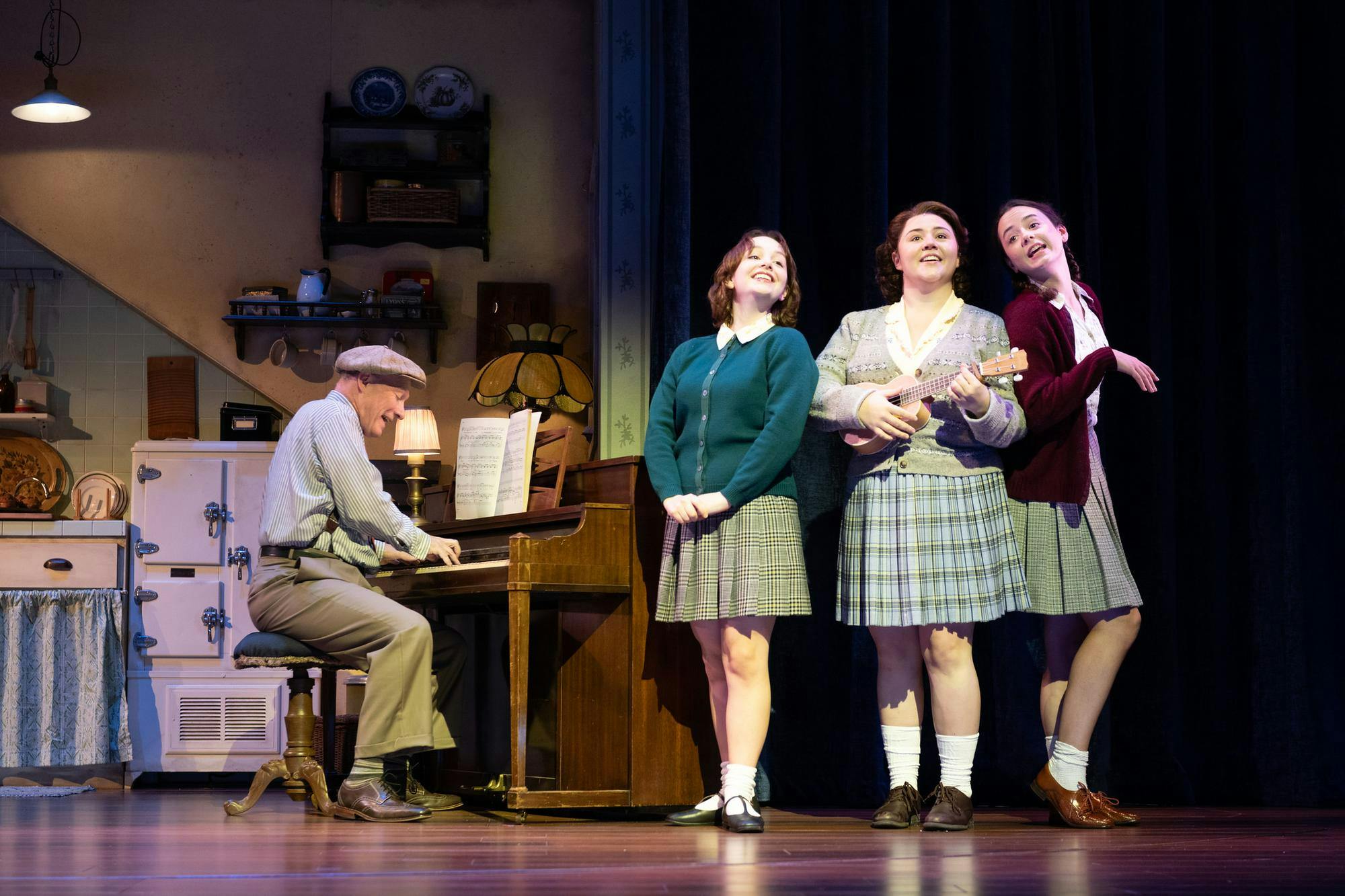
The set rotates when the story jumps backward in time to 1955, revealing another area of the guesthouse in which the Webb sisters grew up — this time a kitchen parlor. In both the 1976 and 1955 sets, staircases go to places the audience cannot see, reminding us of the fact that we are as trapped in the nostalgia as the characters are. “The Hills of California” is a play that is very concerned with comings and goings, and so the stairs are a crucial part and symbol of its narrative.
The 1955 scenes — showing the Webb family in a hopeful, prelapsarian state — have a coziness to them that is absent from the 1976 scenes. We see the sisters as energetic tweens and teens and Veronica as a vibrant, fiercely protective maternal presence. Young Jillian (Nicole Mulready), Young Ruby (Chloé Kolbenheyer) and Young Gloria (Meghan Carey) gather around the table, eager to please their mother. Young Joan (Kate Fitzgerald), meanwhile, is something of a rebel.
The music used in “The Hills of California” is one of its most distinctive features. Veronica coaches and manages her girls as a harmonic ensemble in the swinging, boogie-woogie style of the Andrews Sisters, who were most prominent during the early 1940s. The Webb family idolizes the Andrews Sisters’ talent and rise to fame. Veronica uses them as a blueprint for the dreams she has for her daughters, wishing for their future through the lens of a romanticized past.
In Act 2, the plot picks up from its rather slow pace, building on Act 1. In 1955, American music producer and talent scout Luther St. John (Lewis D. Wheeler) is brought in to see the girls perform. Instead of giving all the girls a shot at stardom, Luther only sees “it” in Joan. She takes him upstairs so that he can hear her sing alone — a situation with sexual implications. In a chilling moment, we hear Joan stop in the middle of a line while singing a Nat King Cole song. The silence is deafening. At this moment, the story fully loses its innocence. We soon learn that Joan was raped and impregnated in this encounter, fled to California because of it and never came back home again.
The return of adult Joan to the house in 1976 is the show’s most dramatic sequence, shrouded in fog, colorful lights and The Rolling Stones’ “Gimme Shelter” blasting from the jukebox in the parlor. The adult Joan is something of a mythic figure in the play, so to see her now with her groovy dress and breezy American accent is jarring. Her sisters’ reactions to her arrival are, of course, mixed. The arguments that ensue — coming to terms with the gravity of Joan’s trauma and the imminence of their mother’s death — are tearful, screaming and potent. Tragically, Joan is unable to go upstairs to see their mother. When she attempts to, she encounters her younger self going downstairs and is paralyzed by her past — just as the entirety of the play is.
The show ends with the adult Webb sisters singing “Dream a Little Dream of Me” together (the song that Veronica suggested Joan sing for Luther), but then their voices drop out. Young Joan’s voice rings out alone before again getting cut off mid-lyric. The audience is left to sit with a family severed by death, with dreams stuck in time. Despite all the tragedy, there is something warm and welcoming about “The Hills of California,” where a song is a place you can live.