Content warning: This article contains discussions of gun violence.
Seven years ago, writer and lyricist Kathleen Cahill was on a flight when she had the idea to write a musical focusing on the emotional, human effects of a school shooting rather than the politics.
“I had this period of time where I was thinking that we couldn’t do it, that it was too hard,” Cahill said. “But it felt immoral to have been given this idea and not to follow it through.”
She brought the idea for “LATE” to her past collaborator, Michael Wartofsky, the show’s composer and additional lyricist, beginning the journey toward its first full production. The show was first presented as a workshop in the Boston New Works Festival in 2022 and had multiple readings in the following years, including one in October 2025, as the team reworked and refined the piece’s tone, structure and emphasis of different themes.
This month’s developmental production, which puts the musical up on its feet for the first time, is co-produced by Moonbox Productions, Love Sadie Musicals and the New Opera and Musical Theatre Initiative. Director Ilana Ransom Toeplitz, choreographer Joy Clark and music director David Freeman Coleman, who is also a lecturer of music at Tufts, join Cahill and Wartofsky on the creative team.
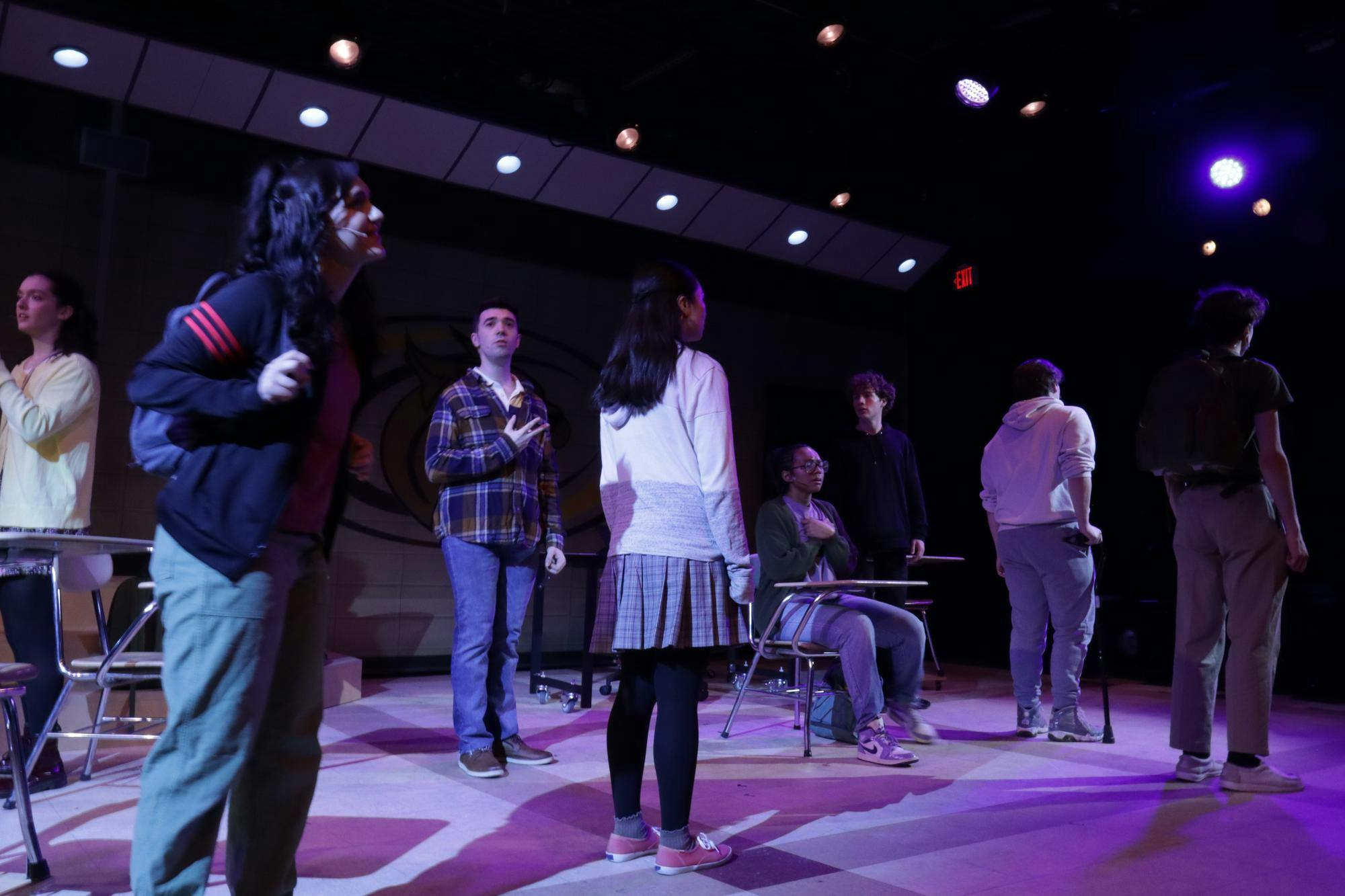
“LATE” follows best friends Billie (Cortlandt Barrett) and Katie (Jayla Shedeed) and their six classmates before and after a shooting at a fictional high school.
In a preview performance on Saturday, the show’s first several numbers filled the intimate theater with laughter. The audience gets to understand the characters as they engage in various adolescent struggles such as relationship drama, menstruation, maintaining friendships and reputations, while enjoying the show’s exuberant tone through the teenagers’ day-to-day lives.
Clark’s choreography allows the clever physical comedy of the cast to boost this spirit. This is particularly prominent in the character Beau, portrayed by Jackson Gentry, which Cahill describes as Katie’s “bad boy boyfriend.”
“There’s all these stories,” Cahill said. “It’s an ordinary day, and an ordinary day is full of stories that you’re just living in and you don’t even really think about. … You start to look at it differently. Like, ‘Yeah, that was my ordinary day, and look how rich it was.’”
Wartofsky expressed pride about a song called “The Seed.”
“Our current version [of the song] is really exciting for me, because it’s a way for all eight of the characters to connect and dream together,” Wartofsky said. “I think this metaphor that children are seeds … and they have huge dreams of what they can become … is really powerful, and it turned into a really fun number.”
The complicated lives of teenagers and relationships between the friends make for an even more complicated aftermath as they continue to wrestle with the tragedy a year later. Flashbacks to the past shed new light on how the catastrophe changes these teenagers as they attempt to reclaim their futures while dealing with guilt, mental health issues, dissension, feelings of futility and the burden borne by student activists.
The writers were inspired by the trauma and inappropriate ‘crisis actor’ allegations faced by student activists and survivors of the 2018 shooting at Marjory Stoneman Douglas High School in Parkland, Fla.
“You so beautifully captured multiple facets of a very multi-faceted response,” an audience member said to the creative team in a talkback after the Saturday preview.
In describing the show, Wartofsky noted overlap with the “youthful energy and angst” of “Spring Awakening” (2006), ensemble storytelling around an event reminiscent of “Come From Away” (2017) and the mature themes and coming-of-age story of “Dear Evan Hansen” (2016).
The show’s contemporary musical theater score feels familiar but refreshing, with emotional motifs that permeate throughout the show. The vocal strength of the cast is a highlight, both as an ensemble and in impressive solo numbers. The production uses only piano and drums “specifically to convey the developmental nature of it,” Wartofsky said. “Hearing [Coleman] play this score on [an acoustic] grand piano at the recital in October … it was so rich the way he was playing it that we have rented a grand piano for this developmental production.”
“We are so lucky to be in a sandbox with the writing team to help make their show more and more what it was meant to be,” Clark said.
Audience members are also important to the show’s development, and are invited to provide feedback on the show through an online survey.
“We live in a time when these tragedies can feel both devastating and strangely distant, because they often reach us through headlines or a quick scroll on our phones,” Toeplitz wrote in an email to the Daily. “Theatre does the opposite. It asks us to gather in a room together and experience a story in real time.”
“LATE” runs through Saturday at the Boston Center for the Arts Plaza Theatre in the South End.