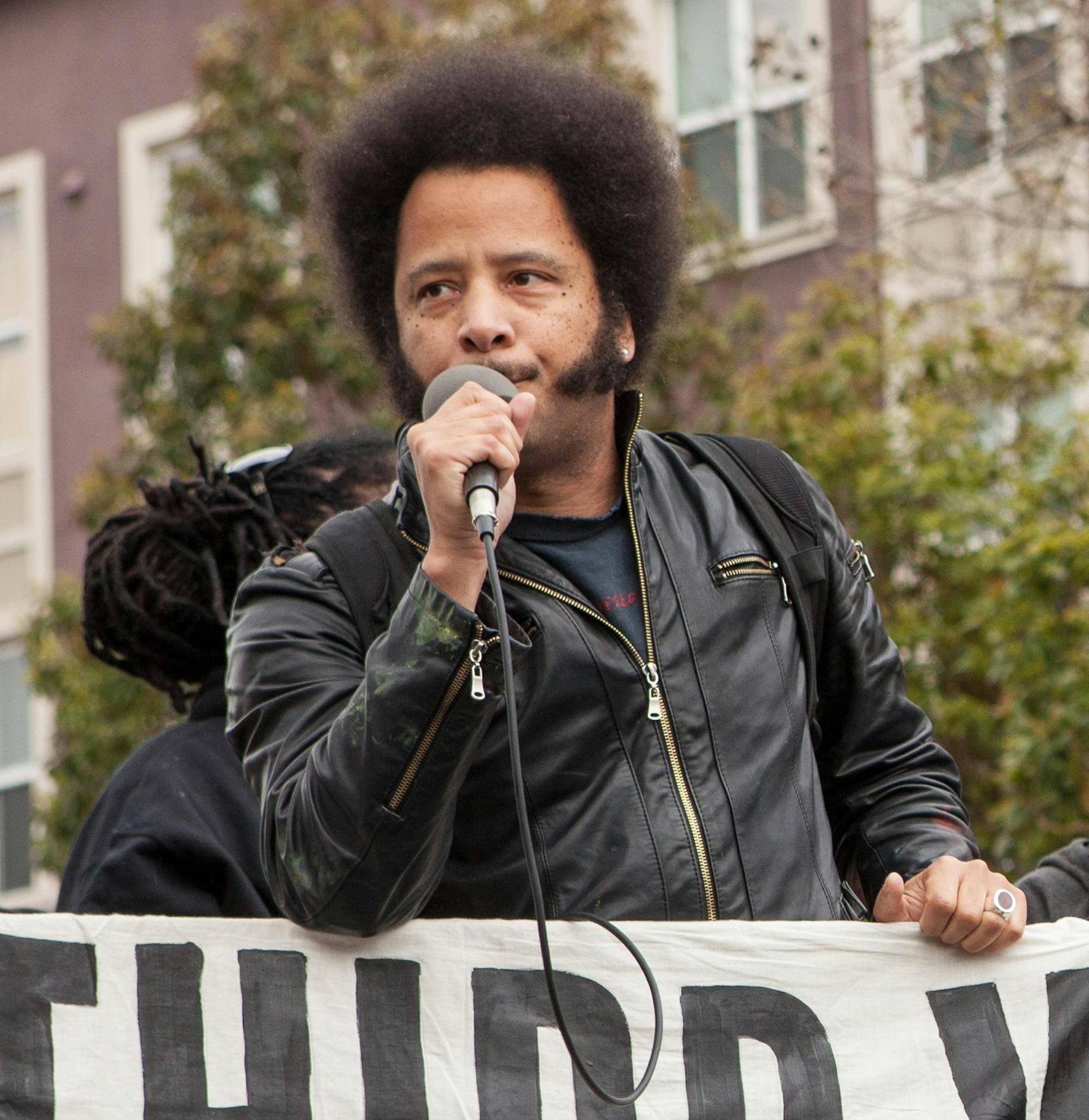
Before Boots Riley redefined himself as a full-blown filmmaker with his 2018 film “Sorry To Bother You,” he was the established front man of Oakland-based rap group The Coup. The group is a politically incendiary collective whose most popular records bear titles like “My Favorite Mutiny” and “5 Million Ways To Kill a C.E.O.” The son of a civil rights attorney and a Jewish refugee-turned-activist, Riley spent his teenage years organizing school walkouts and rising through the ranks of the Progressive Labor Party.
Riley’s outrageously creative latest effort, the ensemble-driven work of sci-fi protest art he calls “I Love Boosters,” reveals the multi-hyphenate to still be far from satisfied. The film’s title cites an eponymous 2006 The Coup track, where Riley praised boosters — crafty individuals dedicated to reselling stolen merchandise — with the lyrics: “My shirt is from Stacey, my pants are from Rhonda / My shoes came out the trunk of a baby blue Honda.”
Riley opens the film with Corvette (Keke Palmer), who uses her powers of seduction to persuade a man into purchasing some merchandise that must have just fallen off the back of a truck. In her dreams, she imagines that she is being chased by something, which turns out not to be far from the truth. Corvette is joined by Sade (Naomi Ackie) and Mariah (Taylour Paige) to form the Velvet Gang, which is being hunted down by MIT prodigy-turned-capitalist-nightmare fashion designer Christie Smith (an extravagantly bespectacled Demi Moore).
To Corvette, Smith has it all. She has a house in a Tower of Pisa-style luxury apartment complex where the foundation is quite literally sinking, and she is herself the subject of a documentary — narrated by Viggo Mortensen doing his best Werner Herzog — that the gang gathers to gawk at. Her label, called Metro Designers, is caught somewhere between high-concept art and H&M, with each of its outlets promoting a different monthly monochrome line (looking for something that’s not chartreuse? “Deal with it!”). At each store, employees like the Hegel-quoting, vape-addicted Violeta (a scene-stealing Eiza González) have the money for their mandatory Metro Designers outfits ripped from their paychecks — totaling around $40 — and are only given 30-second lunch breaks.
So when the trio starts knocking off outlets one by one — partly out of anger after Corvette’s design didn’t win a Smith-sponsored fashion competition, and mostly because she is shown calling boosters “low-class urban b----es” on live television — rooting for them is far from a difficult task. The ping-ponging chemistry between Palmer, Paige and Ackie carries much of the weight here, as does Riley’s gonzo approach with the camera and in the editing room.
As was the case with “Sorry To Bother You,” the longer the film runs, the fewer punches Riley pulls. What he has essentially built is a communist’s “Fear and Loathing in Las Vegas” in the form of a Marvel blockbuster. At times, one may wonder if some simplification might have served the film well. But other forays, such as the jaw-dropping sequence where LaKeith Stanfield’s cloak-and-dagger caricature displays his — literally — otherworldly knack for oral stimulation, are the exact moments that make us cherish the beautiful chaos of Riley’s imagination.
Despite his knack for off-the-wall comedic surrealism — maybe impossible in mainstream media without the work of Eric André, who makes a memorable third-act appearance — it’s clear that Riley intends to incite a serious conversation about the possibility of a non-capitalist society, even if he uses supernatural devices to do so.
It’s understandable that, after a lifetime of protest organization, Riley has no interest in subtlety. Instead, he uses his platform to show a widespread audience how individual motivation can become a pathway to collective power. As the film progresses, the characters’ financial interests take a backseat to their budding socialism — until they are willing to sacrifice control of a shipment of $100,000 suits to bring Smith’s fashion empire to its knees.
The Bay Area itself proves once again to be a perfect stomping ground for Riley’s chaotic energy. Over its history, it has seen tech bro-ification and counterculture flourish nearly side-by-side, and that tension is exactly what Riley hopes to capture.
However, the film does not confine itself to the West Coast, or even to America. When Jianhu (Poppy Liu), a sleuthing Metro Designer factory worker semi-intentionally enters the fray, the story takes on an international element, which helps its commentary achieve a similar universality as found in “Sorry To Bother You.” Just as in his earlier feature, Riley does not let the opportunity to display a worker’s strike on screen go to waste, this time extending his vision of proletarian mobilization across the world using found footage.
If nothing else, “I Love Boosters” is able to nimbly combine political rage with irreverence to form a maximalist saga that rarely feels heavy-handed. Perhaps some symbolism is excessively on the nose — the enormous rolling ball made of invoices and debt notices comes to mind — but at this point we should know better than to expect anything else from this enormous-hat-wearing auteur.
“I Love Boosters” premiered at the 2026 South by Southwest Film & TV Festival, and screened at Independent Film Festival Boston on April 22, 2026. It is set to be released in the United States via NEON on May 22, 2026.