
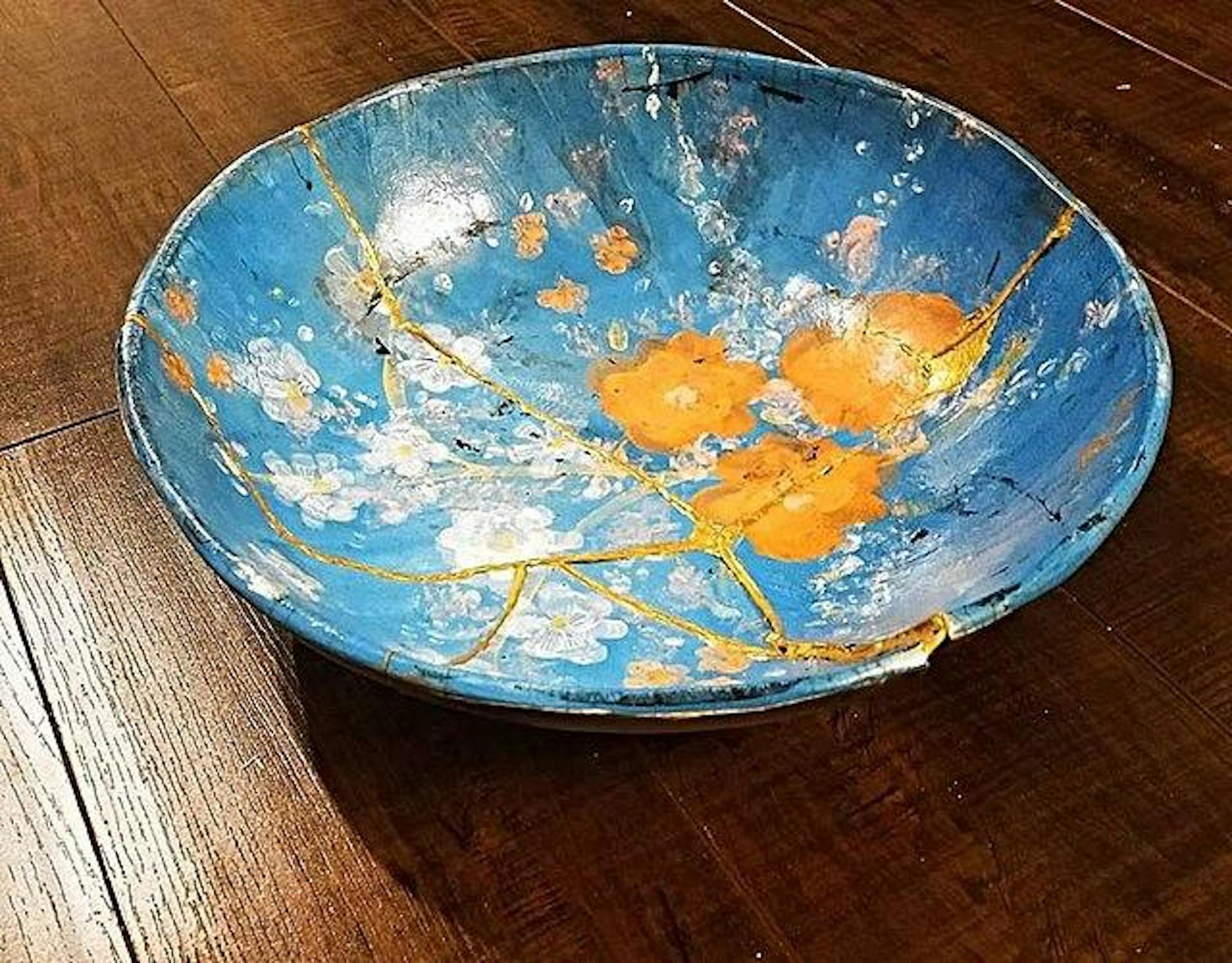
In our dining halls, plates are merely vessels of utility. Students stack them high with Dewick-MacPhie Dining Center fries or Fresh at Carmichael Dining Center pancakes, slam them down on plastic trays beside their friends, and later let them rattle down a conveyor belt to be stripped of ketchup stains and congealed maple syrup residue by custodial staff. For those living off campus, Amazon boxes and Target bags deliver inexpensive, replaceable dishware, valued for durability. Beauty here is an afterthought, or not a thought at all — a convenience that disappears into the dishwasher before a 9 a.m. class.
But in other contexts, a plate is not simply a tool. It is an art form. A plate can serve as an object that embodies history, philosophical ideals and, most importantly, the notion that mistakes are allowed to belong. This is where kintsugi enters.
The Japanese practice involves the mending of broken pottery with lacquer dusted with precious metals such as gold or silver. The flaws within the plate are precisely where the beauty lies. The word kintsugi is a combination of two parts: kin (金), meaning ‘gold,’ and tsugi (継ぎ), meaning ‘to join’ or ‘repair.’ Thus, kintsugi translates to ‘golden repair’ or ‘golden joinery.’ The flaws in the art are what distinguish kintsugi from an ordinary plate. The fracture is not a flaw: It is the very source of value.
Not just an art form, kintsugi is also a philosophy. Plates are sometimes intentionally broken, welcoming gold veins to run through the ruptures. Perfection is not the goal. Wholeness is. And wholeness often requires imperfection to shine through.
Music offers similar lessons. In jazz, Louis Armstrong’s 1926 recording of “Heebie Jeebies” enormously influenced scat singing when Armstrong dropped his lyric sheet and filled the silence with nonsense syllables. His ‘mistake’ became a defining creative moment, inaugurating a whole style of improvisation that blurred the line between voice and instrument.
The danger for creatives lies in mistaking genre or trend for gold itself, rather than recognizing the gold that often lives in the cracks. When we adhere ourselves too tightly to a particular style, we risk sanding down the fractures that might have revealed our truest voice. Perfection conceals. Imperfection discloses.
When we try to mold our artistic tendencies (art, style, music) into a genre that is digestible to the masses, we imply that our mistakes and forms of individuality must still fit into a box. Trends and ‘digestible’ genres can smooth over ruptures in favor of the familiar, polishing away irregularities to make art more palatable, more marketable, more viral. Yet when everyone follows the same ‘aesthetic formula,’ the art form risks collapsing under its own predictability. The plate remains intact, perhaps, but it is indistinguishable from all the others in the cupboard.
Kintsugi dares us to ask: What if the very cracks, our failures, our divergences, our resistances, are the art? What if the fractures in our work are not embarrassments to be buffed out but the very places where gold can live?
This is the paradox at the heart of kintsugi: Something must be broken for repair to reveal its worth. For the artist, the equivalent break might be abandoning genre, defying popular but unspoken orthodoxy or refusing to mimic the glossy surfaces of trend-driven art. It may feel dangerous, even reputation-threatening. But, to cling to unbroken surfaces is to deny the possibility of metamorphosis.
What we can learn, then, is not merely to acquiesce to imperfection but how to seek it and possibly cultivate it. Not recklessly, not as gimmick, but as philosophy. To embrace rupture is to acknowledge that the fractures are what separate art from product and the artist from the craftsman of convention.
Perfection might make something whole, but only imperfection can make it golden.



