
Comedy isn’t always easy to laugh about these days.
From “Jimmy Kimmel Live!” being briefly pulled off the air by ABC after Kimmel’s controversial remarks following the assasination of right-wing political figure Charlie Kirk, to “The Late Show with Stephen Colbert” being canceled by CBS days after Colbert’s criticism of a multi-billion dollar merger with SkyDance Media that required approval from the Federal Communications Commission, it has never seemed more dangerous to be a comedian on a national stage.
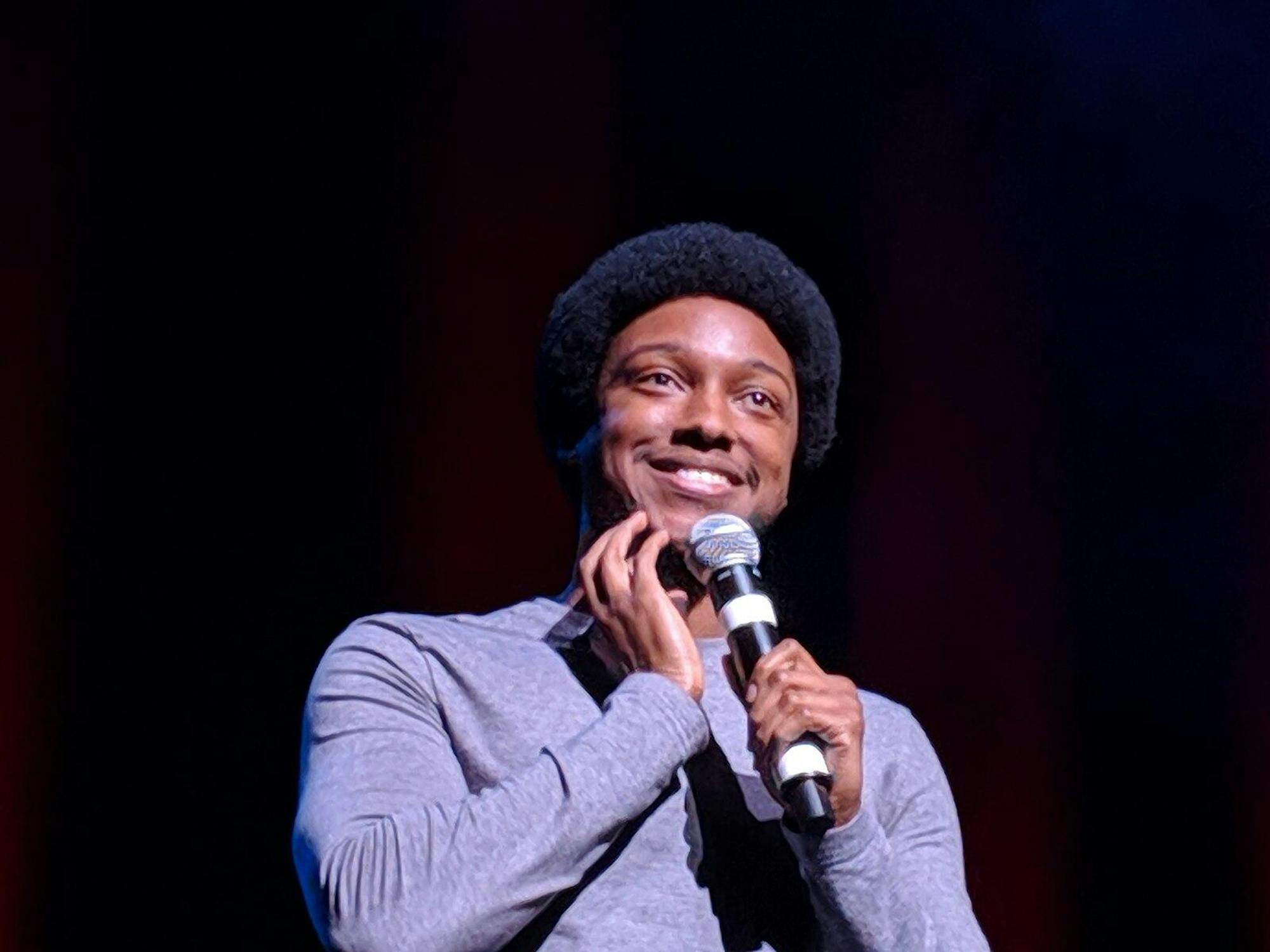
And yet, week after week, Josh Johnson returns to the comedy stage with jeans, a gray hoodie and a desire to bring humanity and connection to a time marked by uncertainty.
For years, Johnson has been a comedian on the rise. He joined the satirical news program “The Daily Show” in 2017 as a writer before working his way up to on-air correspondent in 2024. He hosted the show for the first time in July 2025 and again earlier this month, racking up millions of views and setting a ratings record for the show that year. Johnson is listed as Comedy Central’s “most watched comedian ever,” with more than 40 million views to date across its platforms.
Beyond “The Daily Show,” Johnson has carved out a space for his own work in the comedy sphere. His YouTube channel, which has amassed over two million subscribers, features full-length live stand-up sets released weekly on current social, political and cultural topics. In 2024 alone, he released the equivalent of 28 hour-long specials on YouTube — and he’s projected to exceed that number this year. His videos have also received critical acclaim. One, titled “The Failure, Fear, And Frenzy around Luigi Mangione,” which discussed the December 2024 shooting of UnitedHealth Group CEO Brian Thompson, was on the ballot for the 2025 Emmy awards. Had it gone through to nomination, it would have been the first full-length stand-up set released solely on YouTube to do so.
Johnson’s personal brand of comedy is a mixture of stand-up and commentary, fusing together the two forms in such a distinctive way that it has reshaped comedy in the modern era altogether. Rather than performing a quick set with a relentless string of punchy jokes, Johnson gives his comedy time to build through carefully crafted storytelling. He is unafraid to go several minutes in a set without intending for the audience to laugh at all, as he drives home a particularly poignant or moving message.
Currently, Johnson is in the midst of his national tour, “The Flowers Tour,” which kicked off at the beginning of 2025 and is booked through early 2026. His leg at the Wilbur Theatre in Boston was particularly demanding. From Sept. 3–7, Johnson performed 10 sold-out shows with nearly 11,000 attendees, sometimes performing twice a day.
I had the opportunity to attend one of these shows on the night of Sept. 7, presumably Johnson’s final show at the Wilbur. I went in with anticipatory excitement, but also a near-morbid curiosity as to whether he could pull off what he does in the edited and airbrushed sphere of the internet, week after week. In the confined space of hour-long comedy specials on YouTube, Johnson is always on the mark — constantly with a funny yet poignant observation. I couldn’t help but wonder whether that magic would translate off-screen.
Johnson’s set began, distinctively, with two words:
“I … okay,” he said, as if he were about to confess something to a close confidant.
Already, the whoops and hollers had begun. This signature style of Johnson’s — his ability to make audience members feel as though he’s speaking to them personally rather than to a room of thousands — is a signature part of his charm.
As the set went on, Johnson continued to cultivate this feeling of a confidential gossip session between friends. “Don’t tell anyone this,” he said at one point, prompting laughter at the irony of the request in a packed theatre.
The first half of Johnson’s set consisted of loosely connected musings that had no tether to any specific point in time, from going down a rabbit hole of animal release videos online to obscure, Ivy League-favored sports such as crew, sailing, fencing and equestrian. Johnson good-naturedly pokes fun at these sports, pointing out the absurdity of glamorizing activities people once had to do to survive. “That’d be like if you went 300 years into the future and people in the Ivy League played ‘Gas Station Cashier,’” he said in one of the standout jokes from the segment.
A key reason Johnson resonates with such large audiences is that, in his stories, he is decidedly not the hero. Johnson often acts as a bystander to the bizarre scenarios around him, which he absorbs and repurposes for the audience in neatly wrapped packages of relatability and reason. One mid-set story about a childhood soccer match that went awry embodies this approach. Johnson builds an elaborate account of a fight that broke out between two dads, where one father actually ended up fending off parents trying to to break up the fight — with the help of his own son. “I was not trying to be a hero,” Johnson said, emphasizing that he was simply watching this scene unfold from the soccer field. “Mainly because my coach said, ‘Don’t try to be a hero.’”
At this point in the set, as the laughs died out, Johnson seemed to take a breath for the first time. The shift in atmosphere was tangible, signaling a turning point. The audience watched in anticipation as Johnson pulled out a stool, stared out into the crowd and said plainly: “I do worry that he broke the economy.”
The audience needed no clarification to understand that Johnson was referring to President Donald Trump. Cheers erupted as it became clear that everything prior to this was simply prelude. Although the abrupt transition lacked the usual seamlessness that Johnson is known for, the set had entered the segment addressing Johnson’s signature topic: current events.
In this segment, Johnson focused on the recent slashing of federal government jobs and the rise of job insecurity due to advancements in artificial intelligence. Johnson’s central message was clear: People deserve more credit and respect than the federal government and large corporations are currently giving them.
“Maybe two things can be true at the same time,” Johnson said, speaking on the dissonance between the White House’s messaging surrounding the economy and the lived experience of everyday Americans. “Maybe the economy is functioning exactly as it’s supposed to and you were just made to be poor. That’s a harrowing idea, but it seems like what they’re saying without saying it. Because you tell them it’s not working for you, and they say, ‘But it is working.’”
When discussing AI, Johnson emphasized that people — rather than machines — are where we should invest our time and resources. “Why am I sitting in my room trying to learn how to get better at talking to myself?” Johnson asked. “We have the belief in and inevitability towards AI that we should actually have for people.”
The laughs were minimal during this portion of the set, but Johnson still had the audience’s full attention. He morphed from comedian to people’s preacher, offering smart, thoughtful and personal commentary on issues that seem to dominate the national landscape. Johnson somehow managed to cut through the endless cacophony of circuitous debate and offer a sharp, human-centered perspective on issues that have long seemed impossible to make sense of or solve. Beyond his quick-wit, this quality to Johnson’s performances has always been the beating heart of his shows.
While the set wasn’t quite as seamless or polished as many of his internet specials, I walked out of the theater imbued with an emotion rare these days: hope — far more raw and electric than could ever be transmitted across a screen.
In his performances, Johnson disproves of the mockery and malice that often define mainstream comedy. Instead, he offers the notion that one does not need to punch down to bring joy and laughter. Johnson’s humor is always thoughtful, considerate and good-natured. In a culture of constant ideological battle and intense division, Johnson recenters a fact that is too easily forgotten: At the core of us all is humanity.
“Why is it called The Flowers Tour?” Johnson wrote in an online post in June, noting that he receives the question often. “The Flowers Tour is about giving as many metaphorical, and literal, flowers to the world as possible.” Traditionally, flowers are thrown to the stage at the end of a performance to communicate appreciation for the performer.
But Johnson has a different idea for how audience members should use their flowers — one entirely in line with the intention behind his shows. “If you bring a flower,” he wrote, “I encourage you to use it to meet a new friend.”



