
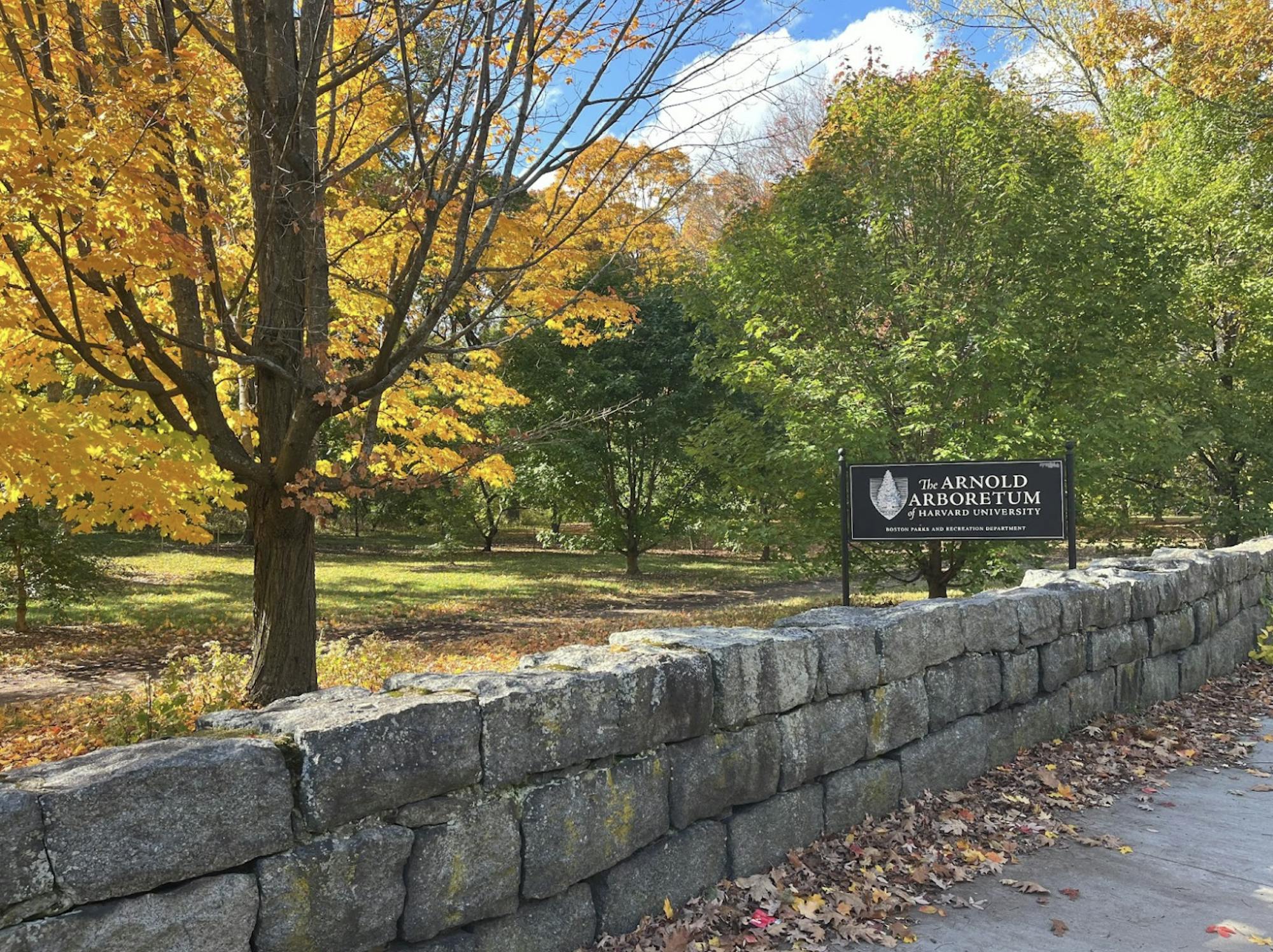
The Arnold Arboretum at Harvard University spans 281 acres with a collection of more than 16,000 plants. Rodney Eason, director of horticulture and landscape at the arboretum, can recognize these plants by sight and tell their stories by heart.
Meet Franklinia Alatamaha. Philadelphian William Bartram and his son John discovered and collected the Franklin tree, named after Benjamin Franklin, along the Altamaha River in 1765. When they returned to the site, every Franklinia was gone. Extinct in the wild, the oldest members of the species were received by the arboretum in 1884 and currently live in the Explorers Garden. The Explorers Garden, located on Bussey Hill, is the warmest area of the landscape and is where plants are tested for hardiness in the Boston climate.
The Franklinia are an extreme example of ex situ conservation at the Arboretum. “One of our jobs being a museum of trees is that we want biological diversity,” Eason said. “[Conservation is] essential to who we are.”
In addition to conserving plants, the Arboretum conserves the work of past artists. Founded in 1872, the Arboretum still follows the initial layout of Frederick Law Olmsted, regarded as the father of American landscape architecture, and Charles Sprague Sargent, the first director of the Arboretum. It was Sargent who began the practice of organizing the plants by family, which is still followed.
Over time, numerous landscape architects have contributed to the park, including America’s first female landscape architect, Beatrix Farrand. Farrand laid out the Azalea Border in 1946, situated in front of a wet meadow. Prior to environmental regulation, Sargent wanted to drain the meadow to extend the arboretum, but the landscape refused to change. “It wanted to be a wet area,” Eason said. Since then, the area has continued to get wetter — some of the azaleas have become unable to grow, so they have had to change the composition of the azaleas over time. “We don’t fully understand the hydrology of it,” Eason said, although he theorizes the rising water table could be caused by sediment buildup.
The azaleas are not the only collection that has been altered. Every year, 300 to 500 plants are removed and added. Eason and his team keep a list of plants they are interested in acquiring, which they consult when a replacement is necessary. “The horticulture team is enthusiastic, and they’re a great group,” said Eason. To ensure the health of the current collection, they conduct frequent inspections of the grounds. Eason focuses on “a health and aesthetic standpoint” while his coworkers look for diseases and pests. With a team of only 20 people, Eason said “communication is essential.”
Like the Franklinia, most plants at the arboretum are wild collected from the US, Asia, and Europe. The seeds are brought back to the Arboretum’s Dana Greenhouses and grown at the nursery until they’re ready to be transplanted into the landscape.
Adjacent to the Dana Greenhouses is the Bonsai and Penjing Collection. Open from mid-April to mid-November, the collection includes over 70 trees, some of which are displayed in a wooden pavilion, equipped with a security system, “just like at a museum.” According to Eason, the bonsai need this protection because they “can’t withstand thousands of hands touching the branches.” Jun Imabayashi, a bonsai master trained in Japan, shapes the trees using copper wire. “He’ll move it how he wants it to grow,” Eason said. “It’s an ultimate art form.”
The bonsai pavilion overlooks a vast landscape dotted with vibrantly orange sugar maples. “It’s just really cool to be in this spot where you’ve got the manipulated and then you’ve got the sugar maples,” Eason said.
The contrast between the more-manipulated and the less-manipulated landscape is once again visible from the summit of Bussey Hill. One side offers a clear view of the Blue Hills while another offers a view of the Boston skyline, barely visible through the foliage. Although Eason wishes it were possible to see both views clearly, he doesn’t want to interfere with how the trees have grown. “I know there are some places where people prune trees to offer a vista,” Eason said. “Since our trees are essentially works of art in Harvard’s tree museum, we probably don’t want to do that.”
Currently, Eason and his team are planning a redesign of Bussey Hill. Although the full scope of the project is still uncertain, changes could include increasing accessibility to the Explorers Garden and extending it to the summit, removing the parking lot on the summit, and regrading some turf by the Explorers Garden. Matt Girard, a landscape architect with the firm Michael Van Valkenburgh and Associates, will collaborate on the project. According to Eason, after the staff’s “initial legwork,” including an assessment of the site’s strengths, weaknesses and planting opportunities, they will meet with Girard for a charette — a creative brainstorming session. If they remove the asphalt on Bussey Summit, Eason wonders, “what would come up? What should we do here? I have no idea.”
Uncertainties are opportunities, whether Eason is replacing a tree or improving visitor experience. But for Eason, one thing is always certain: from Katsura leaves that smell like cotton candy in the fall to persimmon bark that looks like alligator skin, "each tree is unique, and each growth form is unique.”



