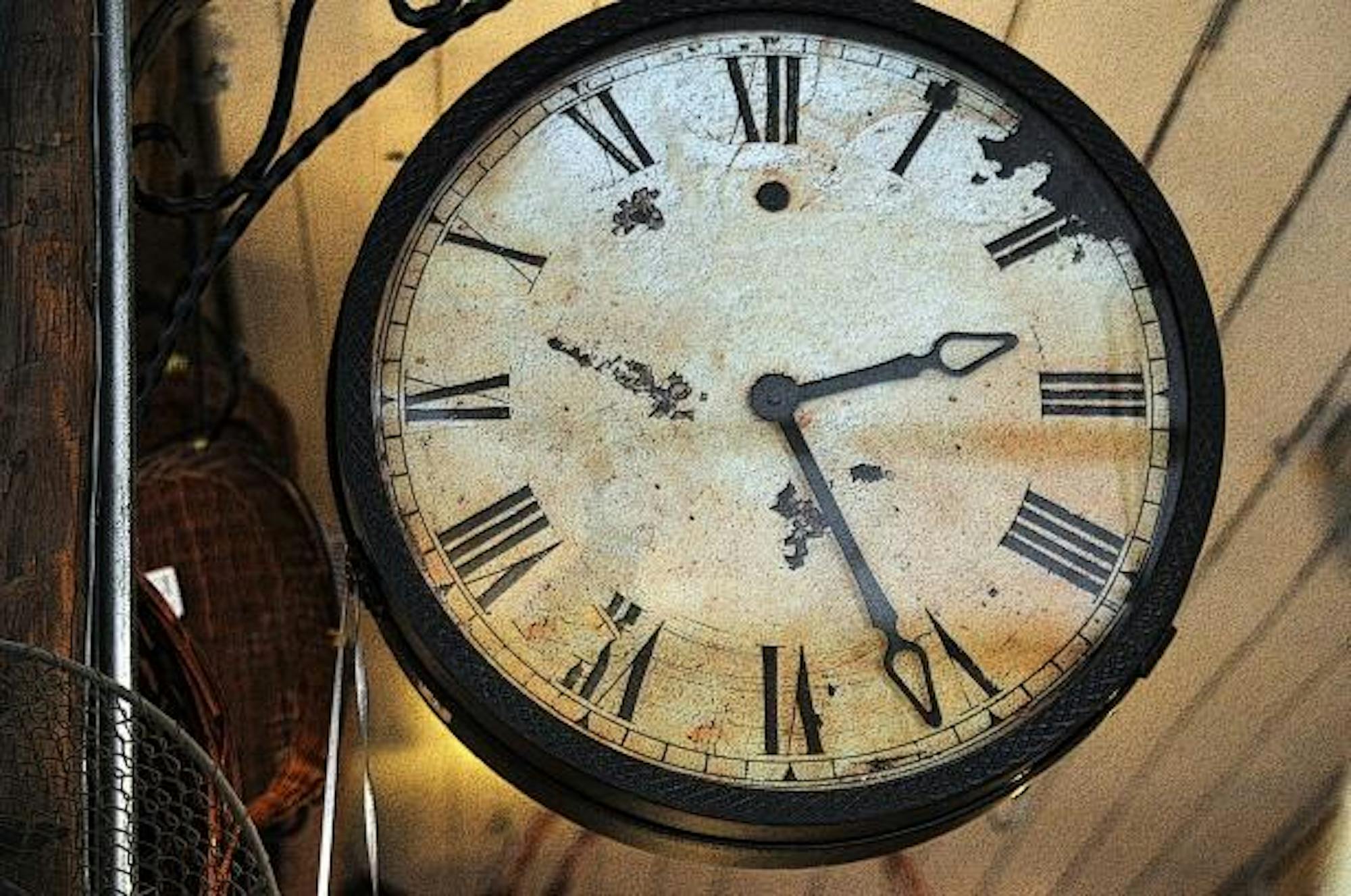
Clockmaking runs in the family of Richard Hills, an antique horologist and owner of Hills Antique Clocks in Holliston. Throughout high school and college, he worked in his brother’s repair shop in Wellesley and, after graduating, continued clockmaking on the side while working as a bioanalytical chemist.
For Hills, problem-solving is a common factor in both professions. “When I worked in the lab, I became sort of the de facto person who fixed the equipment,” Hills said. “There’s a lot of that when it comes to restoration work. You have to be able to figure out what the issue is.”
Eventually, Hills “grew a little tired of the corporate world” and, since he always enjoyed and was good at clockmaking, he transitioned to full-time horology over 25 years ago.
The wide variety of timepieces, including several on the Tufts campus, keeps his work interesting. “You just never know what’s going to walk through the door to work on,” Hills said. “I enjoy the challenge of complicated mechanisms and figuring out what's wrong with them.”
When restoring a clock, Hills begins by identifying the issues with the mechanism and offering a price estimate. If the client chooses to move forward, Hills disassembles and inspects the pieces, cleans them and inspects them again before addressing the issues. While some clocks are quick to repair, others, including historic timepieces, can be complicated.
Hills keeps historic clocks as close to their original condition as possible and tries to avoid replacing parts. If the existing part is irreparable or missing, he prides himself on making repairs so accurate that the average person “would never know that something has been replaced.”
To do this, Hills consults the original piece, if he has it, and historic data in his large collection of books. Even without a reference, he has been in the industry long enough to have “a pretty good idea of what it looked like and can make it correctly.”
In addition to repairing the mechanism, Hills repairs the case. He first focuses on structural integrity because “if it’s rickety or sways, it will actually stop the mechanism.” Once the structure is sound, he turns his attention to cosmetics. While Hills does most of the work, he uses certain artisans for their artistic specialization, including a reverse glass painting artist in Michigan, whom he describes as “probably the best in the country.” Hills added, “I live in fear of him retiring because he’s getting older.”
Clock restoration is an aging industry in general. “We’re definitely losing artisans who do different types of work that was just normal things years ago,” Hills said. He emphasized that for young people who like history and working with their hands, but don’t want to pursue college, clockmaking “is actually kind of a nice fit for that.”
Hills enjoys history himself and recalled working on the Avery-Bennett clock in Boston’s Old North Church, an extensive project covered in a video by the local cable network. The clock was constructed in 1726, and Hills said, “knowing it was there the night they put the lanterns up in the steeple – it’s pretty cool.” Hills preserves history in his workshop as well. About half of his hand tools are antiques that have been in use for around 100 years because, in his words, “They’re made better. A lot of times they just fit the job better.”
With these tools, Hills attempts to solve problems that most commonly include “previously poor repairs.” There was one carriage clock that Hills could not repair because a previous horologist had tried to improve on the wheel, filing and cutting elements. “You run into the point where economics falls into the equation,” Hills said. “I always let customers know whether the clock has the value to warrant restoring it.” While price can be a factor for some, people are often willing to accept any cost for sentimental reasons.
Hills’ favorite part of restoration is working on these sentimental pieces because of “the smile you get on a customer’s face when you’re able to bring something back” and because these customers “have a story attached” to their items. He recalled an antique music box he restored for a woman. It belonged to her grandmother, and she remembered it from her childhood but had not heard the song in decades. When she heard it again, she burst into tears.
Restoring items, like the music box and the Avery-Bennett clock, connects us to the past. “Today, we throw everything away, whether it’s getting a new iPhone every six months because there’s a new one, or IKEA furniture because it’s cheap and looks nice initially, but falls apart five years later,” Hills said. With clocks, there are “pieces that are two and 300 years old that are still functioning and will function if they’re taken care of for another 200 years.”
Over time, Hills has noticed his clientele change. Rather than collectors, he sees more and more young people looking to buy one or two nice clocks for their homes. Hills said, “We’re getting people who are kind of tired of throwing things away constantly, and they want something in their house or their lives that is constant.”