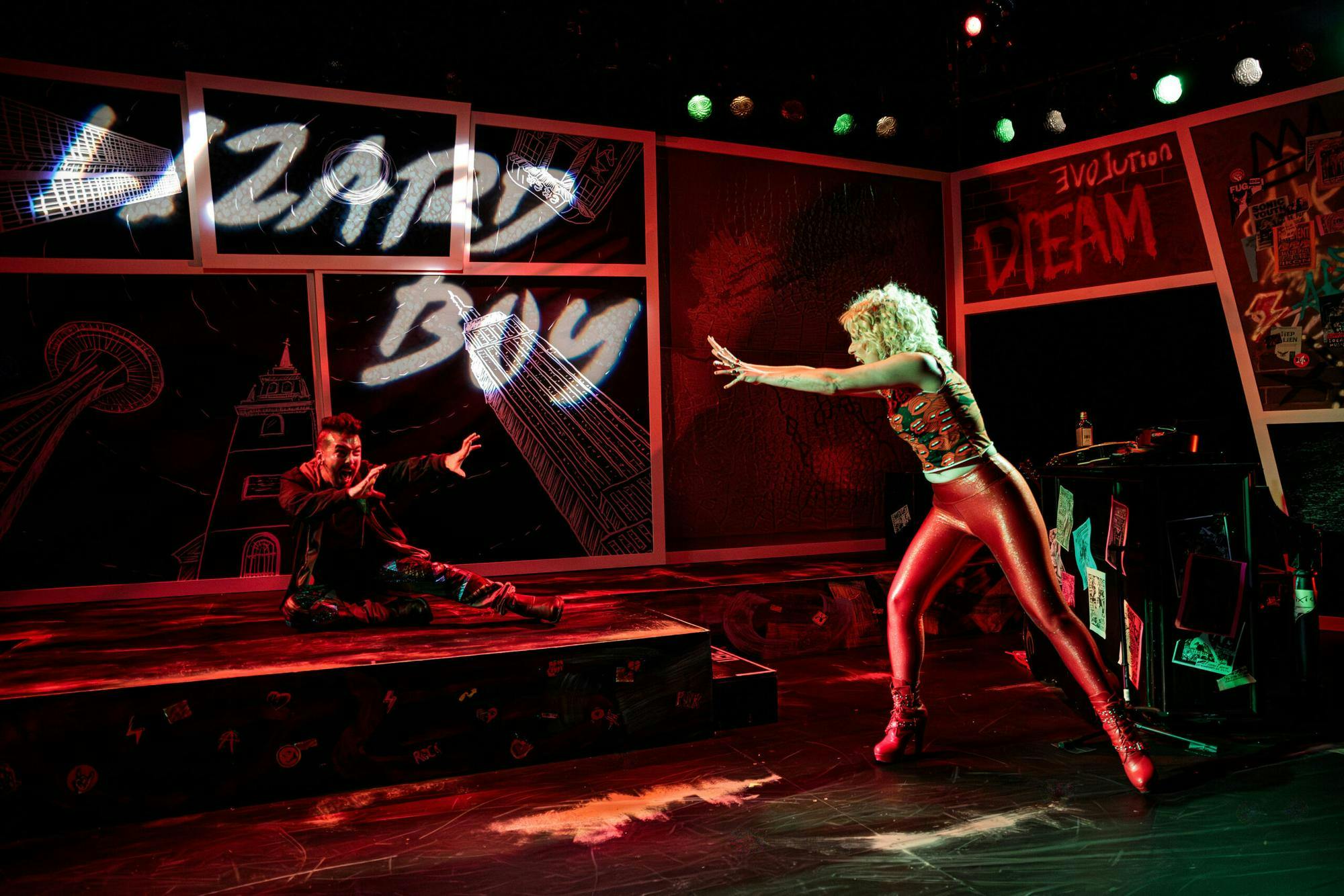
The Roberts Studio Theatre feels like an underground rock club. The stage is set minimally, with panels of graffiti, black boxes, a piano and other musical instruments lit by hazy, colorful lights. The audience is still murmuring when the three characters that make up the cast of “Lizard Boy” casually walk onstage to tune their various instruments. It’s as if a concert is about to start, rather than a musical. The opening display is very intentionally alternative. “Lizard Boy” is a story about an outsider, and the show itself is situated on the boundaries between sci-fi and myth, and between the quirky and the cliché.
“Lizard Boy” is a musical written by Justin Huertas, first performed in 2015. Now, the musical is being put on by SpeakEasy Stage Company, running from Oct. 24 to Nov. 22 in the Roberts Studio Theatre at the Calderwood Pavilion. This staging of “Lizard Boy” is directed by Lyndsay Allyn Cox, musically directed by Violet Wang and features a cast of three characters. The protagonist is the titular lizard boy, Trevor (Keiji Ishiguri), who is deeply insecure and reclusive because of his green and scaly skin. Trevor is flanked by the bumbling-yet-charming love interest Cary (Peter DiMaggio) and the darkly alluring, quasi-villain Siren (Chelsie Nectow), who both send Trevor on a fantastical hero’s journey of self-discovery.
The music is the most impressive aspect of “Lizard Boy” — Ishiguri, DiMaggio and Nectow play their own instruments as they sing. This, paired with the small size of the cast, creates an intimate, alt-rock concert experience. The opening song “He Dies at the End” showcases the cast’s powerful vocals right off the bat, establishing the musical as both a hero’s story and a meta-commentary on the conventions of the hero’s story — specifically, those of the comic book superhero.
“Lizard Boy,” when stripped down to its most basic narrative, is very trite. An underdog becomes an unlikely hero, ultimately winning over evil and the heart of a love interest. But in the details, “Lizard Boy” is very original, combining elements such as a Grindr date (Cary), dragon-attack trauma (the origin of Trevor’s green skin) and an apocalyptic, mythical prophecy (via Siren). It’s this bold and vibrant mish-mash of genres that makes the show an entertaining ride, rather than the framework of the narrative itself.
“Lizard Boy” is very creative with how it portrays scenes and incorporates its characters. A particular standout in the show is the song “Another Part of Me,” in which Trevor sings to both Cary and Siren — separately and simultaneously — through a split scene. It’s like flipping between panels in a comic book — an effect which slightly subverts the linear narrative.
The battle between Trevor and Siren is a highlight of the show, and forms its climax. Trevor must defend himself and Cary — the only path forward is for him to be the hero of the story. The choreography is creative and humorous, incorporating instruments and slow-motion. Here, “Lizard Boy’s” alternative music and comic-book dramatics come together seamlessly.
In the process of the fight, Trevor discovers his powers. It turns out that he had wings the whole time, which explains the green-lit pangs in his back throughout the show. Thus, Trevor undergoes a transformation from lizard boy to dragon man, accepting what makes him unique. His transformation lends itself to the comic-book ethos of the story, but even given that, the literalization of ‘gaining wings’ feels like overkill. Trevor defeats (or rather, disempowers) Siren and saves Cary, in true fairy-tale fashion. The hero gets the guy and the glory.
The dragons come down, as Siren predicted, but Trevor is unafraid. The story ends with him introducing himself to the dragons, becoming a sort of mythical mediator between humankind and dragonkind. After this last plot point, the central message of the show — that being different is a superpower — is delivered through the song “Eleventh Hour.” While the message is extremely important, this moral spoon-feeding to the audience is unnecessary, given how thoroughly “Lizard Boy” projects its message throughout the show. Since the conclusions have been made for the audience, they are left with less to reflect on. But, narrative aside, it’s great to be serenaded one last time by the cast of “Lizard Boy,” and bask in the power of their vocals.