
Neurons are the specialized cells that allow our bodies to transmit impulses, like factories that process inputs. They send signals that help us catch a ball, recognize a favorite song or pull our hand away from something hot; their structure and electrical properties make these rapid responses possible.
Researchers at the University of Massachusetts Amherst have created an artificial neuron that closely mimics this behavior of biological neurons. This breakthrough builds on their earlier work from 2021, in which they created an electronic microsystem using protein nanowires harvested from bacteria. These nanowires act as a sustainable, ‘green’ electronic material with the potential to help electronic systems interact more naturally with biological systems. Inspired by the efficiency of the human nervous system — which processes vast amounts of information using minimal energy — the researchers aimed to design artificial neurons that could handle data in a similarly energy-efficient way.
“Previous versions of artificial neurons used 10 times more voltage — and 100 times more power — than the one we have created,” Jun Yao, an associate professor of electrical and computer engineering at UMass Amherst, said in an article published on the university’s website.
A neuron receives signals from other neurons through its dendrites; if these inputs are strong enough, the neuron sends an electrical impulse down its axon. This impulse is generated because of the way charged particles are arranged around the neuron’s membrane: The outside of the neuron contains positively charged sodium ions and negatively charged chloride ions, and the inside of the neuron contains positively charged potassium ions and negatively charged proteins. When the neuron fires, voltage-gated ion channels open and allow sodium ions to rush in, depolarizing the neuron (making the inside more positive) until the voltage reaches approximately +30 membrane potential. Then, potassium channels open, repolarizing the neuron and causing a brief hyperpolarization. Later on, neurons use energy, Adenosine triphosphate, to restore the original distribution of ions through the sodium-potassium pump, returning the cell to its resting potential.
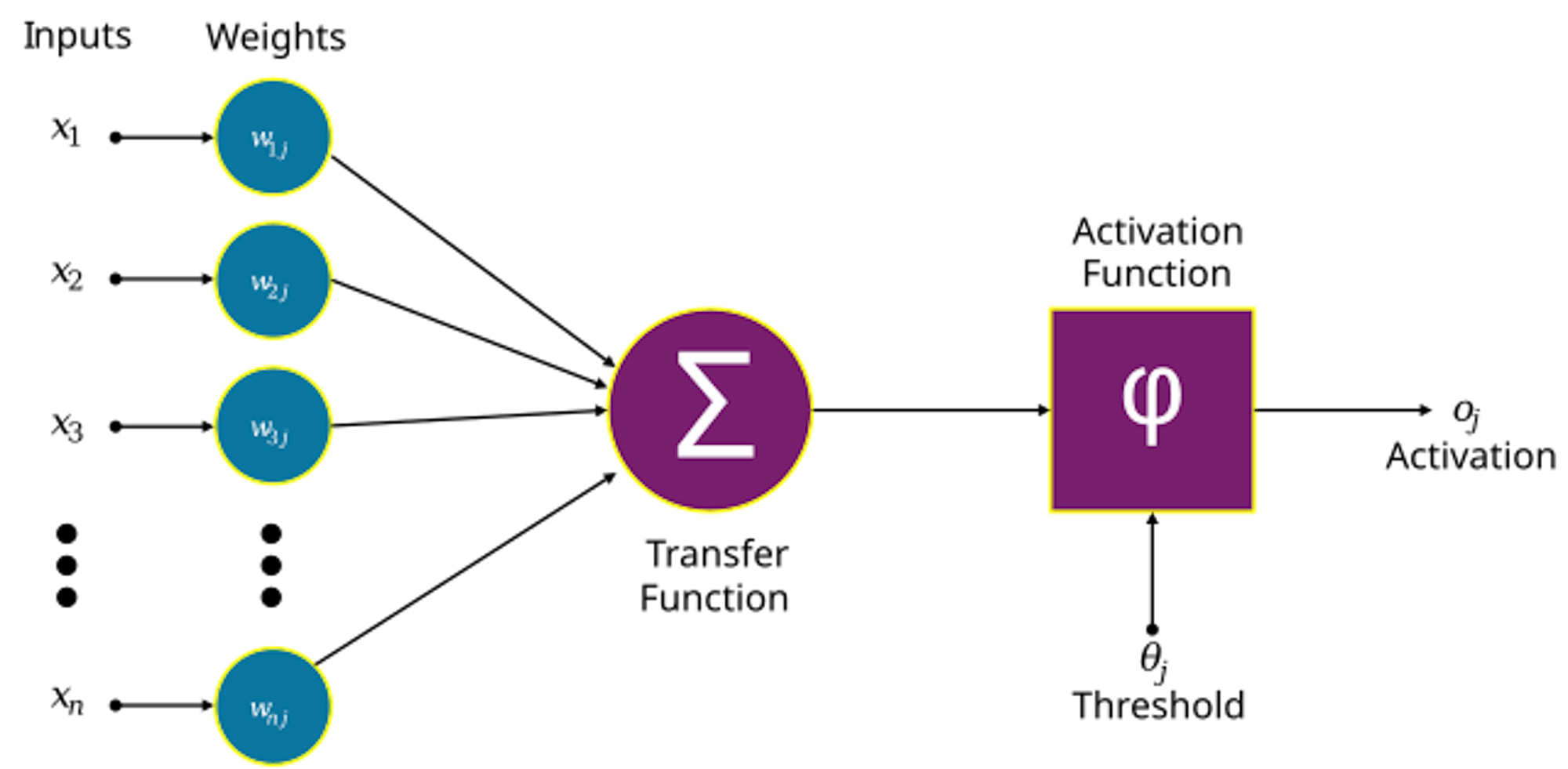
At its core, the artificial neuron functions very similarly to its biological counterpart — it depends on a bio-amplitude memristor, a device that stores and releases charge, similar to how a neuron’s membrane integrates incoming signals. When enough charge builds up, the memristor ‘turns on,’ producing a voltage spike that mimics the opening of sodium channels in real neurons. When it turns off, it produces a brief reverse voltage, acting like a refractory period in biological action potentials. A resistor-capacitor circuit helps shape the timing and dynamics of the neural spike. Together, these components allow the artificial neuron to imitate key features of real neurons, including signal amplitude, frequency of firing, energy efficiency and spike shape.
This technology combines protein nanowires with electricity-producing bacteria called Geobacter sulfurreducens, which naturally generate conductive protein filaments. The artificial neuron starts with a silicon chip patterned with microscopic metal electrodes. A thin layer of hafnium oxide is added to form a tiny gap. Natural protein nanowires from Geobacter are then dropped into the gap, creating a memristor that behaves like a biological synapse. These nanowires come from a remarkable bacterium known for its ability to conduct electricity.
Nanowires in this study act as a biological bridge between artificial neurons and living cells, allowing the artificial neuron to respond to changes in the electrical activity of living cells — indirectly responding to chemicals, much like real neurons respond to neuromodulators in the brain. This adaptability and the low-energy nanowires required in this system hints at future, more efficient technologies where electronic devices could directly interact with biological systems.
This research is promising for the field of science, as the discovery has enabled scientists to consider how computers can be redesigned to draw inspiration from biology. For example, a group of scientists from Loughborough University, along with contributions from other institutions, developed the transneuron, a new device that could perform tasks that mimic the behavior of multiple neurons at once, so it can handle multiple tasks without software updates, promoting real-time adaptations. The researchers hope to integrate this research into a larger form of network to form a “cortex on a chip” to help build artificial nervous systems for robots.
The development of man-made neurons does more than replicate human biology; it opens up a new era of green electronics that are able to interact with living tissues. Innovations like these promise a future where technology operates with the efficiency of the natural world.



