Editor's Note: June Sarkis is an assistant copy editor at the Daily. Sarkis was not involved in the writing or editing of this article.
To sit in the dark of Tufts’ Balch Arena Theater for 2 1/2 hours, watching a musical spun from Leo Tolstoy’s “War and Peace” might sound like an exercise in masochism. Yet the experience turns out to be something far more delightful: a Russophilic, surprisingly tender and wonderfully inventive piece of theatrical adaptation.
The Tufts Department of Theatre, Dance, and Performance Studies staged five performances of “Natasha, Pierre, and the Great Comet of 1812,” written and composed by Dave Malloy, directed by Maurice Emmanuel Parent, led musically by Dan Rodriguez and choreographed by Amelia Rose Estrada. The production ran from Nov. 12–16.
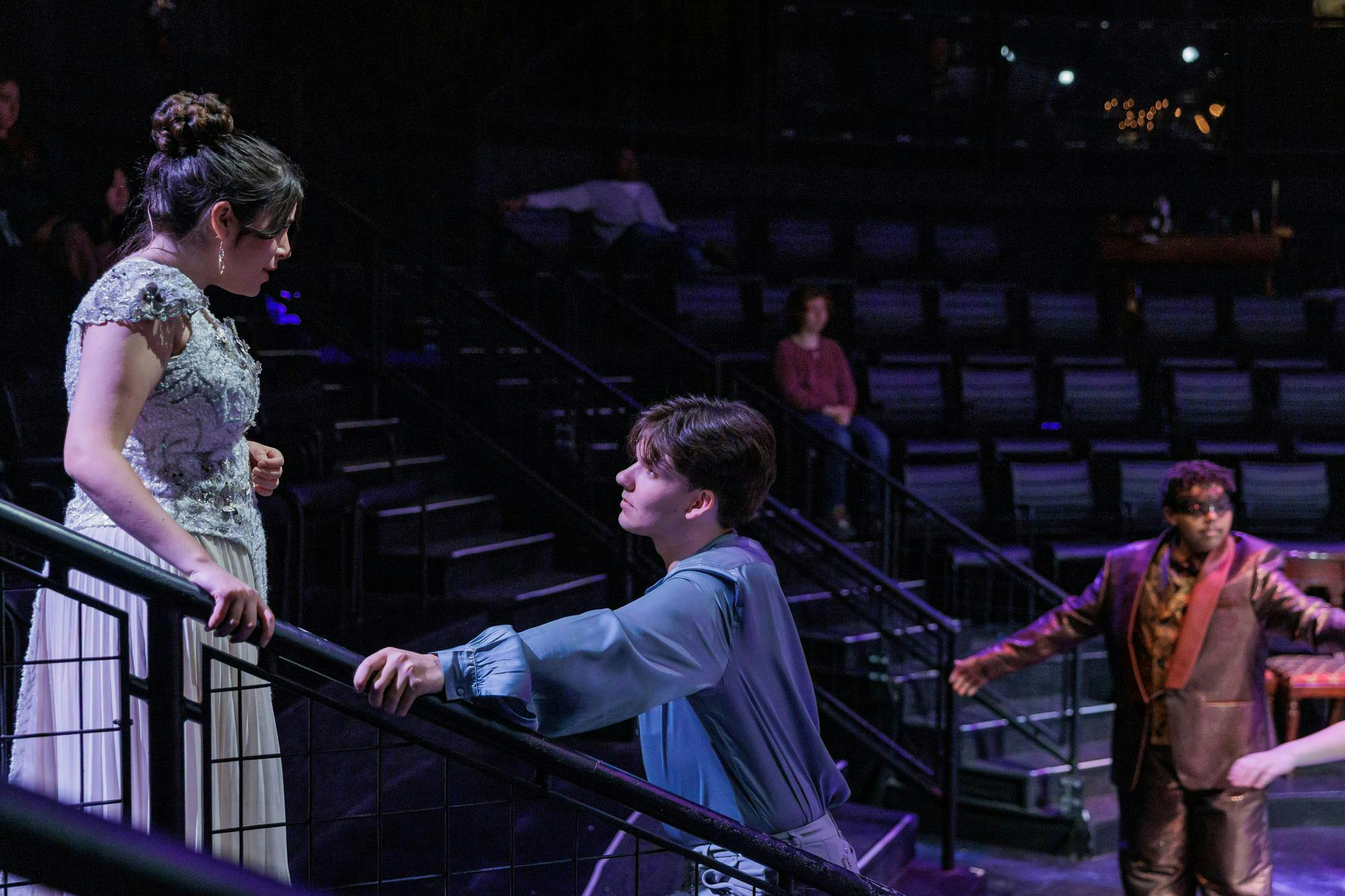
Drawn from a 70-page slice of Tolstoy’s “War and Peace,” the musical follows Natasha (June Sarkis), who is engaged to nobleman Andrey (Wylie Doak). Natasha travels to Moscow with her cousin Sonya (Sophie Sommers) to stay with her godmother, Marya (Keira Haley) and to meet Andrey’s father Bolkonsky (Wylie Doak) and his sister Mary (Zoe Browning). There, she is quickly swept into the exhilarating rush of Moscow society and quickly succumbs to the charm of Anatole (Joe Peterson), a well-versed seducer who tries to win over her affection with the aid of his glamorous and conniving sister Hélène (Katie Spiropoulos). Hélène, married to the hapless and melancholic Pierre (Jake Pandina), is having her own affair with Antole’s friend, Dolokhov (Zach Sabatini). And then there’s Balaga (Kevin Santos), the legendary sleigh driver, who bursts in with boisterous gusto and gravitas. This musical is packed with love and betrayal, and, true to its Tolstoyian quality, the real challenge is keeping track of the sprawling cast.
Anyone who has tackled “War and Peace” knows the agony of tracking names. Remarkably, Malloy’s clever structuring, combined with Estrada’s expressive choreography, makes it easy: Natasha is young, Sonya is good and Anatole is hot. Flamboyant Anatole, during the prologue, runs a hand through his hair with a self-satisfied prince charming flourish. In a production with lots of moving parts, Antole’s flourish immediately signals his presence.
Antole spares no woman unflirted with, not even the audience. He prowls the theater for the perfect seat and sits on an unsuspecting lap. The cast also frequently interacts with the audience, speaking directly to them. When Balaga arrives, the scene erupts into a vodka-fueled party with the cast and audience clapping together, egged on by a 10-person orchestra pit.
As envisioned by Parent, Rodriguez and Estrada, “The Great Comet” treats storytelling as an immersive experience. For audience members whose attention span has been whittled down by short-form content, the show yanks you headlong into early 18th-century Russia.
Malloy favors minimal production design, prioritizing story and music, so the set remains deliberately sparse. Glittering chandeliers and antique paintings gesture toward 18th- and 19th-century Russia, but the bareness exposes the characters’ vulnerability, echoing Natasha’s fragility within Moscow society. The staging also uses height to underscore betrayal: in Act II of “Sonya and Natasha,” Natasha betrays the one person who genuinely cares for her. She looms on the mezzanine while Sonya lies on the floor, defeated by her cousin’s betrayal. The production takes Tolstoy’s obsessive attention to his characters — every glance, every touch, every kiss at the granular level — and dramatizes it so the audience can understand even the most complicated characters like Pierre.
Pierre is profoundly awkward and extroverted all at once. He’s out on the town, buying rounds for everyone, stumbling through aristocratic parties, being pushed around by all these people and looking completely lost the whole time.
Even though his name is in the title, Pierre isn’t driving the story; rather, the musical follows Natasha, with occasional pit stops into Pierre’s emotional journey. Most of the time, he’s stuck at his desk, reading, drinking, obsessing over Napoleon and drowning in a kind of drunken existentialism, married to a woman who couldn’t care less, while the world keeps moving around him. His clothes tell the same story, too. He’s dressed in all black in the midst of glittering dresses, sparkling jackets and heavy Russian furs.
When Pierre finally steps into focus, Pandina balances the character’s self-awareness with genuine emotion. Tolstoy’s psychological detail grounds Pierre’s introspection, while the music, staging and Pandina’s performance reveal his raw feeling. Pandina shifts seamlessly between first and third-person narration, as though Pierre is observing himself from afar. Each gesture — his hesitant reach for Natasha or his calm gaze at the Great Comet of 1812 — betrays his search for meaning. In these moments, Pandina captures Pierre’s quiet triumph in discovering purpose.
In a world that feels disconnected and saturated with endless distractions, Tolstoy’s themes of searching for meaning, and finding it through others, remind us that human relationships remain a source of purpose and understanding.