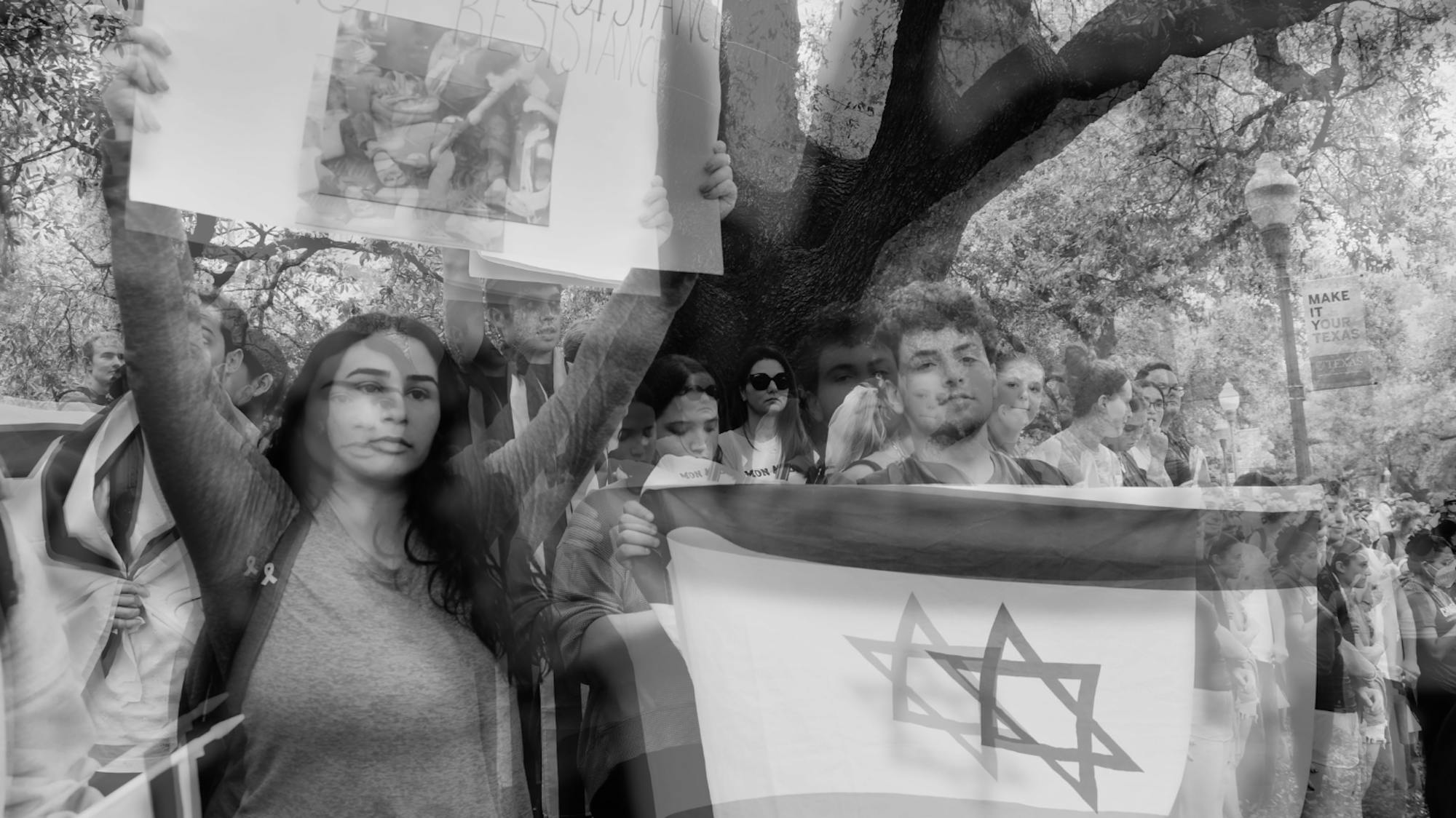
On a chilly spring evening in 2024, 150 student protestors placed their arms around each other's backs and gently swayed to avoid being broken apart by police. Tents where protestors had been sleeping for almost a month dotted the Academic Quad, where a large, makeshift wall constructed of plywood and paint stood tall. Despite the break from chanting “From the river to the sea” and “Apartheid kills, Tufts pays the bills,” the scene was tense. A mere two hours earlier, University President Sunil Kumar had issued a “no trespass order” to all students remaining in the encampment. Students anxiously waited to see whether their sleepy Massachusetts campus would erupt into the kind of violent confrontation between police and protestors seen at Columbia University and University of California, Los Angeles.
Such demonstrations at Tufts and other universities have been viewed by some as emblematic of the antisemitism Jewish college students have faced in the past two years. In the months following Oct. 7, 2023, activists and politicians alike have called on universities to take stronger action to protect Jewish students. Tufts later became one of 60 universities under investigation by the Department of Education following complaints of antisemitic discrimination.
Yet for many Jewish students, conversations regarding campus culture today have misrepresented their lived experiences. While many have endured antisemitism amid the campus turmoil, others have greater grievances against university administrators’ handling of protests and the administration of President Donald Trump's crackdown on free speech.
Over the past two years, many Jewish students have found their identities scrutinized by their peers and exploited on the floors of Congress as the President waged war against universities. Amid ever-increasing political tensions, Jewish college students have longed for a simple dream: to just be college students.
I. Healing — רְפוּאָה
Two days after Oct. 7, 2023, Tufts’ Students Justice for Palestine sent an email praising the “creativity” of the Hamas attacks that killed 1,200 people in Israel. Soon, cries of “Glory to intifada” to the beat of a makeshift drum, echoed across campus, and the seeds of activism began to sprout. For Jewish students, the fall of 2023 blurred into grief, confusion and frustration as they navigated both the tragedy of the attacks and the divided campus they found themselves in.
Junior Peri Karpishpan, a freshman at the time, recalled the difficulty of that fall. “It was tough. The idea that a bunch of people got murdered [or] taken hostage, some of whom … you know, and then you have a bunch of people celebrating it — that was hard,” she explained.
But Karpishpan also stressed that people should continue to protest, so long as such demonstrations don’t become disruptive or veer into antisemitism. “If somebody were to start a protest right now to end the war — for a ceasefire — I’d join it,” she said, “But [I] couldn’t join it now, because they’re gonna still scream ‘Long live the intifada’ … and imply that Israel shouldn’t [exist] at all.”
Tufts has since suspended its SJP chapter — a decision Karpishpan believes has made campus safer. Indeed, universities around the country have suspended or banned their SJP chapters, citing violations of school policies or incidents of antisemitism.
Yet for some Jewish students, curtailing Pro-Palestinian activism will not have the positive effect administrators may think it will.
Senior Meirav Solomon, national board president of J Street U, a student arm of the wider J Street organization that lobbies for a two-state solution, discussed how political polarization has further complicated the ability to process the conflict. “It can’t just be that somebody makes a mistake and says the wrong thing … and we just shun them. … That’s not how we build the community that we want to build,” Solomon said. “We have to bring them in. We have to say, ‘Here’s how you hurt me.’” While Solomon believes many of the actions taken by SJP were harmful, she disagrees with the university’s decision to suspend the organization. “I think that every club has a right to exist on this campus,” she said. She believes it’s necessary to provide students with a path toward having these difficult conversations.
For Jews everywhere, the pain of the Oct. 7, 2023, attacks has been compounded by a renewed confrontation with Zionism and a concerning uptick in antisemitic incidents. For college students in particular, the ability to move forward came with its own unique set of challenges.
Solomon reflected on living in a dorm her sophomore year in the aftermath of Oct. 7, 2023, knowing that the hallways could contain students with a constellation of different viewpoints, some of which were likely directly at odds with her own. She points out that, “as college students, you see news pundits all the time. They get to argue about Israel and Palestine, and … never have to see the other person they were arguing with on the show ever again if they don’t want to. … We have to live next to each other.”
Moving past the Oct. 7, 2023 attacks and to a point of normalcy has proven nothing but difficult for students. In the wake of campus turmoil, many Jewish students have been forced to censor their beliefs to avoid social ostracism. A study conducted by Tufts professor Eitan Hersh for the Jim Joseph Foundation found that one in four Jewish students nationwide feel the need to hide their Jewish identity to fit in on campus. The study also noted that 45% of Jewish students at elite college campuses had lost friends because of the conflict.
Sophomore Ely Cristol-Deman described feeling apprehension about sharing his Israel-forward views outside Jewish spaces, and expressed discomfort with the “Zionist” label.
Karpishan also noted the social risks that come with outwardly expressing Zionist views. She explained, “When you say you’re Zionist, you’re kind of f---ed no matter where you are, because that’s such a loaded term,” adding that, “You walk in the door and like, [people will think], ‘Oh, it’s a white supremacist. It’s a person who hates Arabs.’”
Even within Jewish spaces, finding catharsis has proven difficult for many Jews. In the wake of campus turmoil, Solomon found it challenging to attend services at Tufts Hillel, where she felt her views were judged. “It’s one thing to pray with the people you disagree with, but it’s another thing to pray in a space that you know fundamentally wouldn’t allow for your ideas to be presented, or welcomed as genuine or valid,” she explained. Ultimately, Solomon turned to other outlets for spiritual fulfillment, attending off-campus synagogues and finding community through J Street.
II. Repair the World — תִּיקּוּן עוֹלָם
In Washington, the protests on college campuses prompted congressional hearings with university presidents, academics and students to better understand the situation at hand. While heading home from her brother’s bar mitzvah, Solomon received a call asking her to testify before the Senate about her experiences as a Jewish student. Although she was incredibly grateful for the opportunity, she said the experience encapsulated the high expectations placed on Jewish college students today.
“When I left the Senate testimony, I had midterms to get back to,” Solomon said, adding, “My primary job right now is to be a student. … It’s not to be telling US senators, ‘Please don’t cut my university’s research funding because you think that somebody holding a Palestinian flag is anti-Semitic,’ because it’s not, and I’m Jewish and I’m fine.”
Solomon also described how the media has poorly represented the experiences of Jewish students, further leading to misunderstanding. “Imagine watching somebody say that they’re telling everybody else your life story … and everything is wrong,” she said.
Much of the tension surrounding the conflict has only been exacerbated by the Trump administration’s response.
Cristol-Deman described the president’s current actions as the “political weaponization of the term antisemitism.” He noted that, for many Jews, watching Trump suddenly seem to care about antisemitism — despite his association with Charlottesville and the Jan. 6 insurrection — feels frustrating and insincere. Karpishpan agrees, asserting that, “the idea that the way to solve [antisemitism on campus] is to get the government involved and threaten to withhold funding until the school caves … is not going to end well for anyone, and I certainly do not support that.” In fact, roughly 60% of Jews disagree with the White House’s decision to freeze federal funding from Harvard and UCLA on the grounds of protecting Jewish students.
Cristol-Deman further expressed concerns that recent restrictions the university has placed on pro-Palestinian-related activism will ultimately cause people to blame Jewish people for suppressing free speech. “The far left is going to say, well, this was done in the name of Jews, and so the Jews are going to be scapegoated for it; at least that’s my cynical prediction.”
If neither the president nor the university is doing an adequate job at protecting Jewish students, who is?
When asked, Solomon responded with a laugh. “You’re the first one to ask that,” she said. After reflecting, Solomon described the importance of J Street in protecting both Jewish and Muslim students. Solomon also noted how many of the organizations that Jewish students have relied on have ultimately failed to be there for students and, in some cases, betrayed their mission altogether.
Karpishpan believes that Jewish organizations, specifically Jewish on Campus — a group dedicated to writing about antisemitism and providing resources to help students address it — play a significant role in protecting the well-being of students. Cristol-Deman also credited Jewish communities such as Hillel with looking out for Jewish students during these tumultuous times.
III. Hope — תִּקְוָה
After two years of war — to the day — Hamas and Israel reached a ceasefire agreement on Oct. 8. All 20 living hostages were returned back to Israel in exchange for 2,000 Palestinian prisoners. The announcement of the ceasefire came during the Jewish festival Sukkot, a time marked by singing and dancing. For Jews around the world, the return of the hostages marked the end of what had been a long nightmare. Yet at the same time, reconciling with the Palestinian and Israeli lives lost has only just begun.
At Tufts, the two-year anniversary of the attacks was met with varied responses. “Bring them home” was painted on the cannon one day, hoping for the hostages’ return; “Free Palestine” was painted on the cannon the following day.
Still, this October was far more peaceful than the divided campus of 2023. Red and orange leaves covered the rolling hills of President’s Lawn, and the sounds of students chattering between classes filled the air. Grass has long since grown over the spots where tents once filled the quad.
Though doubts about whether the ceasefire will hold certainly remain, optimism for the future of campus life persists. However, the pressure placed on Jewish students over the past three years is still very real.
“Once I graduate, I’m so excited to not be a Jewish college student, and just be a Jewish young adult,” Solomon joked.