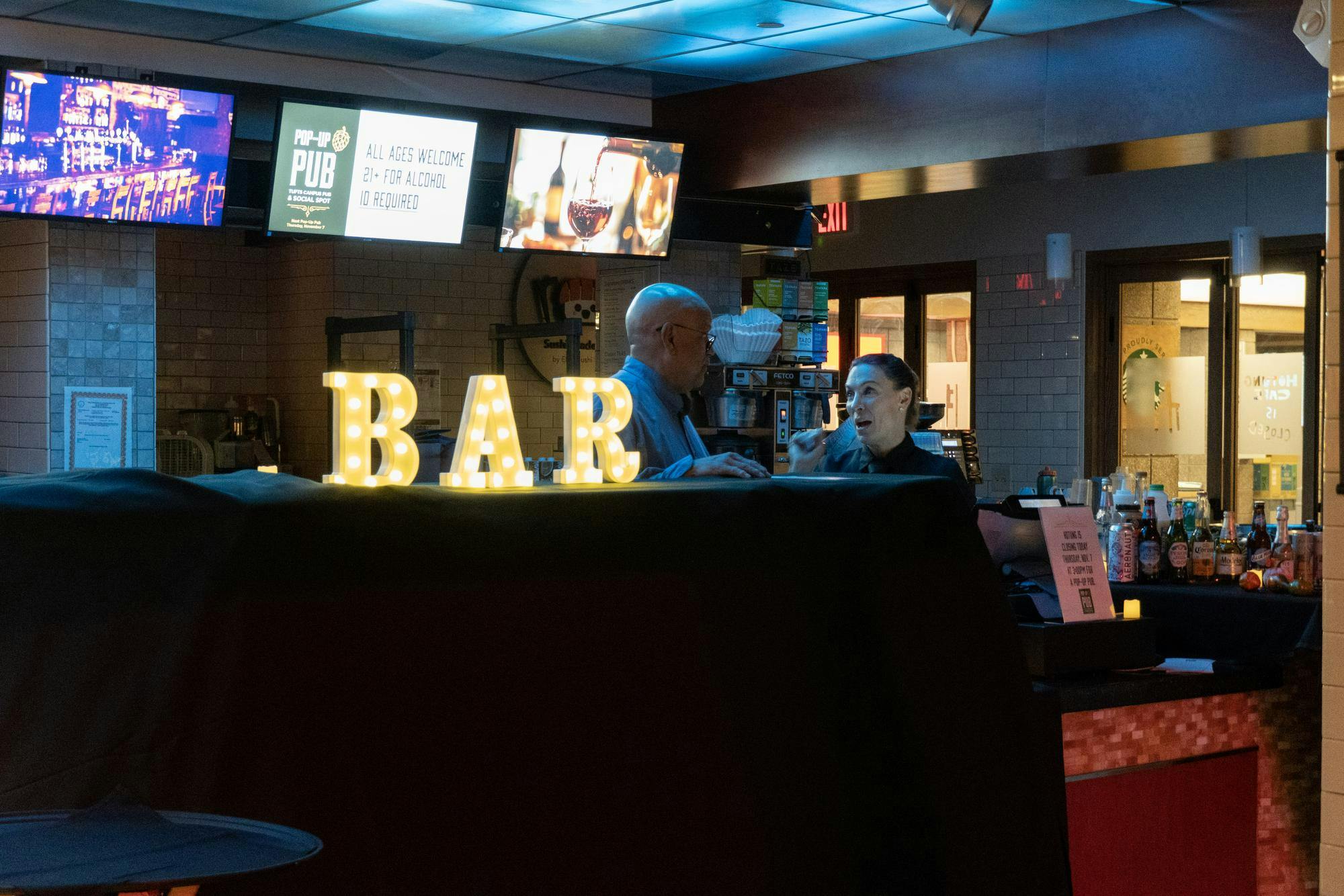
It’s a Thursday evening, and the normally cozy, inviting Hotung Café is blocked off from the rest of the Mayer Campus Center. Deep purple mood lighting fills the space. The counter that serves vanilla lattes and chocolate croissants by day is now a fully stocked bar serving alcoholic beverages to those 21 and older. The café’s glamorous alter ego that only comes out to play once a week from 5–9 p.m. is here: the Pop-Up Pub.
The Pop-Up Pub launched in November 2024 as a joint effort by the Tufts Community Union Senate and Tufts Dining, with support from the deans of the School of Arts and Sciences and School of Engineering, the chief student officer for AS&E and University President Sunil Kumar.
Conceptually, it’s a very attractive setup: a cool place for students to chill out, crack open a cold one or try a classic cocktail without ever having to step foot off campus. However, there is one small problem.
No one is there.
One Thursday around 6 p.m., I noticed the sliding doors separating the swanky little area of Hotung from the perpetually crowded Campus Center had been pulled shut. I walked around to the exterior of the building, only to find both doors suspiciously locked. I returned to my friend, defeated because my plan to check it out had fallen through.
As I left the building about 20 minutes later, I decided to try again. This time, the door was open. I was greeted by manager Jasmine Allan, who, with a bright demeanor, answered my questions about the pub. Despite her enthusiasm, the loneliness of the pub itself was quite depressing. We took our place as the only people in the seating area.
Allan, a retail dining manager at the Campus Center, said the highest attendance she’s seen at an alcohol-serving Pop-Up Pub event is 13 patrons.
“I’ve heard a lot that [Tufts Dining has] tried [to increase attendance], and it’s just going nowhere,” Allan told the Daily. “A lot of the students [on the] marketing team just don’t want to come, don’t want to promote it or anything. It’s like beating a dead horse at this point.”
Allan believes that inadequate marketing strategies have contributed to the low turnout.
“In my opinion, advertising could be a little better, especially because you get so many new students,” Allan said. “And in my first couple weeks of doing the pub, I have had people coming and going ‘What is this? What’s going on?’ And then they’re like, ‘Oh this is really cool — this happens every week?’”
However, Allan is hopeful that the pub will grow in popularity and has spoken with groups such as Tufts Film Club and Jumbo Drag Collective about collaborating on events. She sees strong potential in the space, especially for movie nights and drag shows. But realizing that potential is another story.
“The idea is there, but bringing people in is tough,” Allan said.
According to Amy Hamilton, manager of strategic communications and marketing for Tufts Dining, the Pop-Up Pub intends to enhance the student experience by fostering community and conversation on campus, but the space relies on student organizations and other campus groups using it for collaborative functions.
“Attendance has varied from week to week, with higher turnout when the Pub partners with a collaborator who brings their members,” Hamilton wrote in an email to the Daily. “These collaborations are most successful when the partner actively promotes the event.”
Hamilton explained that partnering with student organizations, who increase the attendance by bringing their members to the pub, is an essential part of its marketing strategy.
“There have been recent initiatives to boost attendance, but they rely on student groups to take the lead in organizing and promoting the events,” Hamilton wrote. “The Pub provides support and space, but a successful turnout depends on student involvement in planning and outreach.”
Still, programming options remain limited. If a group wants alcohol at their Thursday night pub event, they must, as Hamilton suggests, “get creative with their programming, like [with] trivia nights, interactive games, or a crafting activity.” The current liquor license at Hotung Café does not permit alcohol to be served alongside live entertainment.
Senior Rory Myers believes that having live music would boost attendance substantially. The Burren, a popular Davis Square pub, offers live music by college bands and alcohol on Thursday nights, putting the Pop-Up Pub at a competitive disadvantage.
“There’s already a major event going on for people who are over 21 on Thursdays,” Myers said. “So, already everyone wants to go to that. … [The Pub could be more popular] if it was on another day and they perhaps had more exciting things available, perhaps even live music.”
Allan recognizes this competition as well. As a new manager, she is working on getting a new liquor license that she believes would solve this conundrum.
“I have had friends that are currently going to Tufts or have graduated and most of them have been like, ‘No, I’ve never been to the pub because it’s on a Thursday. I’m going to The Burren.’ Or something of that nature,” Allan said.
Myers had a similar experience. When I asked if he had ever been to the campus pub, he simply replied, “Nope.”
He had come across the pub once unintentionally and, put off by the lack of signage and promotion, promptly left. It felt slightly unusual because a campus pub at Tufts should be a big deal — students had been asking for one for years. And yet, it sprung up almost silently on the Tufts campus, like a mushroom through soil.
“I lowkey didn’t know about it until this year,” Myers said. “There was, like, one sign outside the Campus Center. And I was like, ‘Oh, that’s a little weird — I wonder what that is.’ And then I never went.”
Because Tufts is, well, not exactly known for its thriving party scene, Myers believes that an event run by the university would seem performative.
“It feels like more of an advertisement, that we have more of a social life [than we actually do],” he said.
How do we make the Tufts pub not lame? Myers said more student feedback would help.
“I think there’s ways to make it more interesting and that would involve talking with students,” he said. “And also perhaps loosening up some of the social rules they have in place outside of the campus pub.”
Hamilton noted that student input has been used to develop the pub, but responsibility falls on students to host collaborative events that reflect what they want it to be. Ultimately, the Pop-Up Pub is what students make of it.
“Student feedback has played an important role in shaping the Pop-up Pub,” Hamilton wrote. “We’ve heard consistently that students enjoy having a casual, social space on campus, and that interest increases when events are tailored to specific communities or themes. As a result, we’ve focused on collaborating with student groups to co-host events that reflect their interests and identities.”
Allan wants to be more engaged with students and incorporate their feedback into an iterative process, but her role gives her little direct access to student comments.
“I would love to have more of a way to [reach out to students directly],” she said. “So far we’ve just been utilizing a little QR code around dining [centers], but us as retail managers, we have no access to see any of that. It all goes to somebody else. So I would love to know what people think.”
And what do Jumbos really think?
“Tufts should have a dispensary,” Myers joked.