
In Boston’s Symphony Hall, beyond the sprawl of hallways and swinging double doors, there lies a room — the Rabb Room — where conversations take place under the hum of quiet classical music.
On Nov. 21, a group of Tufts students, led by their Music and Nature professor Jeremy Eichler, had the opportunity to spend their afternoon there, speaking to the composer of the afternoon performance’s piece before enjoying the composition itself in the grand performance hall.
The young English composer, Grace-Evangeline Mason, discussed her 12-minute piece entitled “The Imagined Forest,” which was about to be performed by the Boston Symphony Orchestra. Describing her intentions for the piece, Mason emphasized the importance of audience interpretation.
“It’s meant to be the forest of your own imagination. I don’t want to prescribe to you, kind of, what you should be imagining,” she said.
The co-authors of this article, indeed, found their own ways to nature through the composition. Onion-De noted the fluttering of butterfly wings, the prodding steps of a large mammal and moments of dance through playful percussion. Between moments of intense weather and rushing water, the piece also provided quieter moments of reflection.
For Stearns, the evocation was foresty without necessarily being incarnate in animal form — he felt both curiosity and awe in the music, and a sense of immersion through stasis: rumbling percussion, quivering violins and slowly sliding trombones. He wondered, though: Did he imagine a forest because he was told to imagine a forest? Or was the music itself inherently, tangibly ‘natural’?

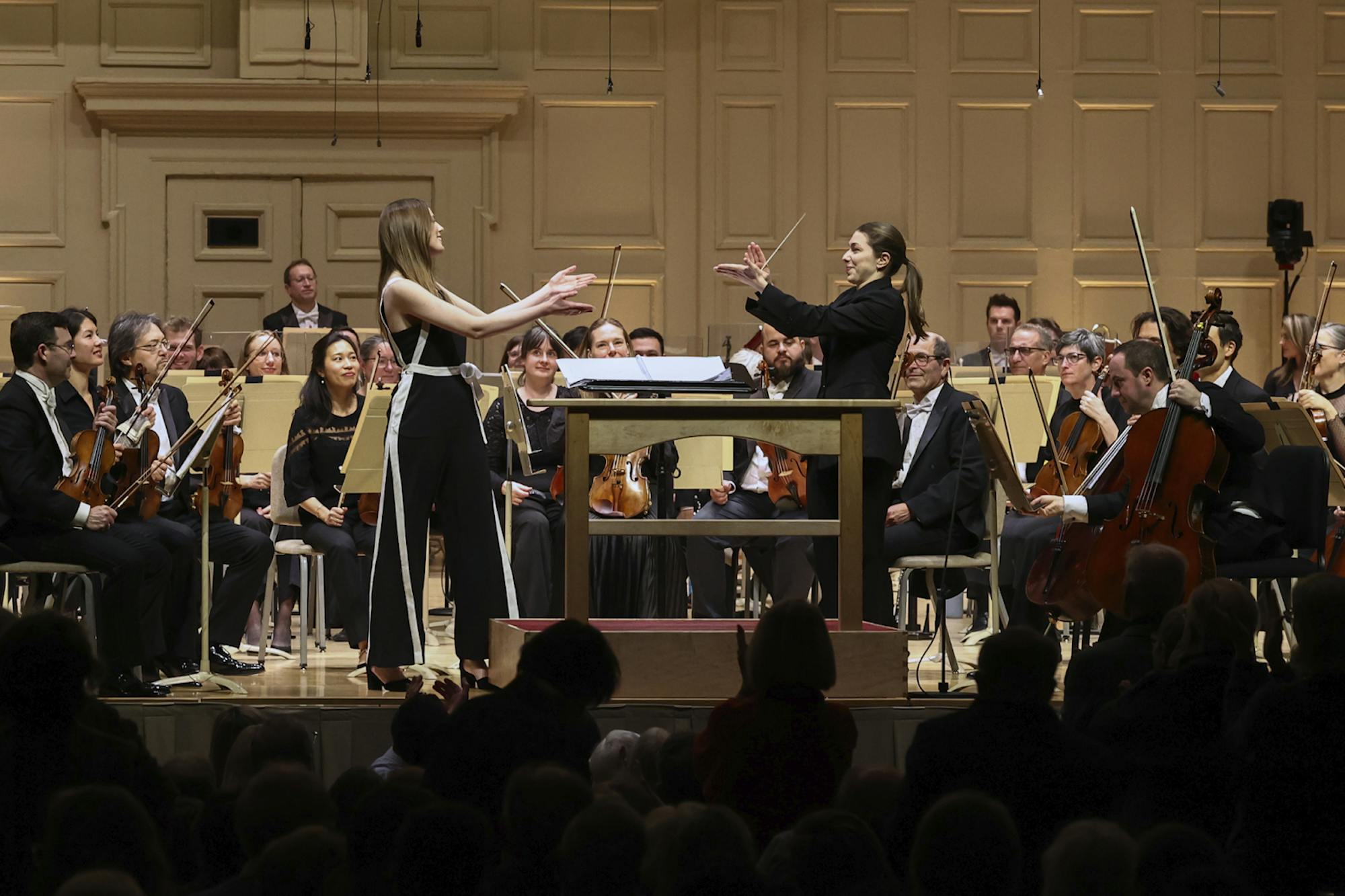
Anna Handler conducts the orchestra.
Sophomore Rubio Castagna-Torres, a student in the class, described his own interpretation and imaginative landscape.
“There [were] a few moments where I heard a bunch of birds overhead. There [were] definitely certain times where I could really visualize leaves rustling,” he said. “Especially in the stiller moments, you could just really picture yourself, I thought, in a forest, hearing the sounds that trees make.”
Mason finds delight in the range of responses to her composition.
“When people hear it, some people have told me that they’ve heard completely different things,” Mason said. “An audience member last night told me that they heard an elk braying in the forest. …That’s a new one. I quite liked that.”
Mason’s composing process draws heavily from her experiences with the natural world. “There’s definitely music in nature, from my perspective, at least,” she said.
She also found it important to consult an extra-musical source, such as visual art or poetry, noting the inherent music in poetry.
Castagna-Torres particularly enjoyed how a prior knowledge of Mason’s creative process affected his listening experience.
“She said when we were meeting her that she was more recreating the feeling [of nature], which contextualized it really well for me,” he said. “Hearing her process was really awesome. I loved hearing her perspective on the music in nature.”
“The Imagined Forest” was performed to a packed house under conductor Anna Handler, who also led the BSO through Thomas De Hartmann’s “Violin Concerto” and Modest Mussorgsky’s “Pictures at an Exhibition.”
Visiting “superstar violinist” Joshua Bell, the soloist for the de Hartmann piece, was a centerpiece of the program; he wielded his violin like a hero would a sword, with a vivid triumph etched on his face after every phrase. This stood in contrast to Mason, who delivered brief opening remarks, then sat in the right wing of seats to experience the concert for herself along with the other concert-goers.
“I’d rather my music be more escapism than something that’s … [of] the modern world,” Mason said. “I’d rather use the music or the visual art that inspires me as threaded to this thing that I feel is timeless.”
During the discussion, Tufts students’ raised political questions; some wondered whether her piece might carry an environmentalist message. Mason’s response was clear.
“The thing that draws me to nature is almost that it’s bigger than ourselves. … By writing art about it, regardless of whether it’s deeply trying to make a statement, it sort of is making a statement — in its celebration of nature.”



