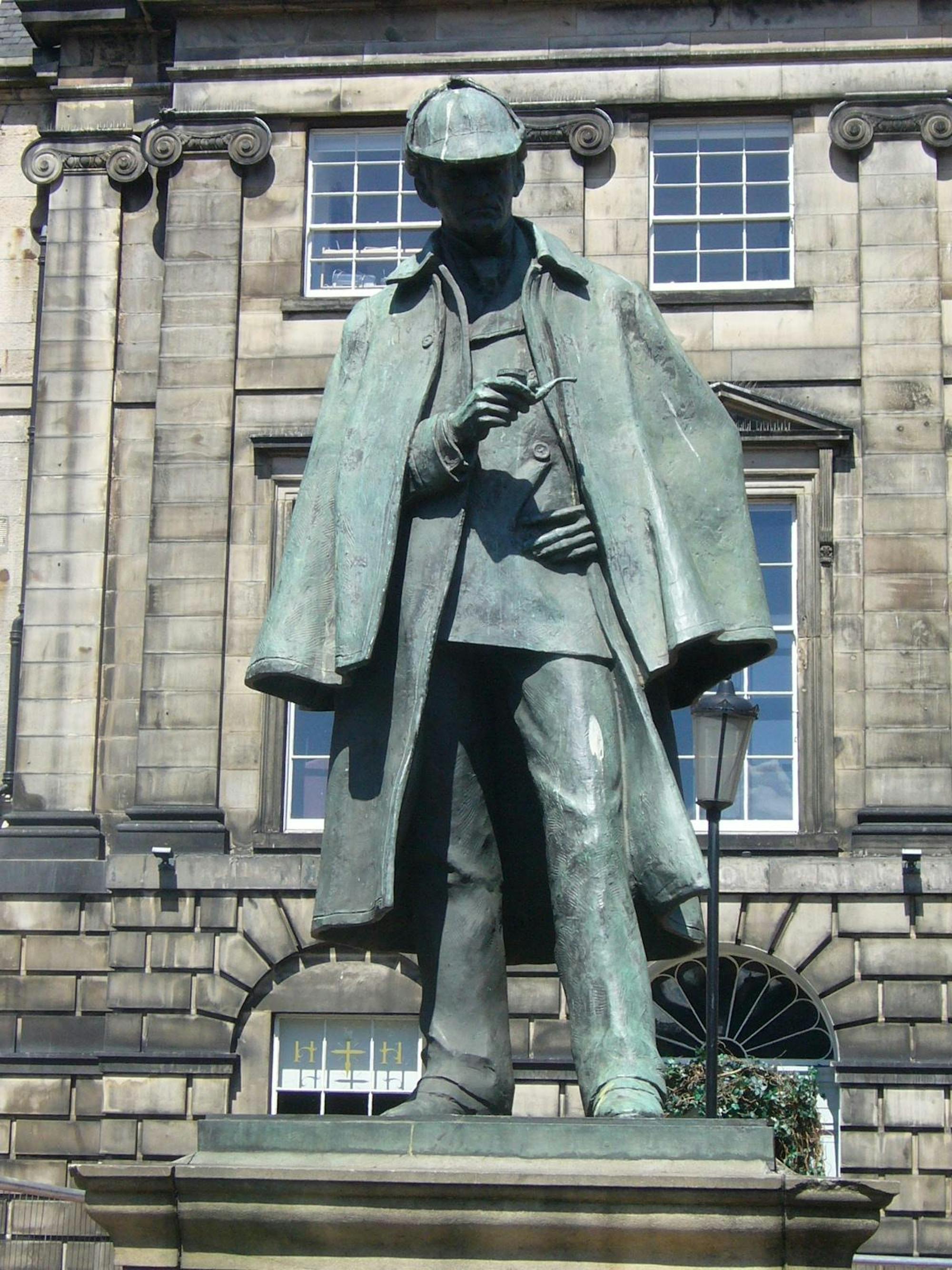
“Moriarty is dead, to begin with.” And after spending three years without his nemesis, master detective Sherlock Holmes is bored and depressed. No case in London tempts him, and he is estranged from his now-married friend Dr. John Watson, even refusing to come to his house for Christmas. Worse, he imagines that he sees Moriarty’s ghost around London. Gloomy, grouchy and very much not in the Christmas spirit, Holmes mopes alone on Christmas Eve — until a doctor asks him to investigate a mysterious death.
Despite his ennui, Holmes cannot help but deduce everything about the doctor: He was poor in childhood and grew up severely ill, but was later healed and educated thanks to a wealthy benefactor who is, unfortunately, the deceased. Naturally, the doctor is a grown-up Tiny Tim, and his benefactor is Scrooge, who, after encountering the three ghosts of Christmas, changed into the kindest and most beloved man in town. Now there is a missing will and a stolen jewel— the Blue Carbuncle — and Sherlock Holmes cannot resist the case.
Mark Shanahan’s “A Sherlock Carol,” first performed in 2021 at New York City’s New World Stages, will run at Lyric Stage Boston until Dec. 21 and is directed by Ilyse Robbins. The comedic Christmas mystery mashup of Sherlock Holmes and Charles Dickens’ “A Christmas Carol” is full of Easter eggs that will delight fans of either work. While many jokes reference the source material, all that’s needed to enjoy the show is a willingness to suspend disbelief and embrace the absurd.
The play features only six actors, four of whom — John Vellente, Michelle Moran, Mark Linehand and Leigh Barrett — take on multiple supporting roles, switching between them with impressive dexterity as they narrate, carol and act.
The set transports us to a foggy London street illuminated by street lamps, with a cityscape projected behind the brick facade of a building. Staged in the round, the direction allows actors to give attention to each section of the audience without it appearing unnatural, even as furniture is reoriented between scenes. Actors climb the audience stairs to reach Scrooge’s study, situated on a balcony overlooking the stage and decorated with Christmas garlands.
From the beginning, the play compares the depressed Holmes and Scrooge prior to his ghostly visitors. Holmes shouts “bah,” scorns Christmas and eats his meals alone. These similarities grow increasingly absurd as the play goes on. For instance, after forgetting his coat, Holmes borrows one that just so happens to have belonged to Scrooge — and then frightens people with his resemblance to the deceased.
Actor Paul Melendy brings a masterfully sulky demeanor to the detective, juxtaposed with Christopher Chew’s Scrooge, who bubbles over with joy. Their performances are not naturalistic: Chew strikes dramatic ghostly poses and prances about giggling, while Melendy raises an eyebrow at the audience after quoting Conan Doyle’s particularly famous lines. This extremity adds to the delight of watching Holmes’ transformation, as Shanahan and Robbins bridge the gap between the unchanged Holmes and the changed Scrooge in unexpected — sometimes far-fetched, but always amusing — ways.
The exaggerated comedic reactions also emphasize moments of character development. Unlike “A Christmas Carol,” Holmes changes not primarily because of the ghosts, but because of the people around him. In the cold London air, he is given a scarf, then a coat, then a hat and, finally, a hug from various characters — despite his rudeness. Amid exasperated groans, frequent insults and spooky encounters, Melendy’s Holmes becomes still, pensive, afraid and unmistakably human — learning to both receive and express kindness while unsure whether he can truly change.
The play’s absurdity is justified by its source material itself. The mystery closely follows that of the Sherlock Holmes story, “The Adventure of the Blue Carbuncle.” Lines such as “By the way, about the bird, we were compelled to eat it” and “This year, our good host, Windigate by name, instituted a goose club” come directly from the text, as do dramatic sobbing pleas for mercy and a literal goose chase. Both stories also conclude with acts of kindness by Holmes, suggesting that he is not as cold as he is often portrayed.
Holmes’ transformation is complete when his joy as he induces a suspect to confess resembles that of Scrooge on Christmas Morning. Laughing hysterically and overflowing with energy, the cheeriness of Melendy and Chew reflects the joys of Christmas itself. And while unexpected, it does not seem out of place when Sherlock Holmes replaces the original scarf he was gifted with a plaid Christmas scarf and closes the show by singing “We wish you a Merry Christmas” with the full cast as snow falls onto the stage.