
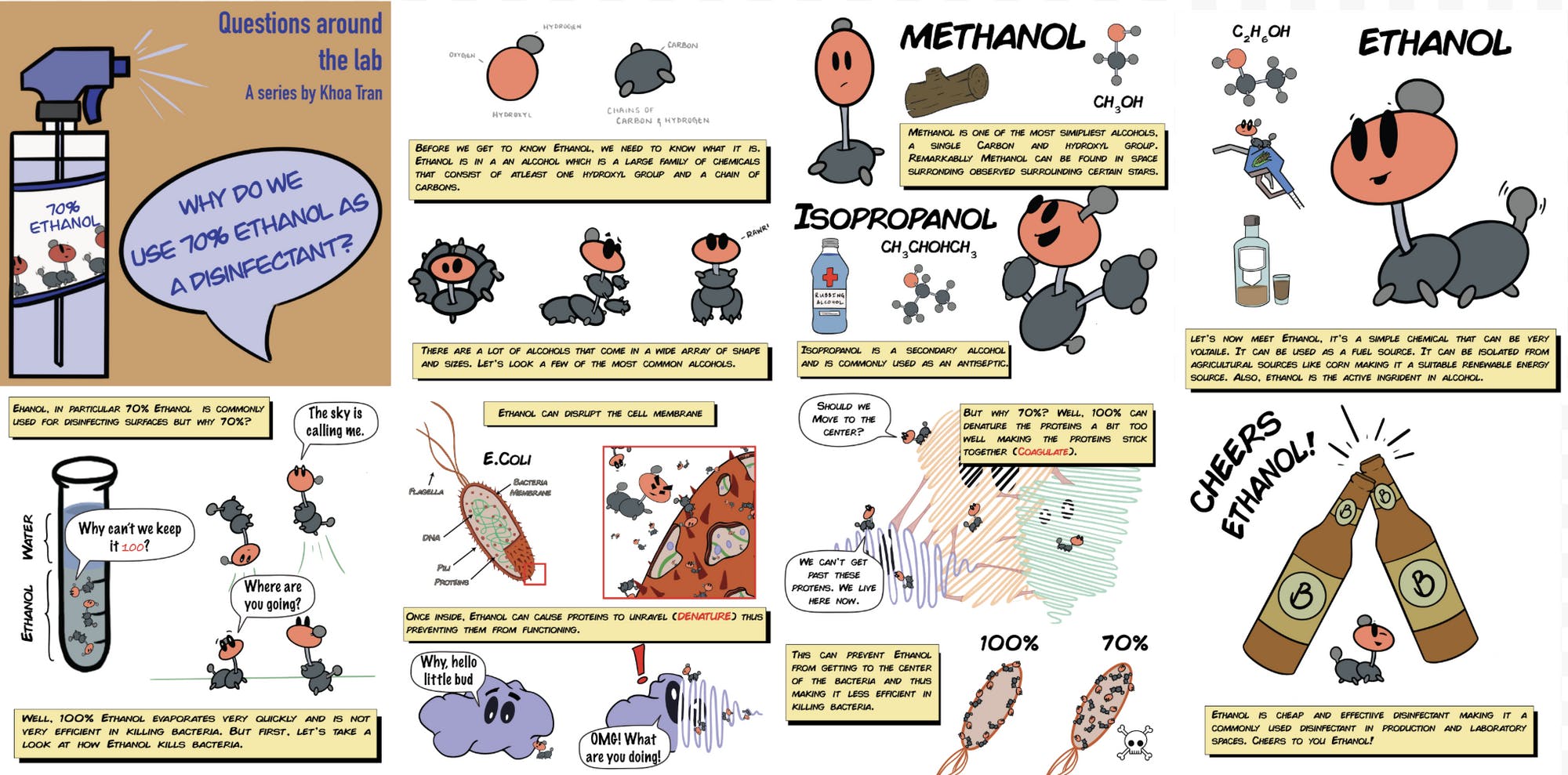
LABLINES: “Linking Arts and Biology through Lines & Narrative for Engaging Science,“ is set to launch at Tufts this semester. The initiative recently received a grant from the Tufts MUSE funding program, which supports “arts, humanities, and humanistic social sciences projects” that may otherwise have limited funding options.
Isabella Arabia, a biology master’s student at Tufts, worked with assistant professor and researcher Khoa Tran to design LABLINES. Both navigate dual identities as artists and scientists, using artistic media as a vessel to communicate their scientific research.
Arabia is a graduate of Tufts’ combined degree program in biopsychology and fine arts. Her art practice centers on raising awareness about science and animals. For example, her senior thesis aimed to foster empathy toward ants.
New to the biology faculty at Tufts, Tran is also a co-founder of JKX Comics, alongside Tufts Assistant Professor Jaye Gardiner and Dr. Kelly Montgomery, when the three were graduate students. According to JKX Comics, their mission has been to “increase scientific literacy, access, and exposure to a variety of STEM disciplines using comics as a vehicle” since their inception in 2015.
Their shared background in both art and science inspired their first meeting, where Arabia said they came up with the idea to apply for the Tufts MUSE grant together. “Khoa already had this idea [that] he wanted to bring the comics here to Tufts and make it something that helps undergraduate researchers get visibility for their work,” she said.
From there, the pair workshopped LABLINES as an initiative that seeks to increase visibility for undergraduate STEM research. The program works to give students the skills to communicate their findings while also encouraging cooperation between SMFA students and STEM researchers.
LABLINES plans to engage audiences through a variety of art forms, including murals and comics. Tran highlighted that comics can be an enduring and approachable medium that engages readers of all ages, making scientific research more accessible.
Through LABLINES, student artists and researchers are not encouraged to adhere to a specific artistic outcome. Tran and Arabia aim to maintain a hands-off approach to students’ creations. “We have two artists that have very diverse art styles, and then we want the scientists to really communicate what they're passionate about and their story, [because] they know the story the best,” Tran said.
The LABLINES project also intends to create a mural on campus to increase visibility for undergraduate research opportunities at Tufts. Tran believes the mural, which will include a QR code linking to research information, will help students who are unfamiliar with how to access research positions.
Tran and Arabia both noted that undergraduate students often struggle to join research labs due to a lack of information about the process. Through LABLINES, Arabia aims to increase accessibility by “sharing the story of not just the research that’s being done, but the scientists behind it and how they got from point A to point B.”
In addition to improving undergraduate access, LABLINES also aims to make science more accessible to people outside the research community. According to Tran, one of the project’s main goals is the “dissemination of science and making sure [it] is accessible across a wide array of … demographics.”
LABLINES will also support communication between current undergraduate researchers and aspiring students. “I feel like a lot of undergrads don’t have a forum to talk to other undergrads,” Tran remarked. Through fostering these conversations, LABLINES aims to increase accessibility to research for all students.
Finally, the initiative will foster collaboration between SMFA students on the Boston campus and STEM students on the Medford campus. Arabia, who studied at both locations, noted that there’s often little overlap between the groups. LABLINES will provide a unique opportunity for students from different academic backgrounds to learn from each other.
Currently, one undergraduate biology researcher and two SMFA artists are set to collaborate this semester to pilot LABLINES. Arabia and Tran hope to eventually establish the initiative as a long-term project at Tufts, involving more student researchers and artists in the future.
While LABLINES is currently limited to biology research, the team hopes to expand into other STEM disciplines in the future. When asked about future growth, Tran commented that delving into other sciences will be a valuable future endeavor. The research background of a biology versus an engineering student is going to be vastly different, and he wants people “to understand the diversity of that experience.”
For now, LABLINES aims to highlight the often-unseen experiences of undergraduate biology researchers and promote a culture of accessibility within the Tufts community.



