

Welcome back to a new semester of Dissertation Diaries. This is the series where we highlight Ph.D. students at Tufts as they approach the end of their degree. This time, we will be highlighting Nicholas Mandel, a fifth-year Ph.D. student in the Sergei Mirkin Lab here at Tufts.
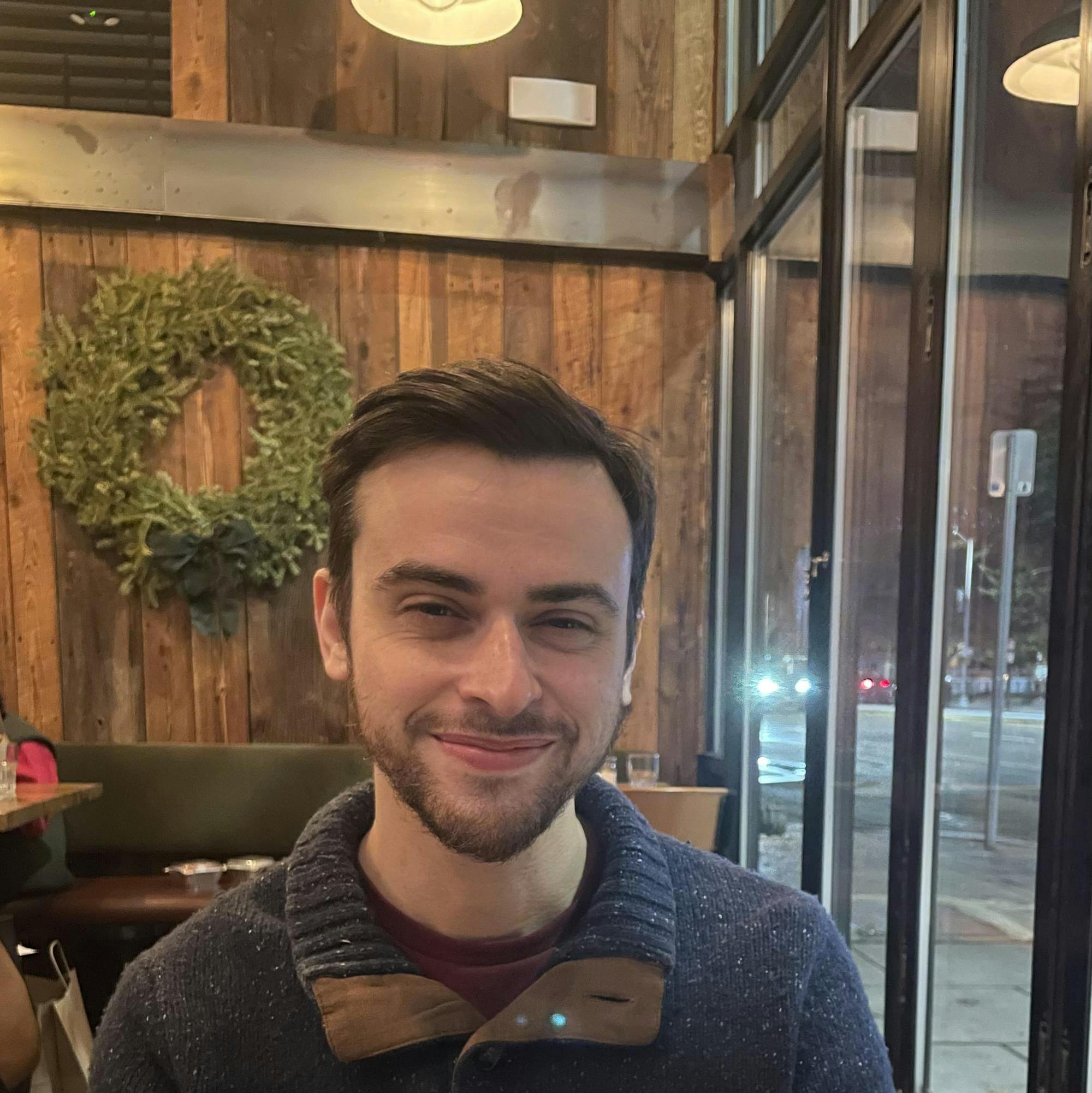
Nicholas Mandel is pictured.
Mandel attended the University of Central Florida after growing up in Tampa, Fla. Originally studying biology, Mandel kept asking questions that his professors would inevitably answer with “you’ll learn that in biochemistry.” This led him to switch his major to chemistry in an attempt to find some answers to those lingering questions. Mandel describes chemistry as a “really mystical and kind of bizarre science when it comes down to bridging the gaps between biology and physics.”
While Mandel was a student at UCF, he met a doctor through a brief internship that introduced him to Tufts, prompting him to do more research into the school.
Mandel was particularly drawn to the Mirkin and McVey labs at Tufts as their research focused on DNA replication and repair, reinforcing his understanding of the mechanisms he was learning in his biochemistry class.
The Mirkin Lab, which he ultimately chose for his Ph.D., examines DNA structure and function, with a focus on understanding how structure-prone DNA repeats lead to genome instability.
DNA is generally known to exhibit a duplex form, with two separate strands forming a double helix. It’s made up of monomers called nucleotides, which contains three components: a nitrogenous base, a five-carbon sugar and a phosphate group. The possible nitrogenous bases in DNA are adenine, thymine, guanine and cytosine, with adenine pairing with thymine and guanine with cytosine.
Although DNA is depicted as a double helix, its structure is far more versatile. Repetitive DNA sequences are patterns observed in DNA that can occur multiple times within a copy of the genome.
What intrigued Mandel was the phenomenon in which these repeat sequences result in unusual DNA structures. More specifically, they can form knots, G-quartets or even triple-stranded DNA molecules.
Enzymes cut and repair DNA, but this can lead to entanglements during the process and form knots. G-quartets, also known as G-quadruplexes, form from guanine-rich sequences and self-bonding through hydrogen-bond base pairings. The resulting structures have many implications for DNA functioning and processes.
Mandel is currently studying how the different structures previously mentioned impact DNA replication.
While workshopping techniques in the lab, Mandel observed replication stalling within a specific DNA sequence — analogous to traffic jams and roadblocks. This discovery inspired his current project, as he is now investigating the underlying causes and consequences of these repetitive sequences.
These findings have important implications for human health. Cerebellar Ataxia with Neuropathy and Vestibular Areflexia Syndrome, or CANVAS, is a neurodegenerative disorder resulting from malfunctioning genes.
Repeat expansions in the replication factor C subunit 1 gene are known to cause CANVAS. Healthy individuals have a gene with the sequence AAAAG, which differs in individuals with CANVAS, as the ratio between adenine and guanine are not proportional.
A normal RFC1 gene typically has between 10–200 AAAAG repeats, while those with over 400 AAGGG repeats serves as a threshold for individuals diagnosed with CANVAS.
There are other mutations in the RFC1 gene, however, there is not sufficient research to understand their direct correlation to the disease.
Mandel has also been involved with other projects throughout his time at Tufts. During his first few years as a Ph.D. student, he studied to conduct research and eventually publish a paper. Later into his career, he had the opportunity to collaborate with other institutions and offer his skillset.
Mandel said that his favorite aspect of research is being wherever he’s currently working.
After gaining familiarity with the lab and research, Mandel enjoys having autonomy: “Now, as I’ve gotten older and have my own projects, it’s nice to go, ‘I know where I want to go with this project, and I have different students that have their individual skills.’ They’re going to handle that aspect of this project, and … assume more of a leadership role in that particular position.”
Mandel shares that a significant challenge he has faced through the years is imposter syndrome. The idea of pursuing a Ph.D. may be daunting due to the belief that only highly qualified and capable individuals are able to achieve it. After assuming larger responsibilities, he handled this challenge by continuing “to move to the next thing.”



