
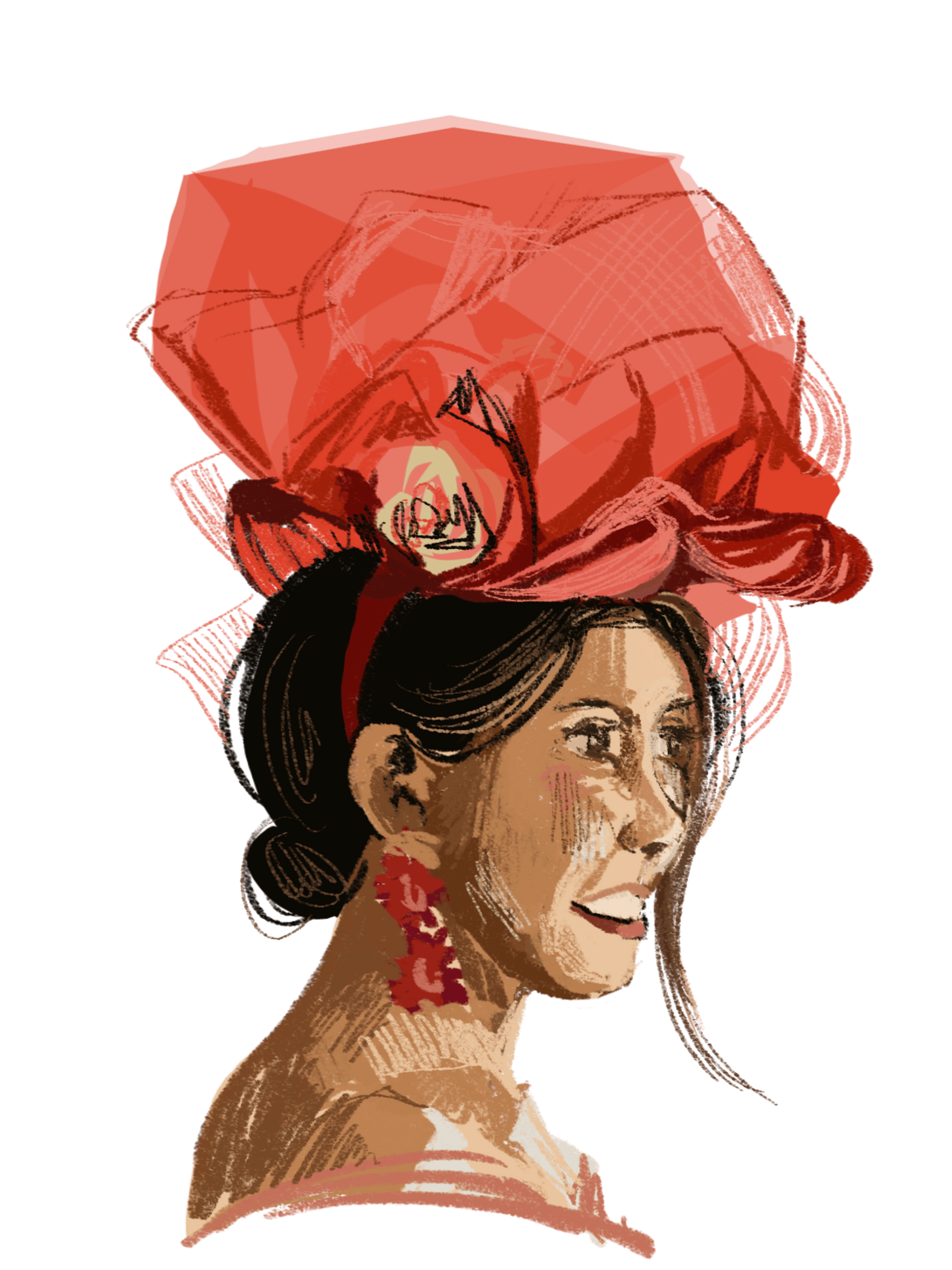
Ellie Ayati Jian began her career as a milliner by coincidence. Originally trained as an architect and interior designer, she stepped into the world of hat-making when a friend asked her to enter the contest for the Longines Prize for Elegance at the Belmont Stakes, a fashion contest in New York. When Jian couldn’t find a fascinator to match her outfit, she decided to make one instead, ultimately winning the prize for most elegant look of the day.
“It was the start of thinking that … maybe this is something that I can spend more time on,” Jian said. She devoted herself to learning the trade, taking a course at the Fashion Institute of Technology during COVID-19 and teaching herself through YouTube videos. She started her business, Ellie Jian Millinery, five years ago after moving to Boston. In her work, she hopes to combine traditional techniques with new trends to create something that can be “used by the modern woman.”
To this end, her techniques range from hand-sewing to 3D printing. “I find my inspiration by seeing other artists’ work,” Jian said, which includes mediums beyond millinery itself. Her process usually begins with background research and “having the materials in [her] hand” rather than sketching the headpiece. While designing, Jian prioritizes the client’s experience. “It’s very important that besides the aesthetic look of the headpiece, it will be comfortable on the wearer’s head,” Jian said, adding that she often wears hats herself for several hours before offering them to a client.
In addition to commissions for clients, Jian has submitted her work to international millinery competitions and collaborated with designers for runway shows. For Jian, competitions are “good excuses to start making something more dramatic.”
Jian developed a special connection with her submission for the Bes-Ben competition, an opportunity for milliners to showcase designs inspired by famous milliner Benjamin B. Green-Field, founder of the Bes-Ben brand. After researching Green-Field for a month, Jian settled on a beehive design, which she created using 3D printing and laser cutting. “The whole time that I was working on it, it seemed that I could feel Bes-Ben beside me,” Jian said.
She also recalled a satisfying moment during an interview with an art curator. “I just showed [the hat] to her without giving her any background,” Jian said. “She said, ‘Oh, this hat reminds me of Bes-Ben’s works.’”
When collaborating with another designer for a show, Jian said “timing is very important.” Ample time allows Jian and the designer to “inspire and motivate each other to make new looks,” while a time crunch requires more independent decision making. Regardless of the process, Jian said it’s exciting to see how “different things [come] together to make something unique.”
Whether on a runway or not, Jian said headpieces “give you a special and unique statement.” Statement pieces created for important events, like bridal hats, can be a challenge. “It’s a one-of-a-kind piece, and I know it’s very important for them,” Jian said. For these significant projects, she emphasized the importance of “getting to know each other” during the consultation process so clients can “show their history.”
In addition to clients’ history, Jian often draws from her own experience. Her signature piece, a headpiece that covers part of the face, began as a Halloween costume she made for herself. She also embraced her architectural background when creating her New York fascinator — a design based on the Statue of Liberty with hand-drawn buildings.
“I really would like to try to make my hats accessible to a broader audience,” Jian said. “And I really would like to serve the Boston community.” To this end, she offers a rental service for people who want a hat for an event without the cost of a custom design. Her rentals maintain a personal touch, as she invites clients to browse the roughly 100 hats in her studio and helps them select a piece.
She has worked at Boston-area events such as Party in the Park, Mayor Michelle Wu’s Rose Garden Party and Kentucky Derby celebrations. These events have become more frequent over the years, Jian said, which she views as a positive sign that people are wearing more hats.
For those interested in experimenting with headpieces, Jian suggests starting with something more conservative until they feel comfortable. She recommends consulting a milliner to receive guidance based on “their personality, … their taste and the occasion they’re going to wear it for.”
Jian is currently a board member of the Milliners Guild, a U.S.-based organization with around 60 members. “We try to share our experiences and help each other,” Jian said. She began as a mentee through the guild’s mentorship program and now serves as a mentor.
Jian encourages aspiring milliners to join communities like the Milliners Guild “to know that [they] are not the only one” and “to constantly learn.” Although her career began unexpectedly, she now intentionally incorporates hats into her daily life, wearing them even to small gatherings. “It’s very important not to see it as a passion,” Jian said. “It’s very important to try to bring it to real life, and it’s best to start from yourself.”



