
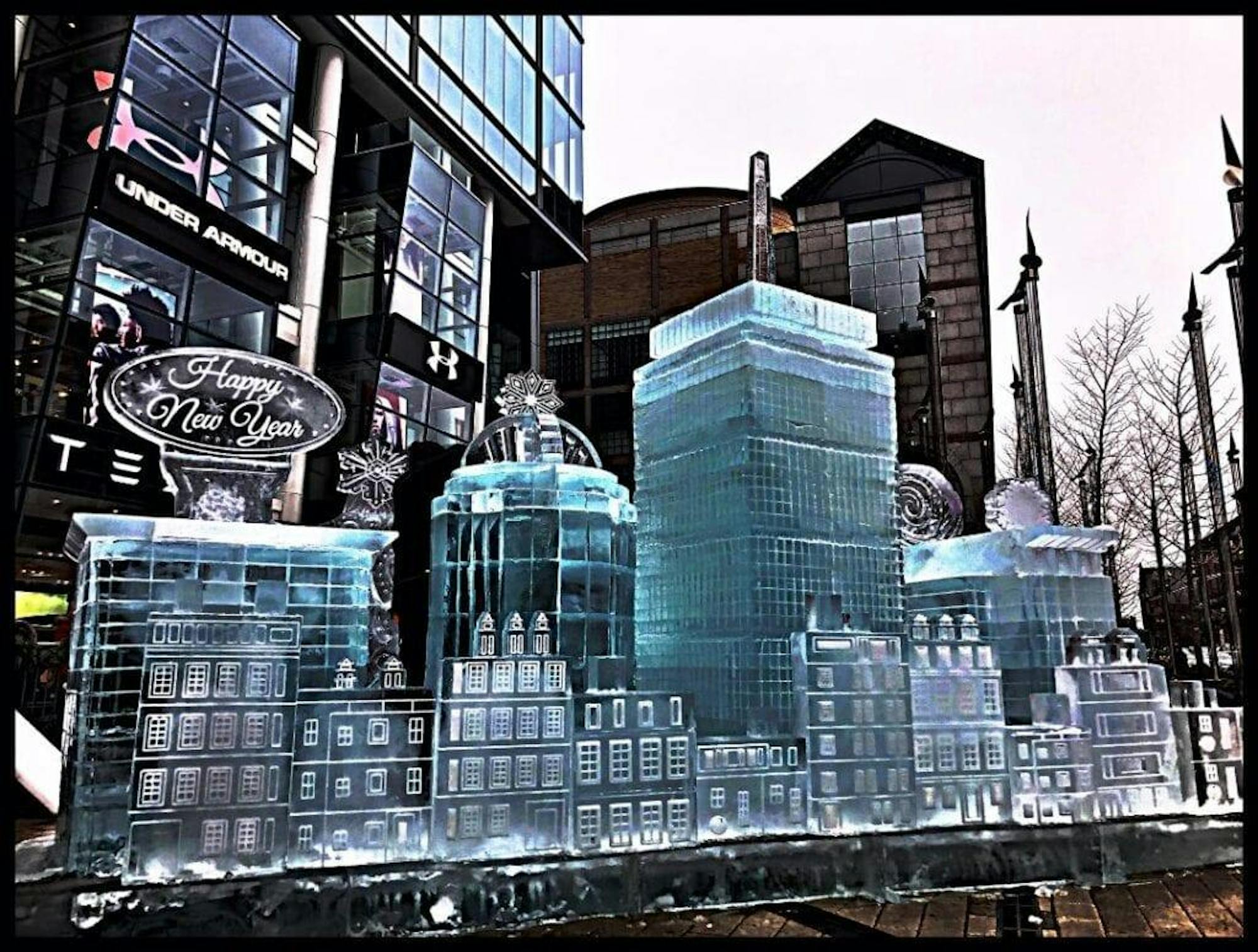
Donald Chapelle, founder and owner of Brilliant Ice Sculpture, made his first foray into the world of ice carving at 18 years old. He was living in a hotel and noticed a large block of ice in the freezer. A waiter told him it was used to make sculptures.
“I would sneak up at night and take a kitchen knife, and I made a sculpture,” Chapelle said. “I hid it behind cases of frozen vegetables.”
What did he make? “45 years ago, swans were all the rage,” he said.
It would be decades until Chapelle officially entered the ice sculpting business. He worked as a chef at Michelin star restaurants in Geneva and Vienna before coming to Boston, where he served as the executive chef for the Museum of Fine Arts for 14 years. After a stint as a corporate executive chef at Whole Foods in southern Florida, he returned to Boston and started the restaurant concept Brew Moon with six other people. He sold the business in 2001 and began teaching college students.
Chapelle soon realized that life as an educator was not for him.
“I decided … I can’t deal with this,” Chapelle said, “So I started this ice carving business.”
His first studio was in a mill building in Lawrence, Mass. He began with one ice maker and delivered the sculptures in his late father-in-law’s Lincoln Town Car. In his first year, he estimates he made around $17,000. By his fourth year, thanks in part to his marketing strategies, he reached profits around $200,000. Although he still uses Google Ads when he anticipates a slow season, marketing has become less of a priority for Chapelle.
“I don’t want to grow this business,” Chapelle said. “I have enough customers. I don’t really need to reach out.”
Chapelle’s experience as a chef is an asset considering that he often sells to chefs and restaurant managers.
“I speak the language,” Chapelle said.
When working with people who lack culinary experience, including event planners, Chapelle said “nine times out of 10, I know what they need more than they do.”
His experience in the kitchen also helps him incorporate edible or decorative elements into his sculpture, including flower arrangements, fruit or drink ingredients. Currently, he is freezing “five ice makers full of 16 pound salmon” for the Seafood Expo North America. While Chapelle has a competent team, he still sculpts and delivers.
“I do a lot of anatomy stuff [that] the guys can’t do,” Chapelle said, including sculpting a bust of John Quincy Adams for the Quincy President’s Day event.
He enjoys doing deliveries because he can feel “the pulse of every part of the business.” Although he used to hate long delivery drives, they have become one of his favorite parts of the job as he tries to admire the scenery and “enjoy life.”
Deliveries are not the only opportunity to enjoy life as a sculptor. Chapelle said, “Having a small business like this, that’s niche … allows you some flexibility to have a decent life.” After working long and exhausting hours as a chef, Chapelle says he is “making up for it.” He takes time off for international biking trips with friends and maintains side hustles during slower business periods.
Summer is typically the slower season when, according to Chapelle, most sales come from drink luges, weddings and corporate events. Winter brings more projects for festivals, including past pieces for First Night Boston. Chappelle’s larger pieces have ranged from an 18-foot Tom Brady to Michaelangelo sculpting David. Although Chapelle is proud of his large projects, he emphasized that “even some of the small things that we do for weddings are just mind boggling.”
When working for an outdoor festival, “it’s not warm weather or rain that kills it, it’s sun.” Chapelle recalled sculptures he constructed for Gloucester’s So Salty in January. Those built in the shade have endured while those in the sun have not. Some sculptures are totally ruined within hours. The transience of his pieces doesn’t bother Chapelle.
“I stopped caring, as long as you get a decent photo of it, that’s enough,” he said. “You just got to move on.”
When approached by a client, Chapelle first directs them to his website.
“I’m big on branding. For instance, I have three different swans. If someone wants swan number two, they’re going to get exactly swan number two,” Chapelle said.
He added that “there’s no artistic license” when it comes to standard designs. For custom designs, Chapelle makes drawings for the client to approve before beginning work. Although some clients can be difficult to work with if they change their minds or try to avoid payment, Chapelle enjoys witnessing people’s reactions to his sculptures.
“You see firsthand how happy we make people,” he said.
After a lifetime of sculpture, Chapelle at times wonders if the craft is going to get passed on. Obstacles including expenses, niche skills and occasionally grueling work cause Chapelle to conclude that “this will be a dead art in 20 years.” While he believes that a “young and ambitious” sculptor “could have quite a good life,” very few people have expressed the interest or ability to carry on the tradition.
“It’s a little sad,” Chapelle said. “It is what it is.”



