
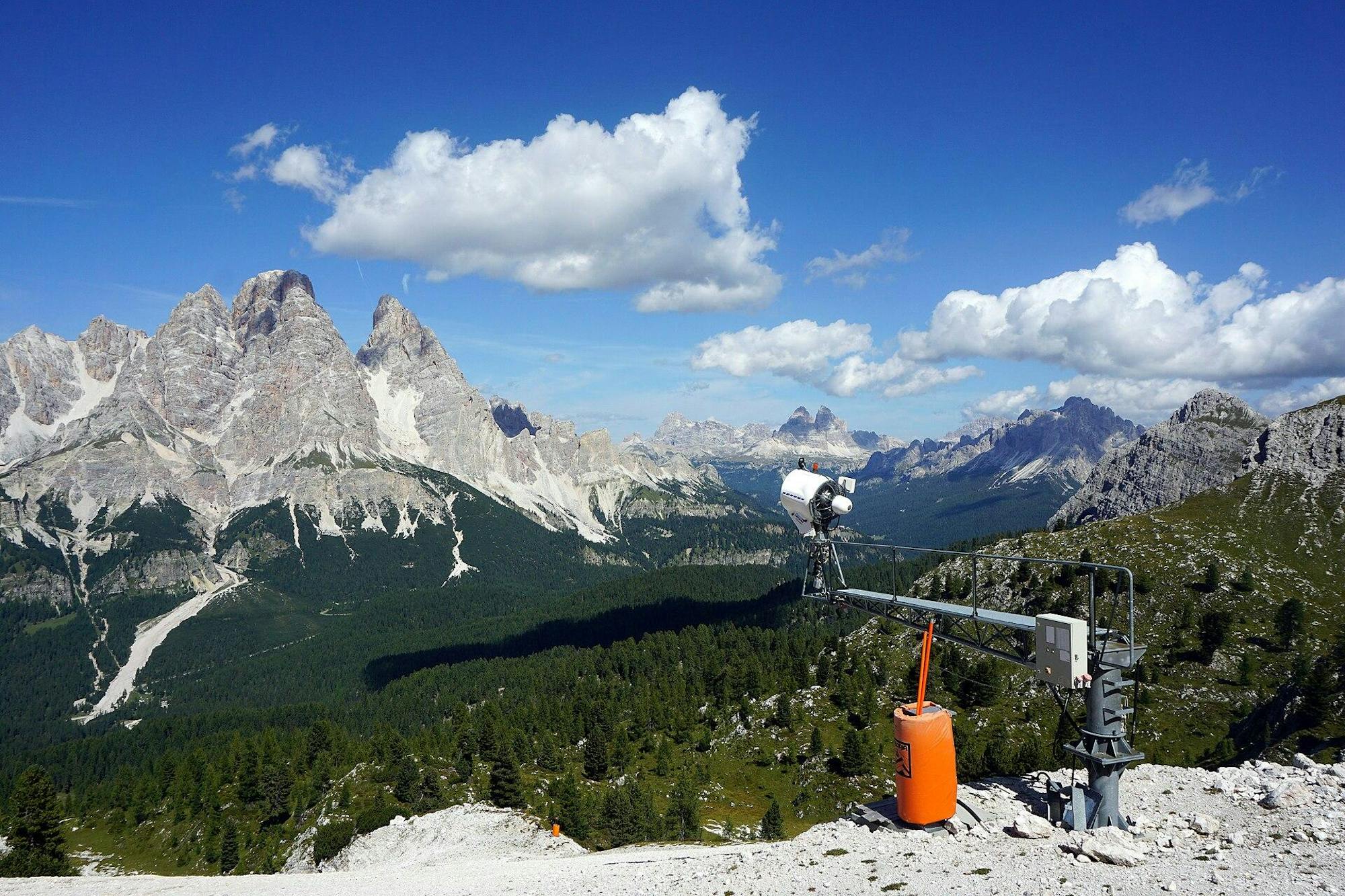
The Winter Olympic Games, this year hosted in Milan and Cortina d’Ampezzo, Italy, have increasingly had to rely on human-made snow due to climate change. Shrinking snowpacks, rising temperatures, fewer freezes and shorter snow seasons have led to an estimated 85% of competition surfaces in the 2026 Olympics requiring artificial snow. The two host cities this year have created massive artificial reservoirs to provide sources of water for snowmaking. Cortina d’Ampezzo itself has experienced a 3.6 degrees Celsius increase in average February temperature and 41 fewer freezing days annually since they first hosted the games in 1956.
This could also have significant financial implications for cities scheduled to host future Winter Games, as many may soon be unable to do so. By the 2050s, only 52 out of the 93 potential host cities will have reliable climate conditions for the Winter Olympics, according to Climate Central. The Paralympic Winter Games, hosted in March, face even fewer prospects of reliable host cities. According to the Observer, only four of these 93 host cities would be able to support the Winter Olympics by 2050 without artificial snow.
The International Olympic Committee has published studies on the dwindling number of cities able to host the Olympics, and why artificial snow is a necessity. They have also even considered moving the games to January in an attempt to get more snow and combining the Olympic and Paralympic Games. The Euro-Mediterranean Centre on Climate Change argues that artificial snow can’t be their only solution to the issue of lack of snow, as higher temperatures would still melt artificial snow. They also raise awareness of the energy, environmental and economic costs.
While the need to produce additional snow may feel like a distant issue in Boston after one of our largest recorded snowfalls, the current Winter Olympics in the Italian Alps prepared 56 million cubic feet of artificial snow, which is incredibly water intensive. Time Magazine estimates that this is equivalent to about 84.8 million cubic feet of water. Conversely, part of the reason these two cities had their bid approved to host the Winter Olympics was their pledge to showcase the conservation of mountain ecosystems.
This process of artificially creating snow began at the 1980 Winter Olympics in Lake Placid, N.Y., and involves using fan guns and lances to spray atomized water into the air, creating frozen, more resilient ice crystals that resemble rounded beads of ice. Their structure is not the same as the structure of natural snowfall, and often the polymer sodium polyacrylate is added, or other aerosols or mineral dusts. The additives used can disrupt soil pH and contaminate watersheds. These ice crystals are also more than four times harder than real snow, and their production is very carbon-intensive. Additionally, many scientists and Olympians report that this makes snow sports, especially skiing, more dangerous and unpredictable.
Specifically, athletes are at a greater risk of injury because artificial snow is icier, denser and harder than real snow. Unpredictable snow and climate have also made training consistently harder for athletes, and halfpipes are often primarily made of ice. This also leads winter sports to rely heavily on industrial snowmaking. The sound pollution from producing this snow and the risks to workers operating the machines are also factors that should not be ignored. An accident at Jiminy Peak Mountain Resort in Massachusetts highlights this concern.
Many climate organizations, such as Protect Our Winters, have made it their mission to advocate for bipartisan solutions to these climate problems. They have benefitted from the support of athletes such as the professional skier Amie Engerbretson, who has utilized her platform to create films that tackle issues such as climate hypocrisy, using humor to bring these ecosystems and the challenges they face to a broader audience. While no organization, athlete or panel will be able to fully stop our climate from changing, they can help curb our impact in the ways we adapt and move forward.



