
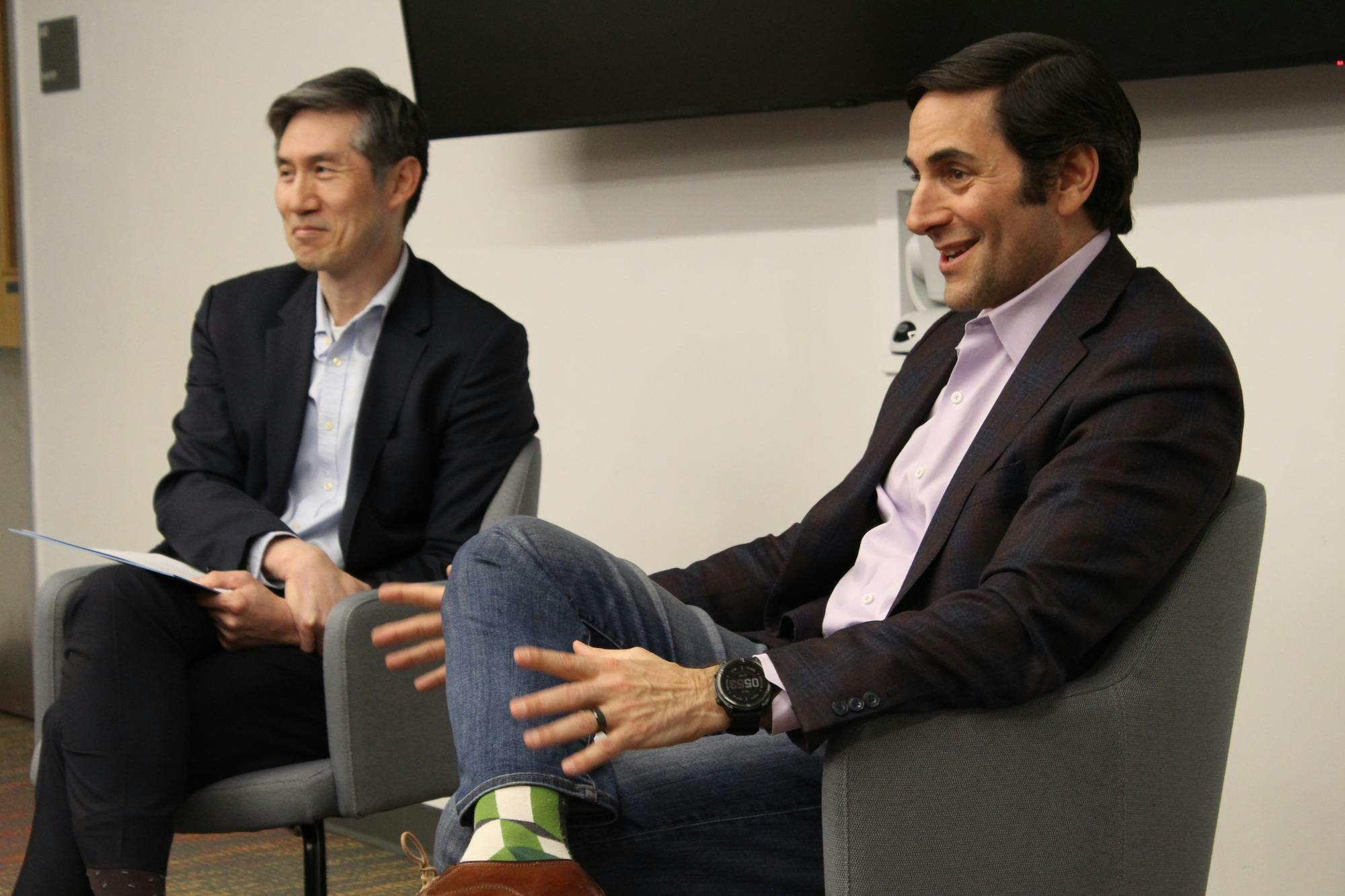
For most students, science is limited to the lab bench — pipetting solutions and taking precise measurements to check the validity of their hypothesis. Yet, beyond the world of the wet lab, quietly supporting scientific discovery, is the high-stress, high-reward business of biotechnology. Last week, Ted Myles, chief executive officer of Cellarity, came to speak at Tufts as part of the School of Engineering’s Biotechnology Industry Series. He spoke candidly about his journey, sharing several insights into the lessons that have shaped both him and his career.
The Biotechnology Industry Series is an initiative that brings top professionals and leading voices in biotechnology to campus to help students understand their coursework’s application beyond exams.
“There are very few straight lines in a career,” Myles told the audience. Throughout the talk, he reflected on his decades of experience in biotechnology leadership and what he’s learned about ethical decision making.
As an undergraduate at the University of Hartford, Myles started on the pre-med track. However, after struggling with a disconnect between the biology and chemistry he was studying and their human impact, he pivoted. He found that connection through collaborative team projects in business. Ultimately, he graduated not with a biology or chemistry degree but with a degree in finance and accounting. This foundation gave him the flexibility to explore his interests across a wide range of industries. After only his second year in public accounting, Myles joined Genzyme, a biotech company focused on developing treatments for rare diseases. To further his understanding of business and, as he described it, to scratch his ‘itch,’ Myles pursued an MBA while continuing to build his career in biotech.
One of the career-defining moments Myles discussed came during his time at Advanced Cell Technology. After stepping into a leadership role full of passion and motivation, he learned of several scandals and lawsuits involving the company and its CEO, as well as significant debt. For many, this would be enough reason to move on quietly. However, Myles’ mindset was clear: “If you put the challenges on the table, they’re our challenges,” he explained. “If you keep them in your desk drawer, they’re your challenges.” He chose not to avoid or minimize the issues but instead to confront them directly — rebuilding investor trust while addressing the company’s financial instability.
Reflecting on what kept him and his team motivated during this period, Myles recalled hearing stories from patients who were losing their independence due to illness and wanting to make a difference. After six challenging months of legal battles, Myles helped the company rebrand and open new beginnings. The lesson, he noted, was not just about past wrongdoing but about the power of accountability and transparency. Although the ability to memorize, understand and analyze complex technical information can open doors in biotech, Myles stressed ethical decision-making — especially when patients’ lives are on the line.
Beyond crisis management, Myles also stressed the importance of soft skills. He discussed the importance of finding areas of growth and having strong mentors who will push you.
In sharing his journey, Myles was not aiming to tell the story of a flawless path to success. Rather, he highlighted the reality that mistakes are inevitable. What matters, he suggested, is extracting growth from those experiences by leaning into discomfort. As an engineering student myself, I can attest to the narrow perspective students sometimes have of science as limited to problem sets and lab work. Hearing about Myles’ experiences and the lessons he has learned throughout his career broadens that perspective. With leaders like Myles guiding the industry, the future of biotech feels promising.



