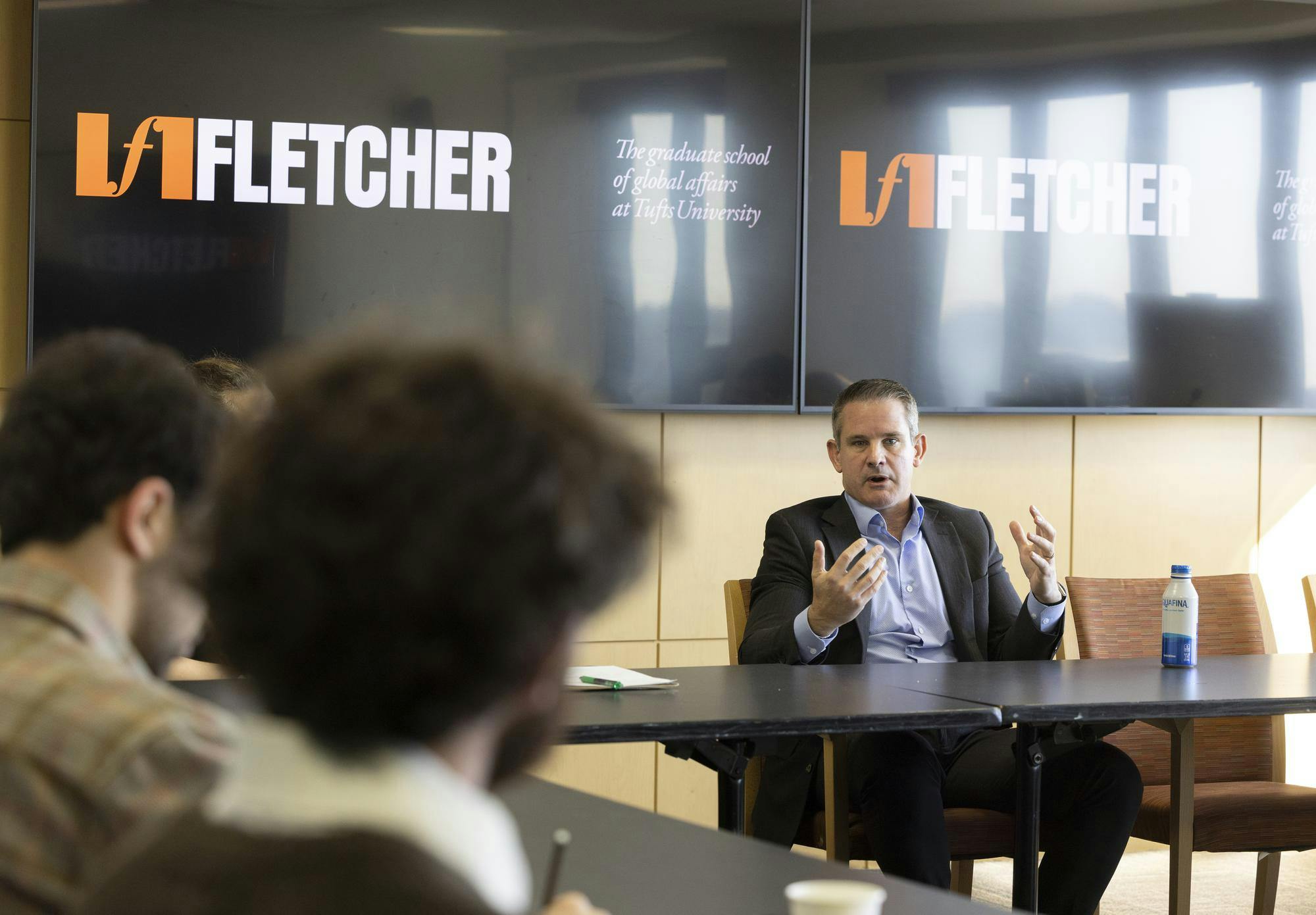
Members of the Tufts community sat in a packed auditorium on Wednesday evening while former Congressman Adam Kinzinger reflected on a decision that solidified his reputation and legacy within the American political sphere.
“For me, it was not even a debate because you can’t attack the capital of the United States, and you can’t try to convince the country that an election was stolen,” he said. “Self-governance will never work if half of the country believes that the system doesn’t work [and] if half of the country believes it was stolen.”
Kinzinger, who represented Illinois in the House of Representatives from 2011–23, became one of the most prominent Republican critics of President Donald Trump. He was one of two Republicans to join the select committee investigating the Jan. 6 insurrection and one of 10 House Republicans who voted to impeach the president. The decision drew sharp backlash from within his own party and played a part in his eventual decision not to seek reelection.
Now, Kinzinger is a senior political correspondent for CNN, author of the 2023 political memoir “Renegade: Defending Democracy and Liberty in our Divided Country” and the latest guest for this semester’s Solomont Speaker Series, hosted by the Jonathan M. Tisch College of Civic Life. This series hosted historians, politicians and journalists to reflect on the 250th anniversary of the United States’ founding. The discussion was moderated by Tisch College Dean Emeritus Alan Solomont and covered a wide range of topics, including Kinzinger’s own political history and decision to leave Congress, as well as broader topics such as the current state of the Republican Party and the war in Iran.
Half an hour before the public event, Kinzinger sat down for an interview with the Daily to expand on these themes and touch on other topics related to higher education.
Kinzinger was one of only 35 House Republicans — out of a total of 211 at the time — who voted to establish an independent commission to investigate the Jan. 6 insurrection. Kinzinger’s decision to vote against party lines regarding the attack was considerably unorthodox in the United States’ modern political climate. In 2020, the percentage of party unity votes within Congress reached 70%, up substantially from 32% in 1970.
Kinzinger attributed this pattern to increasing displays of tribal politics.
“I think people, more than they even fear death, fear being kicked out of a tribe,” he said. “Your identity is your passport into a tribe. … When it comes down to it, it’s like, ‘Here’s a constitutional thing that I need to stick to, but my party is demanding otherwise.’ This is the mentally right thing to do, but emotions win out.”
Although tribal politics is not a new concept, it has become increasingly apparent in recent years as political polarization in this country has surged. Kinzinger ascribes this shift both to the politics of Trump that largely reformed the Republican Party and American political stratosphere, but also to the age of endless news cycles.
“Trump is a symptom and a cause [of polarization] at the same time,” he said. “It’s also the media landscape. It’s 24 hours now. There’s so many different information sources. They’re all competing. They all need to make money. How do they make money? They get you outraged. They get you hooked on outrage. And years and years of that just creates where we’re at today.”
Kinzinger noted the importance of being exposed to multiple viewpoints, not just in news sources but also in universities. Still, he condemned the Trump administration’s attacks on higher education through methods such as withholding funding, freezing federal grants and ending programs entirely.
In February, the Department of Defense announced that they will limit academic ties with 13 universities in the fall, including Tufts, to ban service members from attending certain graduate-level programs and fellowships at these institutions, which U.S. Secretary of Defense Pete Hegseth referred to as “woke breeding grounds.”
“There’s 10% accuracy in the point of universities’ need to be tolerant of all kinds of viewpoints. They’re academic institutions. They’re based on friction. That’s how you get smarter. … But what you can’t do is start saying that we're going to take funding away, particularly with the military,” Kinzinger said. “War ... and defense [are] about strategic thinking … It takes education and smarts. What this is doing is taking away a huge group of people that could bring that kind of perspective in.”
In fact, Kinzinger argued that the federal government withholding funds and making demands of universities is anti-conservative. Kinzinger expressed his belief that the conservative movement that he had originally identified with is dead.
“The Republican Party [is] a right-wing movement, but they are not a conservative movement,” he said. “There’s nothing conservative about the president taking kickbacks from everywhere. There’s nothing conservative about reckless wars. There’s nothing conservative about the amount of spending he’s doing.”
During the panel, Kinzinger also warned against the United State’s increasing reliance on hard power, as seen through the recent war raged on Iran or the military’s strikes of boats in the Caribbean upon the allegation of drugs being smuggled into the country.
“If you use [the military], you use it because you have no other choice and your goal is a certain outcome, and you want to use it as judiciously as necessary to achieve that goal or to save lives,” he said. “There is a moral imperative [to soft power]. It’s morally damaging to use hard power. Sometimes it’s necessary. But soft power is a cheaper, more morally effective way to do what we need to do.”
Despite the violence and division that seem to be increasingly present within the country, Kinzinger stressed the importance of optimism and hope, especially looking ahead into the future, while standing on a historic moment marking the nation’s past.
“I actually think it’s amazing that this year is our 250th anniversary. … Every generation of Americans has had a challenge that was borderline existential. Every generation had that moment where there were people ... [who] felt like this may be the end for our country. Every generation has carried that weight and left a country stronger than they inherited [it] when that moment passed. I don’t think we’re going to be any different. And I think we’re going to refuse to fail,” he said. “To think that we are going to be the generation that this thing dies on, I refuse to believe it.”