
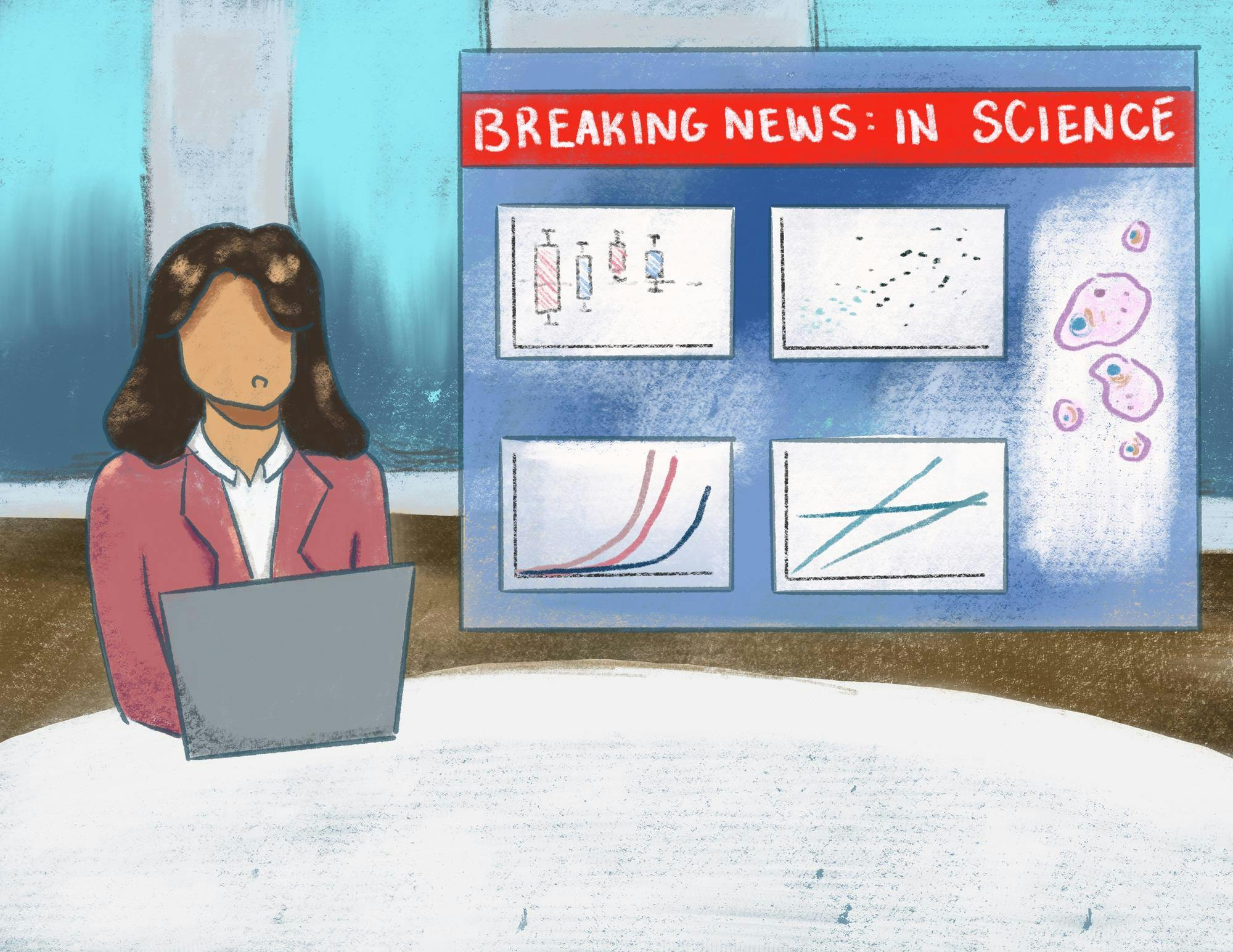
Journalism was probably the last thing on my radar when I walked through the club fair as a first-year. And for most of my time at Tufts, it stayed that way. My best friend Carmen was super involved in that world, but her involvement was the closest I got to that space.
But at the start of the spring semester of my junior year, Carmen — the then-science executive editor — asked me to write an article. The section was tiny and they needed articles. She thought I might be interested.
I published my first article for the Daily in February 2025, a highlight on the Scheck Lab in the Tufts chemistry department.
Around that same time, the Trump administration started to roll out deep cuts to scientific research, and I was seeing an increase of health and science misinformation on my social media feeds.
Between current events and my first article, I had a fundamental shift in perspective. I was protesting for science funding and expressing outrage over misinformation, but then I realized: How can we ask people to trust something that they do not understand?
I was asking people to be outraged about cuts to research because I could see the possible implications, even if they were decades down the road. Many people did not understand my anger; not because they were incapable of understanding, but because of a mix of our current media landscape and failure to communicate.
No one thing has led to our current situation; it is the result of many factors coming together at a perilous moment in time. Also, blaming one issue over another is not a productive exercise. It keeps us in the past rather than paving a way forward.
Instead, I like to think about the future, about what steps we can take to get out of this mess. What I realized that semester was that, no matter how the cookie crumbles, in every path forward, science and health communication are critical.
So in the fall of my senior year, I jumped headfirst into the Daily and went into full recruiting mode. And the work paid off. When I joined the section last spring, we had five writers. But over the course of the past year, the science section has published 66 articles from over 20 authors.
Do I think that science communication will fix all of our problems? No, absolutely not. But what I do believe is that helping the general public understand science, medicine and their health is a crucial pillar of how we rebuild trust.
But this is not only a job for journalists. It is a job for researchers. We need to break out of our echo chambers and bridge the gap between society and science.
I am so proud of all this section has done and of the amazing reporting from every writer who has published this year. And as we work towards a world in which science is shared rather than gatekept, where trust is rebuilt and where research is seen as a two way street, I hope that the Daily and students across the country and the globe can lead the way.
I am so excited to see where the section goes and how it grows.
Thank you, Tufts Daily.
From,
Shoshana Daly
Executive Science Editor 2025–26



