
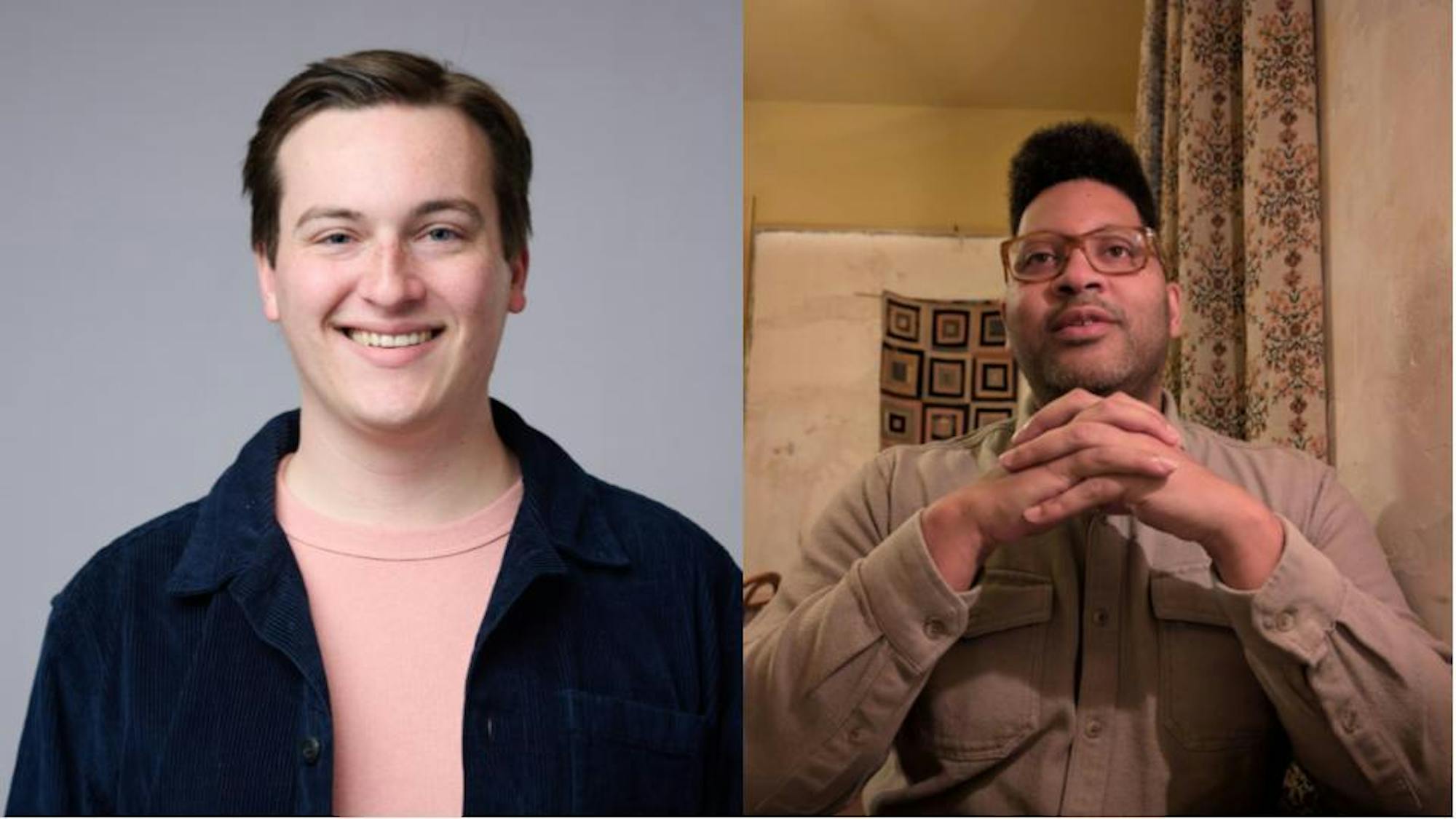
This spring marks the end of physics Professor Peter Love’s quantum information and quantum computing lab group’s time at Tufts. Starting July, the lab will relocate to the University of Toronto. However, this semester has been anything but boring, as four Ph.D. students are set to defend their theses and receive their doctoral degrees. Over the course of their Ph.D.s, these students used math to develop models that can extract quantum information as effectively as possible and applied them to various circumstances related to scientific computing.
TJ Colvin and Carter Gustin began at Tufts in 2021 and are among the four graduating doctoral students in the lab.
Gustin defended his thesis in March, which focused on “using quantum computers to extract information about particle physics or nuclear physics” and outlined his work with quantum simulation. Gustin worked to reduce the number of quantum logic gates required to simulate Hamiltonians in quantum field theory with renormalization techniques. One notable result in his work reduces resource estimates from 10^28 down to 10^14 gates, a promising step toward solving more complicated problems across a broader range of particle physics.
Gustin found himself taking many theoretical physics courses during his undergraduate studies, which inspired him to pursue quantum computing research.
“I never saw myself as an experimentalist, because the number of theory classes I took was so much larger than the number of experimental classes, so it just felt natural,” Gustin said. “So when I took these quantum mechanics classes, and I realized there are things like quantum field theory that describe quantum mechanics a little bit better, I realized that that’s what I was interested in.”
Colvin will defend his thesis on quantum error correction this August. Quantum error correction addresses the innate instability of quantum mechanical systems.
“I’m going to take a nucleus of an atom and I’m going to put information literally inside the nucleus. That’s what we do with a laser and an atom. It’s not hard to imagine that this is not going to go well,” Colvin said.
Using renormalization groups, Colvin helped develop models that arrange quantum bits to protect them from errors.
Before coming to Tufts, Colvin worked as a programmer in the medical industry. While working on medical campuses, Colvin earned a master’s degree in bioinformatics from the University of Arkansas for Medical Sciences and a second master’s degree in physics from Wake Forest University. Ever since starting his master’s degree in physics, Colvin knew he wanted to pursue quantum computing.
“I don’t want to be in a small box, I don’t want to just be a theoretical physicist. And so working in quantum computing — since it’s interdisciplinary — I don’t feel that I’m just this or just that. I really get to sort of do it all,” Colvin said.
Colvin views physics as a tool throughout his experiences in computation and theory. “Physics for me represented this quest for truth when I was really young. ... The way I think about quantum [theory] now and the math that I associate with it is very … utilitarian.” He later remarks on an impactful talk led by a visiting Fulbright Scholar in medical physics, who developed computational methods to make medical imaging technology more accessible and accurate.
“For me, this is where the magic of computation comes in,” Colvin said. “I don’t need perfect hardware if I have good enough algorithms. This also feeds into accessibility and equity. The world would be a remarkable place if we could spread what we already know.”
Both Colvin and Gustin are slated to graduate in August. While Colvin is interested in continuing in industry, Gustin is prepared to explore all the opportunities that studying quantum computing opens.
“I’m not sure if I want to stay in academia or if I want to go into industry,” Gustin said. He explained that quantum computing has roots in both industry and academia that are worth exploring, and this breadth of opportunities can lead to paralysis.
Gustin also reflected on the community fostered by his peers and advisors within the lab and beyond.
“Motivation is the number one thing in hard work, but it’s also about who you surround yourself with,” he said. “I feel like I did a really good job surrounding myself with people who made me a better scientist. If I didn’t have these people, maybe I would be defending a thesis, but I wouldn’t be defending a thesis I was as proud of as the one I did.”



