
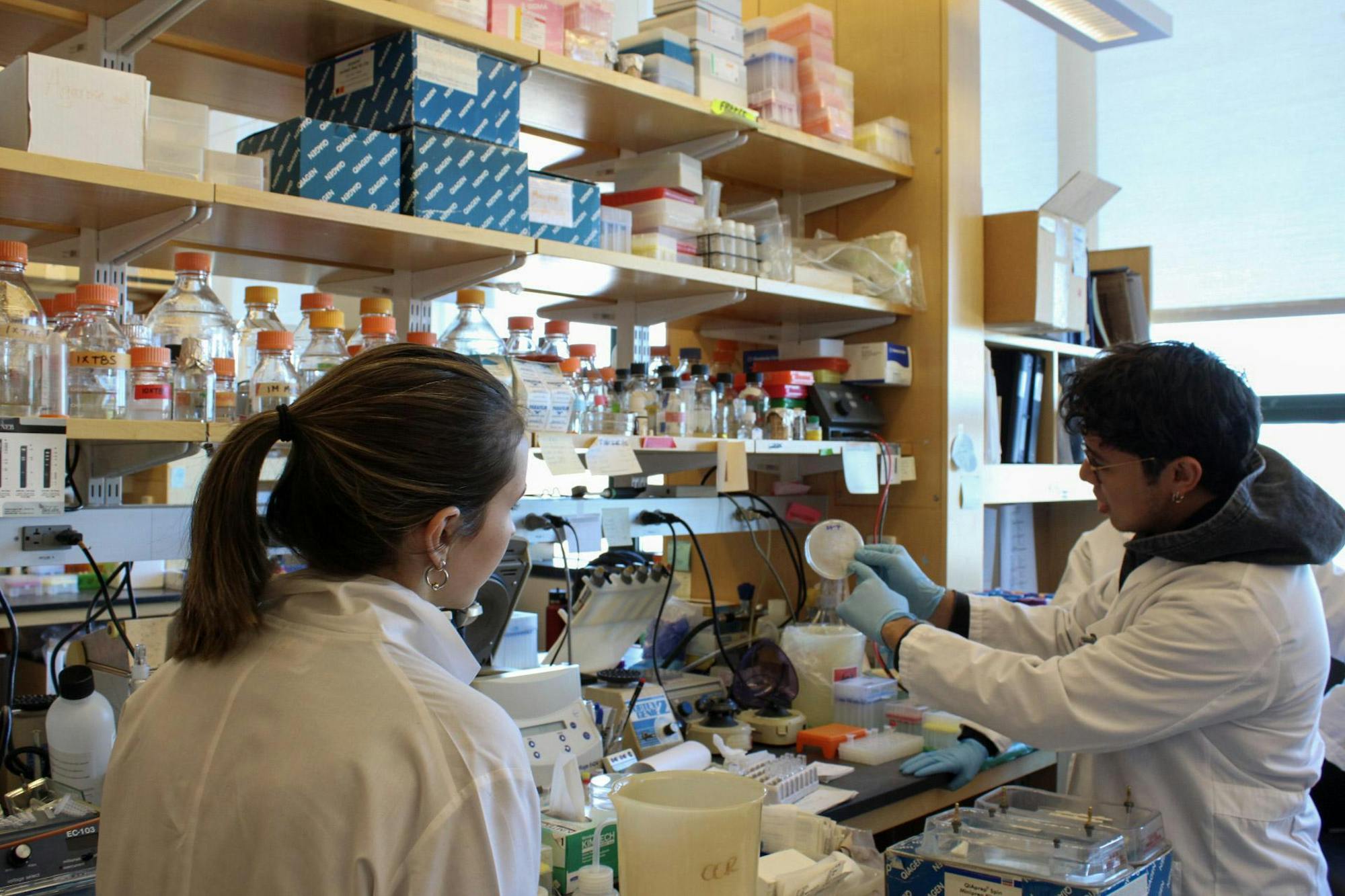
The Tufts Department of Biology offers four undergraduate majors — biology, biochemistry, biopsychology and biotechnology — which, combined, account for roughly 12% of all majors completed by Tufts students over the past five years. Biology is the fourth largest major at Tufts, and the biology department has expanded rapidly in recent years, with five new, full-time faculty joining in the 2025–26 academic year alone.
Jess Shi is a biochemistry major and will be attending Harvard School of Dental Medicine next year. One of his favorite memories from his time at Tufts was when he participated in the Civic Biology Fellowship.
“[What] distinguishes the Civic Biology Fellowship from any of the other courses is how much it emphasizes the fact that biology is a science, and science is meant to serve people,” he said.
As part of the Civic Biology Fellowship, Shi worked with the Boston COVID Recovery Cohort, an National Institutes of Health funded program studying Long COVID and its impact on underrepresented communities in the area. His role included hosting forums where community members spoke about their experiences and challenges with the healthcare system.
“[Dentistry] is an inherently interpersonal career,” Shi said. “[The Civic Biology Fellowship] has prepared me really well for going out to the community, building relationships and finding ways to rebuild trust.”
Maia Zimmers is a biology and community health double-major who plans on pursuing a career in nursing. Zimmers echoed the community focus that Shi mentioned; furthermore, she praised the lab courses available in the biology degree.
“I’ve taken two advanced lab classes … and I’m really glad I did,” Zimmers said. “I took [Microbiology] Lab and Experiments in Physiology, and both helped my writing and understanding of how to put together scientific literature.”
She said that one of the major’s strengths is that students must read a lot of scientific literature which helps them “learn how to disseminate information.”
Further, lab work for undergraduates reaches far beyond the structured lab courses. Students have the opportunity to conduct independent research for credit and pursue an honors thesis in their senior year.
Dylan Higgins, a biochemistry major, conducted independent research in the Levin Lab, “working primarily with bioelectricity and the self-regulating behavior of bacterial systems.”
Higgins said that they were able to strike a really great balance between instruction, mentorship and independence in their research experience. It was because of this balance that Higgins felt they could really push themself and develop their skill set.
Sevi Mast — another biochemistry major — also pursued independent research during her time at Tufts. Mast has been conducting research in the Mirkin Lab since her sophomore year and completed a senior thesis in the lab this year.
Mast said that her work in the Mirkin Lab has made science feel “less theoretical now and more something that I’m practicing in my day-to-day life.” Her research experience made her more familiar with molecular biology techniques and made the field feel less intimidating.
One thing that came up multiple times throughout my conversations was the biology department’s approach to teaching and grading pedagogy. Specifically, Shi, Mast and Higgins all highlighted Molecular Biology as one of their favorite courses in the department.
“[The grading style] allows you to have the flexibility to retest and build on those weak areas,” Shi said, describing his experience in the class.
Taylor Escudero, a biology and community health double-major, will be starting at Tufts University School of Medicine this fall. Escudero conducts research at the Woman, Mother + Baby Research Institute at Tufts Medical Center. Escudero said that biology classes at Tufts have both prepared her for the research and inspired her interest in endocrinology and women’s health.
“[We were] learning more about how the human body worked, but also how other animal systems worked,” Escudero said. “I think it’s one of the reasons why I’ve been inspired to also want to pursue [obstetrics] as a physician, because there’s a lot of endocrinology in women’s health.”
Some of the graduating seniors were able to provide feedback for the department.
“Something that I would definitely add would be a course that focuses on how biology or biochemistry integrates with AI,” Shi said.
Mast suggested the addition of a microbiology requirement to the biochemistry major.
Higgins recommended adding mandatory courses in either statistics or ethics to the biochemistry major. They also suggested the addition of tracks within the broad introductory science classes.
“There are a lot of different overlapping interests within the biology department,” Higgins said. “It might make sense to divide up some of the initial starting points as tracks.”
Escudero serves as an Undergraduate Student Ambassador for the biology department and has been involved in improving the undergraduate experience in the department and revamping the curriculum.
“One thing that we’re actually trying to actively work on right now is adding concentrations,” Escudero said. “Students that feel like they want to be more specialized in their major … being able to take more classes that align with [their] interests and having something on [their] degree to show for it would be really good for the department.”
Each graduating senior offered a piece of advice for future Tufts biology students. Mast recommended that students pursue research as an undergraduate.
“I think a lot of students don’t really realize how many research opportunities there are out there,” Mast said.
Zimmers said the most important thing is to build a relationship with professors early.
“Just going to talk with them and building a relationship will serve you well in the future,” she said.
Shi recommended that students be gentle on themselves during tough times and to feel comfortable with reaching out to their support system.
“It’s really hard, especially with a biochem track,” Shi said. “It can be really easy to be overwhelmed, but my biggest piece of advice would be [to] just take a deep breath at the end of the day. … Taking a breath allows you to shift your perspective a bit and … pave your own pathway towards learning the content and succeeding.”



