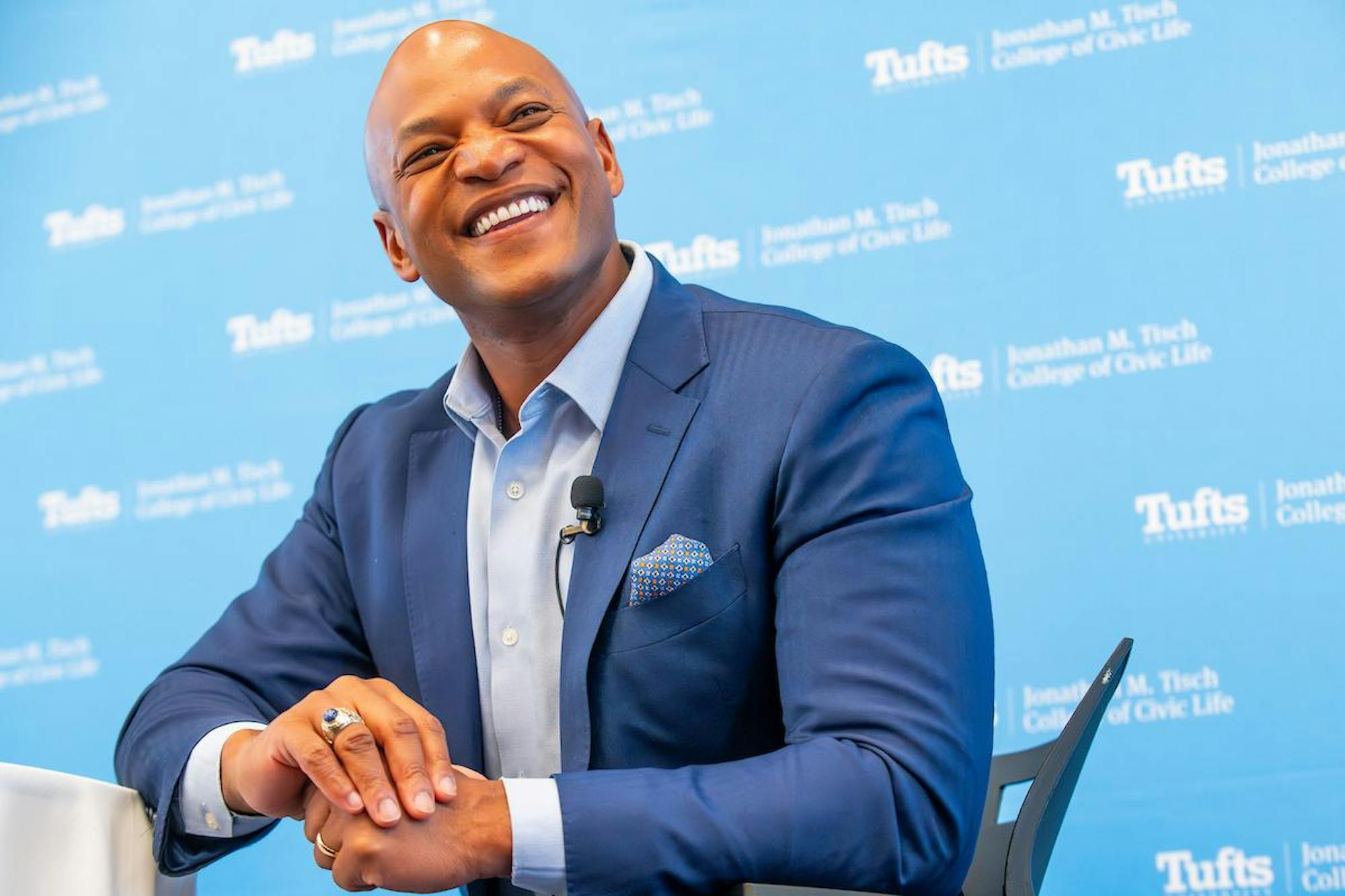
Governor Wes Moore of Maryland visited Tufts on April 16 for an invite-only event with students. The event, preceded by a meeting with University President Sunil Kumar, was moderated by Alan Solomont, former dean of the Jonathan M. Tisch College of Civic Life and U.S. ambassador to Spain and Andorra, and featured questions from students.
Moore, a Democrat, was elected as governor in 2022 having never held elected office. A former Army captain who served in Afghanistan, he went on to lead the Robin Hood Foundation and was a Rhodes Scholar.
Moore also sat down with the Daily to discuss dissatisfaction with the Democratic Party and the Iran war, among other issues.
Editor’s Note: This interview was edited for length and clarity.
The Tufts Daily (TD): What brings you to a college campus, especially Tufts?
Wes Moore (WM): It’s good being back. I was actually here 12 years ago talking about issues of race and class and opportunity, and I think part of the reason I’m back is to say that our society has not made enough progress on these issues. Since then, my personal life has made a lot of journeys where I ran one of the largest poverty-fighting organizations in the country [Robin Hood Foundation], and I ended up running for governor and winning. We’re grateful for the work that we’re doing in Maryland, but as a larger society, we have not made enough progress in actually creating a society that everyone believes in and fights for and feels seen in. I think that we’ve got to make sure we don’t just do better, we’ve got to make sure we speed it up.
TD: Many young people are increasingly dissatisfied with politics, with the Democratic Party. How do you want to win those people back as an elected official?
WM: I should say their dissatisfaction is justified. I’m not satisfied with politics. I’m not satisfied with the Democratic Party. I think that for far too long the Democratic Party has given great talks about creating opportunities in a just society, but hasn’t done enough or moved nearly fast enough to be able to address it. We still have a society right now that [has] watched both Democratic and Republican leadership come and accept the fact that we can have $7.25 as a minimum wage. We’ve had Democratic and Republican Party leadership come and go that allows people to be kicked off of health care. Right now, we are watching a president who is waging foreign wars while kicking people off of food assistance. This is not okay. I think it is important for people to know that if you’re going to be a policymaker, you are responsible and you are accountable to the people who put you there. The Democratic Party has got to stop being the party of no and slow and start being the party of yes and now.
TD: Higher education has been a target for the Trump administration. How do you view those attacks? Do you think universities need more ideological diversity? How do you think they should fight back against the Trump administration, if at all?
WM: Higher education has been, ironically, a very distinct target by this administration. We’ve seen how hundreds of millions of dollars have been pulled from Maryland’s public institutions. For our private institutions, the number’s in the billions in terms of grants, supports [and] scholarships for our historically Black colleges and universities. While [higher education is] not for everybody — and we shouldn’t necessarily just pipeline people to go to four-year schools — we should make sure that people understand that it’s also one of the main attraction items for even other people around the world [and] that our institutions of higher education are not just places that grant degrees. They [have] people that actually present technologies and innovations and pathways and cure diseases. That’s what our higher education institutions do as well. I think that we need to make sure that people understand that higher education is not the end-all, be-all. However, higher education plays an indispensable role in our society that we’ve got to better leverage.
TD: You’re a former Army captain. What do you tell potential service members who want to serve their country but do not believe in the wars that the administration is waging?
WM: It’s hard, because I always knew and I always had faith [that for] the wars that we were fighting, there were a few things that were always kept in mind. One was that military action was the last option. The second was that we had a clear understanding of what the end game [was] and what mission accomplishment actually looked like. The third was that there was an international coalition that was being built around it. I think the problem with what we’re seeing right now overseas is: I’m not sure if [the administration has] either answered any three of those questions, or has even thought through them. For anyone who’s looking to serve, I thank them for their continued commitment to this country and we’re going to need them to do it. We’re also going to need them to remember their oath — that their pledge is to the Constitution, their pledge is to the people [and] their pledge is to follow the lawful orders of the commander-in-chief, and that is the thing I want them to always remember when they take that oath.
JG: States like Maryland and Massachusetts are facing cost-of-living crises. How are you fighting that as governor and how do you think other places like Boston, Medford and Somerville should tackle similar issues?
WM: It’s everywhere around the country, and I think the thing that we have tried to do in Maryland and what I try to do as a governor is to say, ‘I’m going to control what we can control.’ We can’t control the fact that gas prices have gone up over $1.15 in the past month because of an unlawful war. I can’t control the fact that energy prices have gone up 13% in the past year because we are killing energy projects — solar and wind — that are actually ready to go. But what we can do is, while I can’t control rising grocery prices, I can make sure that big corporations are not doing price manipulation. While I cannot control rising housing prices because of illegal tariffs, I can make sure that we can make all state land available to build more affordable housing. I cannot control the fact that the president and Congress have passed the biggest giveaway to billionaires that our nation has seen, but I can make sure that in Maryland, we’re going to give our middle class a tax cut and make the wealthiest of Marylanders pay a little bit more so we can have good public schools and good public safety. I think our job right now is to say, ‘We’re going to control the things that we can control and we’re going to fight back against the things that we can’t,’ but we’re going to make sure that our people are not left behind inside this equation.
JG: You’re here on a college campus. What do you think is the best way to engage college-age students politically?
WM: Honestly, I think it’s to show up, and [that’s] what we did. When I ran for governor, we prided ourselves on going places [where] no one else was showing up. For us, a lot of it meant it was college campuses. Some of the people who first supported our campaign — because I’d never run for office before in my life — were students. We’d do rallies and there would be dozens of students there. Nobody else. That was the fuel for the campaign. That’s what got everything going. We just maintained and kept that now that we have an administration that we’re building out.