
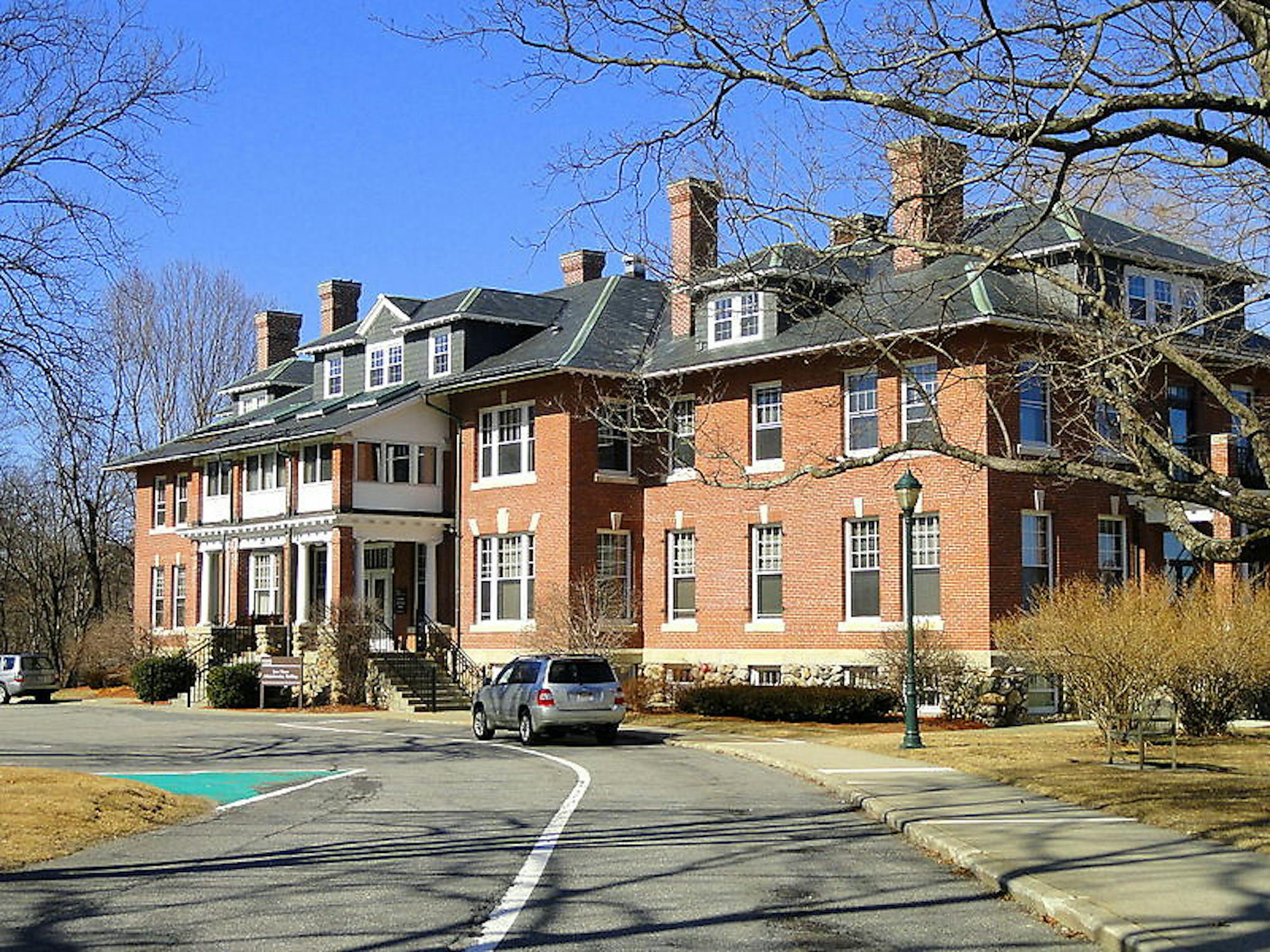
At the start of the academic year, Melissa Mazan (V’98) stepped into the role of dean, ad interim, of the Cummings School of Veterinary Medicine, following the school’s announcement that Dean Alastair E. Cribb would be stepping down from the position effective Aug. 31. In her new role, Mazan plans to grow and improve upon the programs at her alma mater, bringing a unique perspective that stems from her array of educational experiences in various fields.
Growing up in the countryside, Mazan was accustomed to 4:30 a.m. wake-up times, feeding horses and doing yardwork. But she did not always plan to be a veterinarian. Mazan graduated from Yale University with a bachelor’s degree in history. Her career path shifted when she decided to leave her English political history Ph.D. program at Oxford University.
“I got to the point where I was one of the world’s experts on a two-week period in about 1608 in England,” Mazan said. “I began to realize that this was not how I wanted to spend my life.”
At Oxford, she was the captain of the men’s and women’s polo team. When one of the ponies was injured, she spent a significant amount of time with the veterinarian. It was then that her interest in veterinary science reignited.
“I remembered that as a kid and in high school I wanted to be a vet, and I had abandoned that,” Mazan said. “I was realizing that I needed something more — [something] that I could put my hands on.”
This thought stuck with her. She recalls unleashing her frustrations with her friend about her career trajectory.
“[I remember saying] ‘Gosh, I don't think I’m doing the right thing, and I always wanted to be a vet, and it’s too late.’ And I was all of 24, and she looked at me and said, ‘Why is it too late?’” Mazan said.
Mazan was moved by that conversation. She went back and began from square one, completing all of the STEM prerequisites she had not done during her undergraduate studies.
Mazan took classes at the University of Connecticut while also taking on a tutoring job. She was surprised to find that she did very well in the STEM courses that she had shied away from in her undergraduate years.
“I fell in love with every bit of science, and it was so easy to learn compared to history and the literature courses that I took because you just had to learn it and apply it,” she said.
Finally, she made it to Tufts to study veterinary science at the Cummings School. “It was wonderful here. It was very small, very entrepreneurial,” Mazan said. “It felt like you were part of a family that just wanted to see you be the best and the brightest at everything you did.”
But success did not come without a struggle. Mazan remembers doing everything she could to scramble together the money to afford her veterinary education. “I developed the theory of the ‘Three P’s of Poverty.’ It’s peanut butter, pancake mix and pasta,” she said.
Through all of the classes and clinical work, she found her niche in horse medicine, ultimately falling in love with equine surgery.
“I went off to do a residency in equine surgery. It was a very, very busy practice,” she said. “We would do seven arthroscopies in a day, four colic surgeries at night and we’d have 50 foals in the [Intensive Care Unit].”
After working long days and nights performing surgeries, she wanted to do more research into the surgeries she had been working on.
“I wanted to think about why that horse’s blood volume is dropping,” she explained. “And it turned out there was a position open [at Tufts] in large animal internal medicine as a resident. I came back and I really haven’t looked back since.”
Until recently, Mazan spent her days balancing research, teaching and clinical work. She was the director of the Issam M. Fares Equine Sports Medicine Program, where she worked in emergency treatment and internal medicine, as well as making racehorses faster.
Her scientific research crosses into human medicine with her National Institutes of Health-sponsored work on human emphysema, which uses stem cell and regenerative research. Additionally, she runs a nationwide cytology clinic for respiratory diseases called the Tufts Equine Bronchoalveolar Lavage Cytology Laboratory.
In her role as interim dean, Mazan hopes to bring her wide-ranging experiences front and center when working with students and clinicians.
“When I talk to clinicians, I know what it’s like to be here at three in the morning, pulling a foal,” she said. “The longest working week I’ve ever had in my life was 143 hours, and that’s almost impossible. So when I talk with people and I say I know what it means to be exhausted, and we’re going to find a way to make this not be what happens, I can empathize, not just sympathize.”
Mazan also hopes to focus on the school’s connection to everyone who interacts with it. That means students, faculty and beyond.
“I think that one of the most significant things that we … do [is] what we do for our local society and community, what we do for those who are underserved, what we do in terms of delivering education and resources regionally and nationally and then our international footprint,” she said.
Mazan also addressed the Cummings School’s financial situation. “In this really difficult federal funding climate, we’ve been successful. We’re not the biggest in the university, but we’ve held very steady,” Mazan said.
Even with financial constraints, the school has been able to overperform. In a hospital built for 10,000 animal patients, last year they held nearly 35,000 in the small animal unit.
“We’re also working with the university to figure out how [to] have the structure that we need for all of this wonderful success that we’ve had,” Mazan said.
Along with those potential changes, a new Veterinary Learning Center is being built on the North Grafton campus and is set to open in the summer of 2027.
“We finally have … a student commons with tables that people can congregate around, small group areas, larger group areas, a kitchen for the students, lockers,” Mazan said.
Physical changes are not the only way Mazan will leave her mark. The school is launching a new program called Jumbo Care, which Mazan explained has two focuses: “to provide preventive care to the students and staff here … [and] to teach students, starting in the first year, what it's like to be a doctor.”
Additionally, Mazan will be overseeing a new curriculum beginning with students of the class of 2029. “We’ve made it more modern, more hands-on, more small-group, more simulation lab training, all the things that are there to give you competency,” she said.
Ultimately, Mazan hopes that students understand that desires can change and wants students to follow their hearts. “I like to tell my story to students because I want them to know that it’s okay to change your mind, and it’s okay to follow your passions and what interests you,” she said.



