
Featuring two contemporary ballets, Alexander Ekman’s “Cacti” and Akram Khan’s “Vertical Road (Reimagined) 2023,” the Boston Ballet’s Fall Experience poses the question of whether it can be reviewed at all. The experience will run through Sept. 20 at the Citizens Opera House before moving to New York City and Paris.
The Fall Experience begins, not with dance, but with a performance by the Boston Ballet Orchestra of two pieces from Igor Stravinsky’s “The Firebird Suite” (1910). Stravinsky’s score incorporates traditional Russian folk music and borrows from his mentors (including Nikolai Rimsky-Korsakov and Pyotr Ilyich Tchaikovsky), yet is described by Mischa Santora, Boston Ballet Orchestra’s musical director, as “strikingly novel and original, both in spirit and in its compositional techniques, resulting in one of the most invigorating scores in the repertoire.”
This description of Stravinsky’s suite encapsulates the subsequent performances of “Cacti” and “Vertical Road (Reimagined) 2023,” as both propose novel ideas about dance’s purpose and presentation with an irrepressible energy.
The first of the two, Ekman’s “Cacti,” challenges the culture of art criticism by creating an absurdist piece that cannot be analyzed in the traditional sense. Case in point: the intentionally unsymbolic cacti that the dancers procure towards the end of the work.
Audience members compelled to analyze the piece are accompanied in this effort by a disembodied voice. This ‘critic’ uses intellectual but nonsensical language first to define what the show is about before it even begins, then to analyze the deeper meaning behind silly choreography and the cacti and finally to conclude the show by repeatedly asking, “Is this the end? It must be the end.”
This speaker is the only invisible source of sound. In addition to the Boston Ballet Orchestra in the pit, the Anduin String Quartet performs onstage with the dancers. The dancers begin the piece sitting on white squares which become instruments as dancers synchronize body percussion and breathing with the score.
Just as the Fall Experience itself begins with music, the bassist of the string quartet is the first performer to be illuminated under a spotlight before the dancers come to their positions, emphasizing the music as an active participant in the performance.
The ‘critic’ attempts to analyze the piece from afar as if it’s completely planned, whereas the performers interact with each other in an active collaboration. The dancers take cues from the music as if they are unanticipated — several times the music abruptly stops, and the dancers freeze in confusion. The dancers also take cues from each other as if learning something new; one performer will do a silly gesture on their block, and gradually the entire ensemble will join.
Just as the ‘critic’ attempts to define what the dancers are doing, so do elements of the set. The dancers stand and sit on their squares for much of the piece, illuminated individually by square spotlights with darkness between them; they are literally put in a box. The artificiality of these confines is demonstrated as the lighting grid descends closer to the stage, nearly pinning the dancers beneath the lights. Yet, these confines fail to isolate the dancers. They are in constant conversation with each other, often illuminated in pairs or small groups, dancing together on their separate platforms.
This collaboration is made explicit through a sequence in which two dancers take to the stage as if in rehearsal. Their movements are accompanied by their own disembodied voices, both addressing practical concerns — “careful with my head” — and absurd comments — “What about the cat?” — at which point a stuffed cat falls from the ceiling. Like the choreography itself, the process of learning it is silly. One dancer says “got ya,” as he catches his partner in various dips, before intentionally dropping her.
The piece also allows artistic choices to lack depth. In one sequence, a ballerina strikes a variety of poses perched on her white square while another dancer stands several feet away, saying “yep” after every pose until one final “no.” There is no clear criteria for his choice. While the voice of the ‘critic’ seeks philosophical purposes motivating the choreography, this dancer seems focused entirely on in-the-moment impressions.
Through its tongue-in-cheek approach, “Cacti” presents a complete piece that creates the impression of watching a work in progress. Through this process, whimsy and liberty are restored to the dancers themselves as the ‘critic’ fails to limit them, ultimately becoming a figure of ridicule as absurd as the cacti.
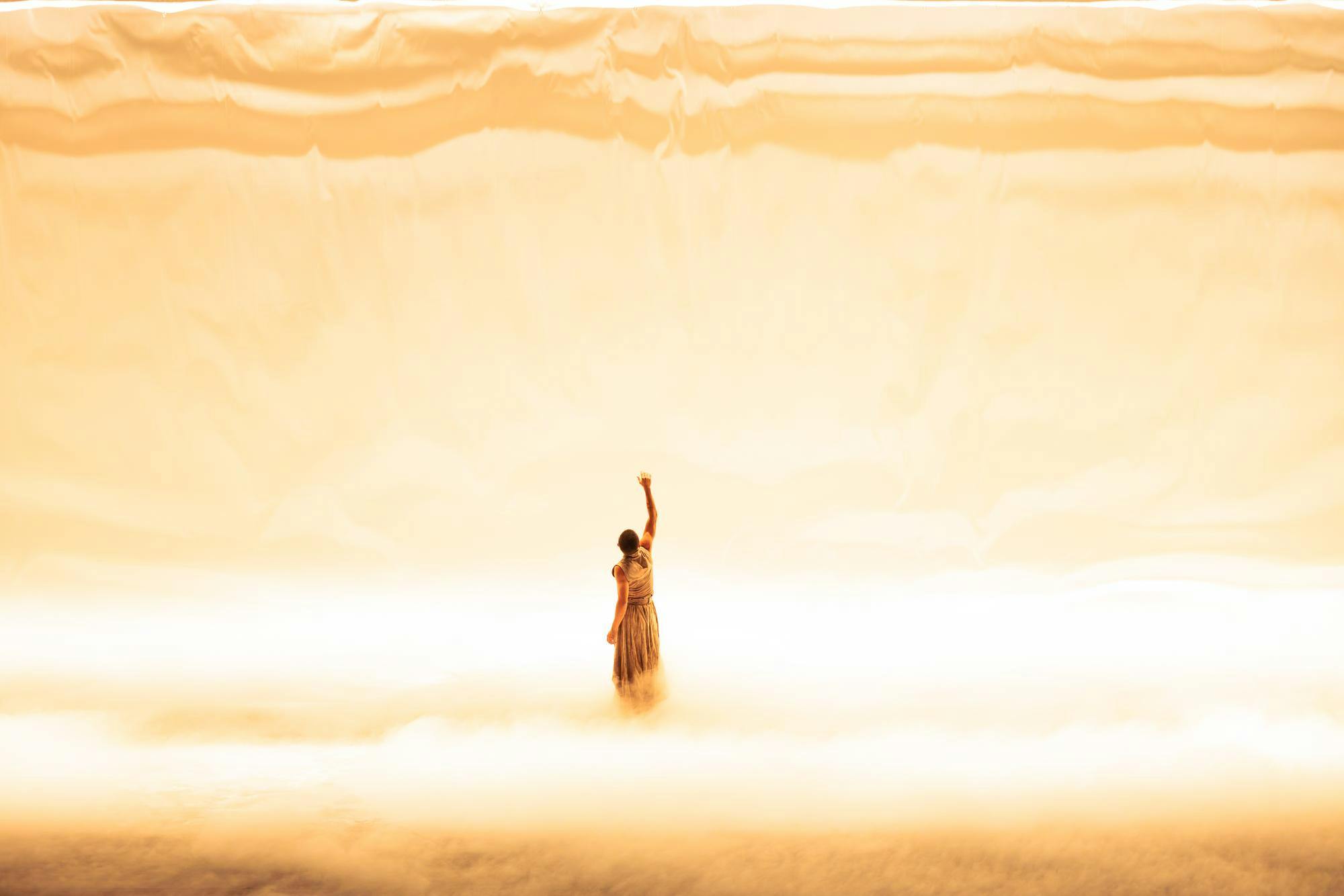
“Cacti” is succeeded by Khan’s deeply emotional and mesmerizing “Vertical Road (Reimagined) 2023.” The piece, inspired by the Sufi tradition and the Persian poet and philosopher Rumi, “explores humanity’s earthly nature, rituals, and the consequences of our actions.”
Khan describes his piece as “about the labor of human movement to try and reach a place, where the movement eventually arrives at stillness. Because in stillness, the real movement begins, which calls upon the inner movement of our soul.”
The inner movement of the soul requires a distinct type of solitude, which is explored through the principal dancer’s journey as he evolves from seeking self-destructive connection to finding peace.
The piece begins with the ensemble standing in a triangle shrouded in shadow as two principal dancers interact with each other. One dancer is completely still while the other attempts to revive her. Unlike the playful relationships in “Cacti,” this dancer’s actions are a mix of compassion and selfishness — he catches his partner before she falls, yet he behaves violently towards her. In one instance, he puts her hand on his chest only to snatch it up repeatedly with increasing speed and aggression as it falls limp off of him.
Once the ensemble is illuminated, they begin to move as one entity. Once again, breath is part of the soundscape. While “Cacti” uses breath for the sound itself, “Vertical Road” imbues breathing with symbolic purpose, like a chant. The two principal dancers ultimately join this group, which, wearing grey clothing, illuminated by grey light and covered in grey dust, feel closely tied to the earth.
The dancer begins by brushing dust off his frozen partner, then ultimately smears some across his face before joining her in the ensemble. Movement and participation in the ensemble are not easy or comfortable — the dancers often appear in disturbing positions, including a sequence in which they drag themselves across the floor.
During this sequence, the principal dancer disrupts what little, albeit dysfunctional, community he has. As the dancers crawl away from him, he steps on one of them to prevent her retreat, prompting the entire ensemble to turn on him and ultimately leave him alone on the stage. As they abandon him, he takes dust into his hands once again and reaches towards them as if to remind them of their shared identity grounded in grime.
Once alone, he devolves into a shocking portrayal of human agony as he convulses on the floor until crumbling in exhaustion. The subsequent moment of stillness begins his transformation. A warm light emerges behind the scrim, revealing the silhouette of his partner, and gradually the rest of the ensemble one at a time. They walk by him peacefully as he attempts to grab hold of their shadow hands. They have all moved on to this other plane of warmth and stillness as he alone remains tied to the world of dust.
After a moment more of stillness, the stage light begins to grow warm, and the dancer reaches forth to touch the scrim. The boundary now falls before him like a sheet of water as he finds transcendence alone, which he could not find while grasping for someone else.
It’s impossible to watch the performance without feeling the performance. Neither show can be adequately analyzed — the first because it does not intend to be evaluated and the second because the message is transmitted viscerally rather than logically.
In the program, Ekman said that some of his friends feel that modern art isn’t for them because they struggle to “understand” it. Through “Cacti,” Ekman aims to share the idea that “everyone can interpret art and experience it the way they want.” Boston Ballet’s Fall Experience is, fundamentally, an experience — it invites audiences to share in the joy of collective creation and the pain of personal evolution from the safety of their seats.



